We all know now that no great cultural event of the contemporary age can be separated from the need to draw attention to its surrounding context. Ever more frequently, international art exhibitions have another objective running parallel to that of the propagation of new art forms, and this is to focus interest on the peculiarities of the local social and economic system. This is the case of Albisola and the Biennale di Ceramica nell’Arte Contemporanea.
The centuries-old history of the ceramic factories of Albisola coincided with the development of a flourishing and prestigious economy, but it was also a reference for many artists who moved to the Ligurian town - per periods of time – to work with the local ceramists.
In the last century, around the middle of the 1920s, Munari, Prampolini and Depero all worked in Albisola, turning the town into the Italian capital of Futuristic ceramics. In the same places, in the late 1930s, Lucio Fontana was starting to produce intriguing and extremely provocative polychrome works, opening the way for the production of baroque ceramics first and spatial ones later.
Since then, the streets of Albisola have continued to intersect the routes traced by the work of artists both Italian and non-. At the end of the 1950s, the Danish artist Asger Jorn produced the Aarhus mural in the San Giorgio factory, commissioned by the Danish government. There is now a Jorn museum in Albisola.
The fatal attraction for ceramics that struck Jorn very soon also infected the Cuban artist Wilfredo Lam, a great friend of Jorn’s, who made Albisola his favourite place of residence.
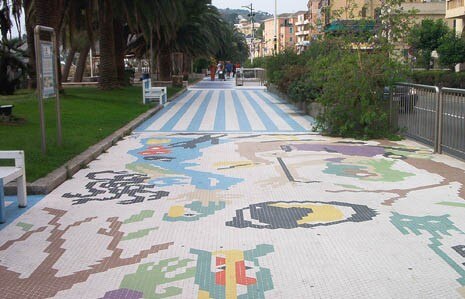
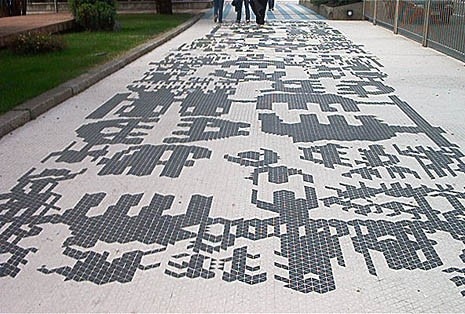
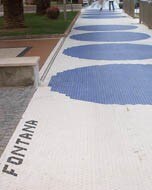
The testimony of the artists’ passage in the town has left a delightful sign that can still be seen today when visiting a section of the seafront called La passeggiata degli artisti, and paved with mosaics reproducing the designs made by these figures.
Consigning such a heritage to the past, especially when the ceramic factories play a role in the social and industrial context that leaves no margins for uncertainty, continuing to attract the interest of international designers and artists, was leaving an overwhelming void. For Albisola, the answer to a rediscovered contemporary identity came yet again from art, with ‘La Biennale di Ceramica nell’Arte Contemporanea’, now in its second year.
Needless to say, the first to adhere enthusiastically to the initiative were the artists; not only did they respond positively to the first year’s invitation, many of them insisted on being invited a second time. As Roberto Costantino, artistic director of the Biennale, has quite rightly pointed out “ceramics allow us to see art in its true conditions of production, beginning with the factory, where the artists are invited to work with the craftsmen”. This was the first challenge, both for the local ceramists and for the artists, who found themselves working on common ground but with totally different timescales and habits. Things worked, thanks certainly to mutual patience, and the presence of African, Korean and Japanese artists and curators has meant that, in certain cases, ceramics became provided the means to involve the local population in the creation of the works.
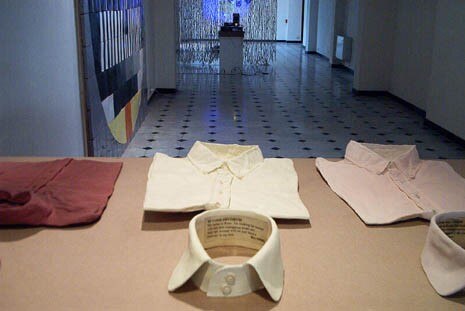
With the help of children from the Albisola Superiore junior school, the African artist, Bilji Bidjocka, produced a curtain – that is intended to be the longest curtain in the world - made up of a number of small ceramic cylinders. Two videos were projected on the curtain: the first was filmed by Bidjocka at the Festa dell’Unità of Millesimo, a village in the mountains in the vicinity of Savona, where the artist had been invited to present his project; the second showed images of the schoolchildren as they worked with the ceramics to construct the curtain.
Once the Korean curator Young Chul Lee had entered the factory and started “helping in the creation of the work, he could not resist proposing a work that would involve the local citizens”, explains Tiziana Casapietra, curator of the Biennale. This collaboration led to Superstring, a large ceramic ring produced with the handprints, names and wishes of the people who took part in the initiative.
After having produced special ceramic vases and then bound them together, the Japanese artist Shimabuku invited the local fishermen to fish for octopus Japanese-style. The experiment had a positive outcome and proved a great success.
Ceramics also offered some artists a pretext to tell their own stories, sometimes very personal ones. The Bulgarian artist Nedko Solakov presented Paura, a work that bared his fear of flying, resembling the limitations of the conceptual artist faced with the need to elaborate a material - ceramic – with timescales and methods that have remained unchanged over the centuries, even in contemporary times.
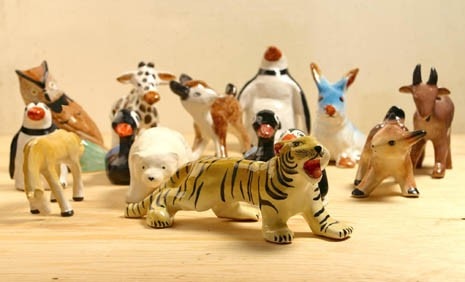
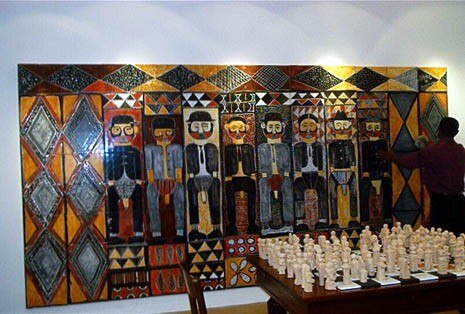
With Game, the curator and African artist Olu Oguibe retraced the tragic events that took place at the Genoa G8 in 2001, which was being held at the same time as the inauguration of the first Biennale di Ceramica. In a dual composition – housed in what used to be Lucio Fontana’s studio – the artist proposed a sort of mural bas-relief in which he portrayed the powerful men of the world. Opposite, on a chess-table, the artist placed a hundred and one terracotta figurines, “that represent no kings or queens”, says Oguibe, “but the masses of people who cross the planet today”. In a sort of, aesthetically beautiful, metaphor Oguibe erased the distances between the themes dearest to contemporary times and very traditional representation.
On an amazing exhibition route unfolding between Albisola, Vado Ligure and Savona, on which every possible idea concerning the use of ceramics was overturned and reinterpreted by artists from all parts of the world, we were seduced by the work of our Italian artists.
With Terracotta, the master ceramist Giuseppe Uncini reproposed the idea of Terre, a series of ‘evolved works’ commenced around 1950 that opened the way to his memorable and poetic Cementi production.
Bertozzi & Casoni turned their attention to a less noble feature of human existence, our consumption of objects and the resulting creation of waste as the product of human activity. In their formal perfection the Rifiuti in ceramica by Bertozzi & Casoni – industrial drums filled with waste that is difficult to recycle, e.g. bitumen, plastic baskets and Bosch batteries – conceal the fragility and sometimes the wretchedness of our existence.
Luca Pancrazi, on the other hand, set up his work in the disused Vado Ligure station. The work Stati d’animo, produced with special ceramic lettering, was prompted by Boccioni’s Quelli che partono e quelli che restano, and is, at the same time, a tribute to his friend Rivo Barsotti (Rivo is short for ‘revolutionary’), who was an excellent ceramist and also worked with Fontana.
The Biennale di Ceramica gives us an opportunity to gain contact with a new and contemporary way of using ‘the earth’; the catalogue, in its essential editorial format, offers a chance to read interesting essays by the curators and also the artists. Do not miss “Dialogo nella cultura interlocale”, by Young Chul Lee.