


When the Norman duke William the Conqueror defeated the Anglo-Saxon forces of King Harold Godwinson at the Battle of Hastings in 1066, England found itself at a cultural watershed. Bishop Odo of Bayeux sensed it early on. A few years later he commissioned a monumental embroidered narrative recounting the event across 58 scenes and nearly 70 metres of cloth.
The Bayeux Tapestry has since become a cornerstone of British cultural mythology, alongside the monarchy and the supposed musical hegemony of The Beatles. Among such untouchable national icons stands David Hockney, long regarded as the standard-bearer of British Pop Art. Over the years his reputation has comfortably eclipsed that of contemporaries such as Peter Phillips, Derek Boshier, Pauline Boty and Peter Blake — the only other surviving member of the scene immortalised in the 1962 documentary Pop Goes the Easel.
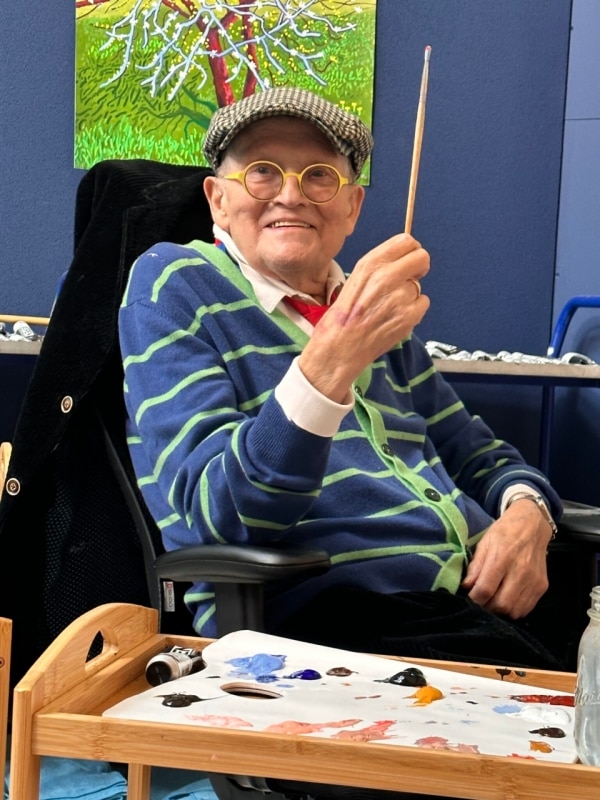
Part of the secret may lie in the glasses: round, oversized and brightly coloured. Worn since his youth, they have effectively turned Hockney’s own face into a Pop image.
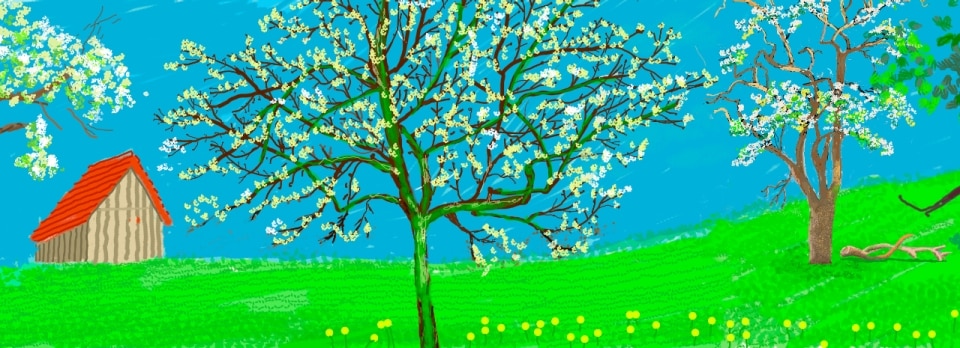
90 meters of landscapes drawn on IPad
At 88, Hockney appears far from finished. His latest London exhibition, A Year in Normandy and Some Other Thoughts About Paintings, opens at Serpentine North. Here two shrines of British cultural imagination meet: Hockney himself, and the tradition of the frieze.
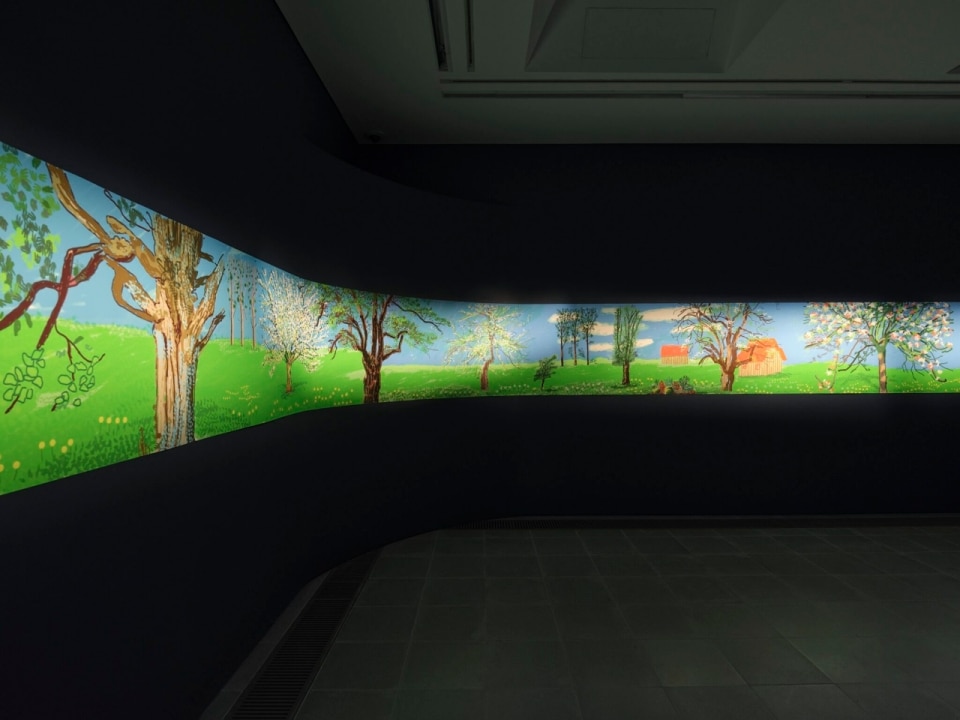
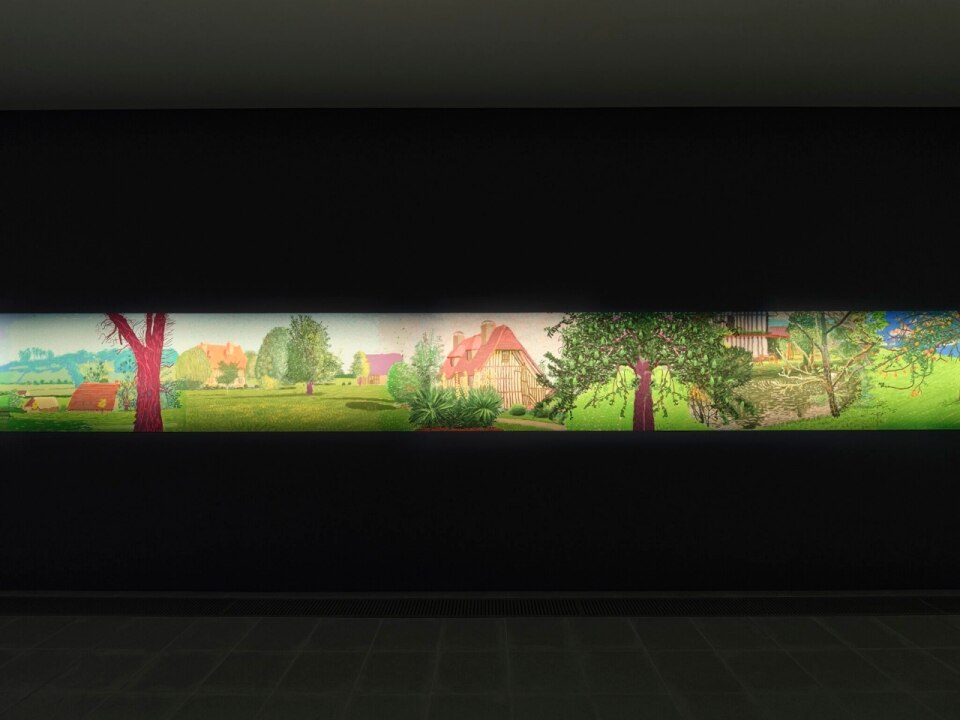
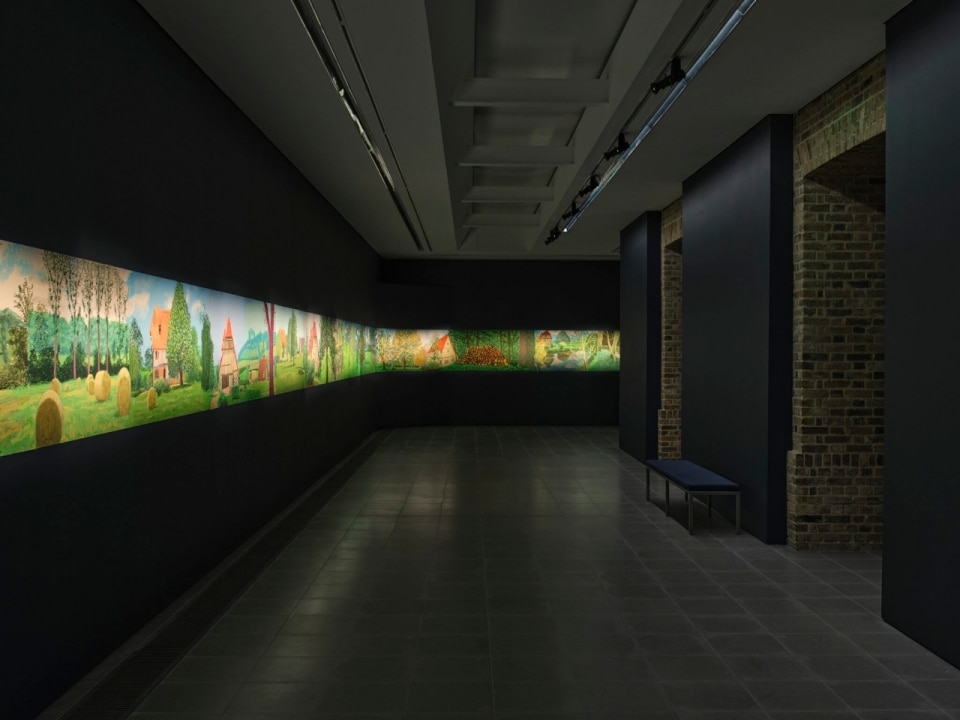
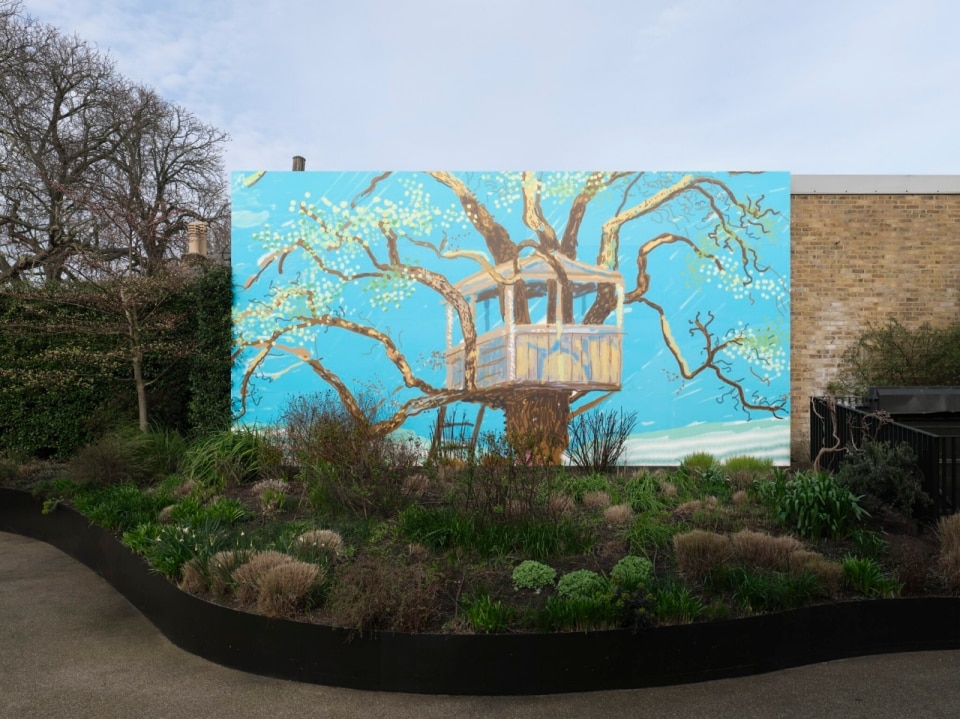
As the title suggests, the show presents a pictorial diary of the year the artist spent in Normandy during lockdown, recording the changing landscape and weather from the window of his house — on an iPad. Around a hundred drawings unfold sequentially along the gallery walls on a continuous panel stretching nearly 90 metres. Hockney may outdo Bayeux in length, though perhaps also in repetition. William the Conqueror, one suspects, might feel quietly avenged.
During the opening remarks, curator and Serpentine artistic director Hans Ulrich Obrist encouraged visitors to put their phones away and look “with both eyes” — before noting that the museum shop offers a range of themed souvenirs. Among them are caps, trays and fridge magnets bearing that same phrase, an old Hockney maxim that has surfaced repeatedly in the artist’s many conversations with Obrist about his philosophy of painting.
Landscapes and seasons for a Instagram-friendly exhibition
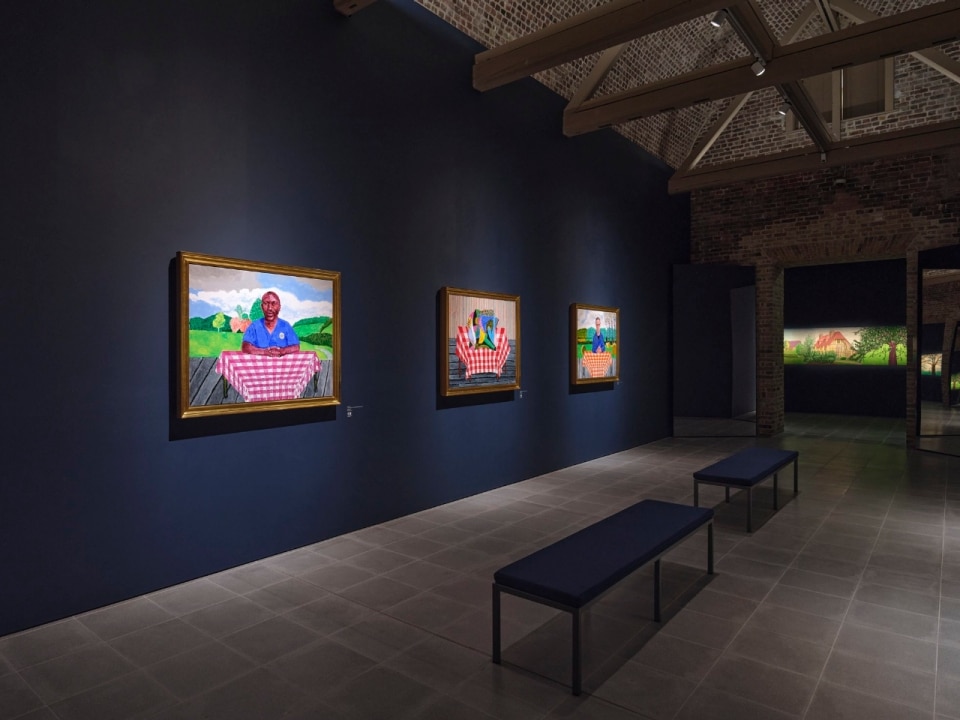
Printed and enlarged well beyond their original scale, Hockney’s Normandy landscapes seem almost to glow against the gallery’s dark blue walls. The effect recalls the much-derided yet hugely popular immersive exhibitions that have recently colonised museums across Europe — prompting the suspicion that these works might feel more at home on the screen of a smartphone.
There, after all, they could collect a gentle stream of approving likes in the midst of distracted scrolling, rather than occupy quite so many metres of the Serpentine’s walls.
Then again, isn’t Instagram-ability precisely one of the qualities most expected of exhibitions today?
Along the tapestry-like installation, seasons and meteorological shifts follow one another chronologically without interruption. As you walk along the gallery’s perimeter, the result inevitably brings to mind the memorable scene in Notting Hill where Hugh Grant strolls through Portobello Road soundtrack by Al Green’s “How Can You Mend a Broken Heart”.
Art as a cultural phenomenon
If the Serpentine reminds us that democratising art does not necessarily entail lowering the level of conversation, the British also demonstrate that the strength of a cultural institution often lies as much in its shop and café as in its exhibitions.
The sponsorship by Burberry is telling in this respect, emphasising Hockney’s cultural significance not merely within the art world but across British public life more broadly.
The accessibility of his work — particularly the earlier paintings — has always played a role in this appeal. Simply ask Luca Guadagnino, who titled his 2015 remake of French classic La Piscine after Hockney’s most celebrated work: A Bigger Splash. Long before his recent digital experiments with fax machines and iPads, Hockney cultivated a visual language that was open and immediately legible. Accessibility, however, should not be mistaken for simplicity. If anything, it helped British art detach itself — with something of a queer, libertine flourish — from the academic stiffness that had dominated the scene well into the post-war years.
The new paintings and portraits
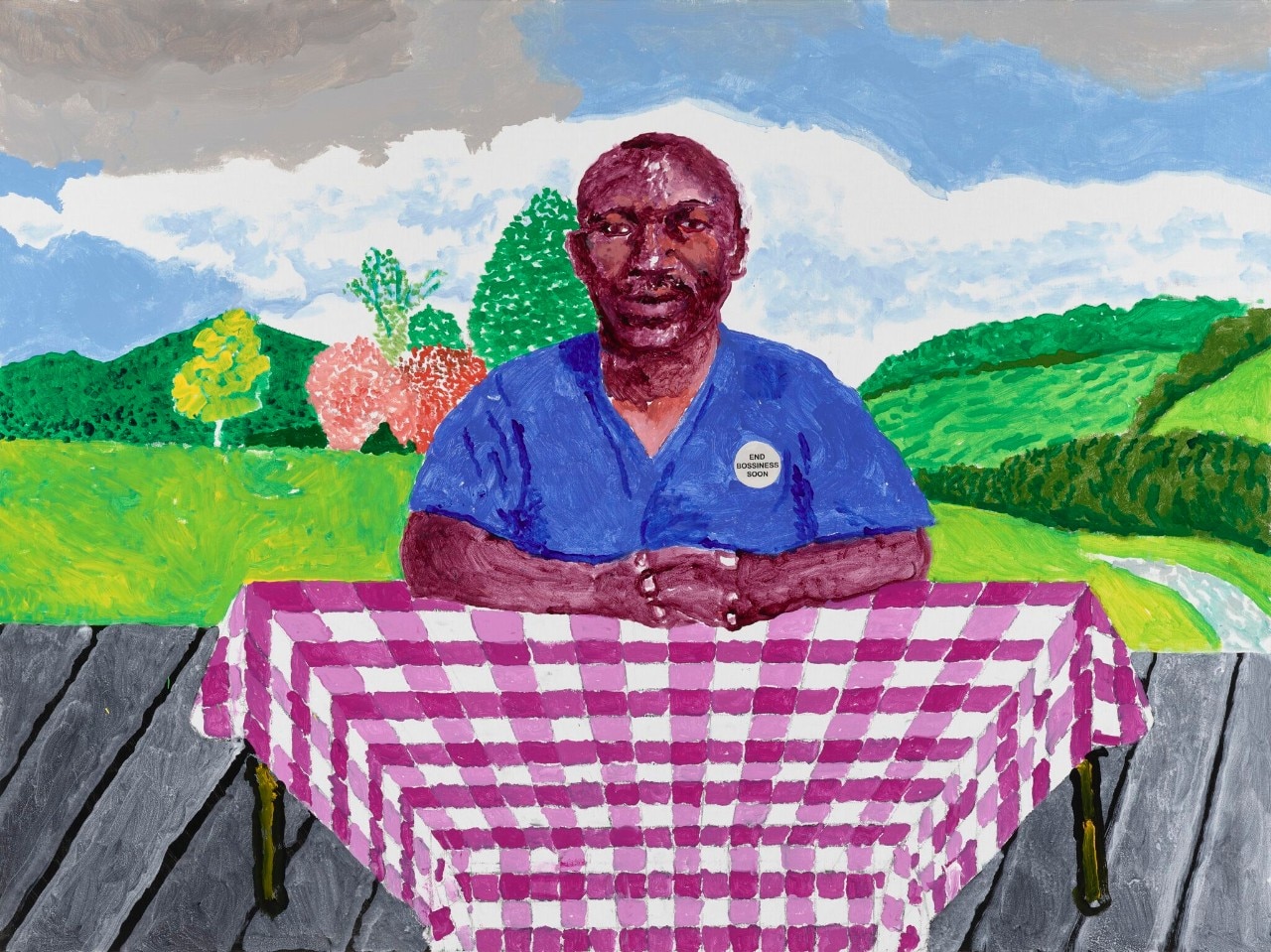
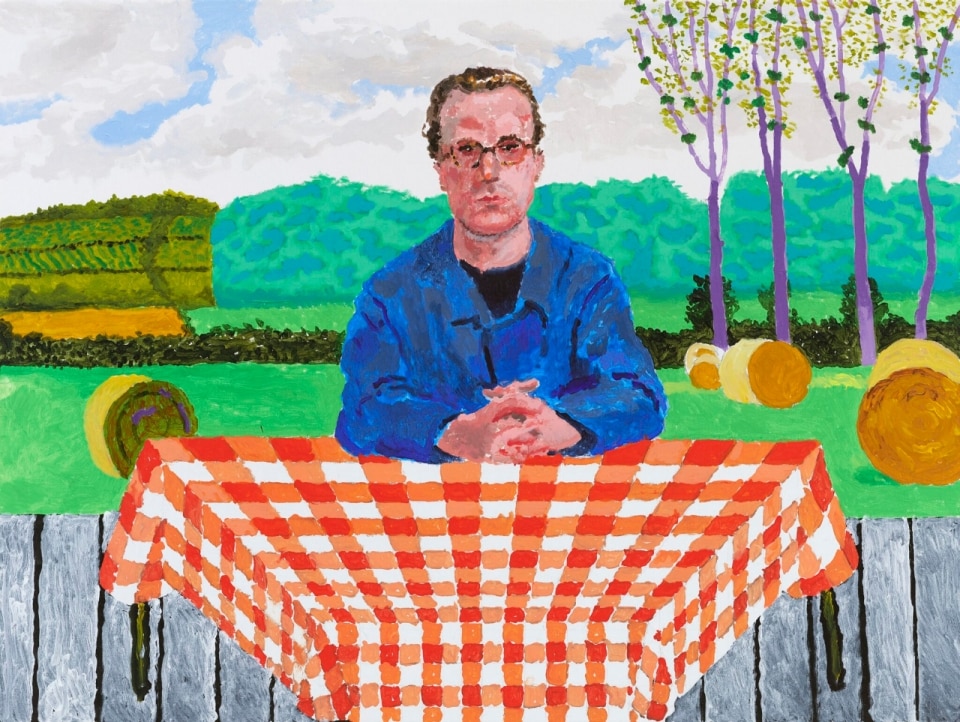
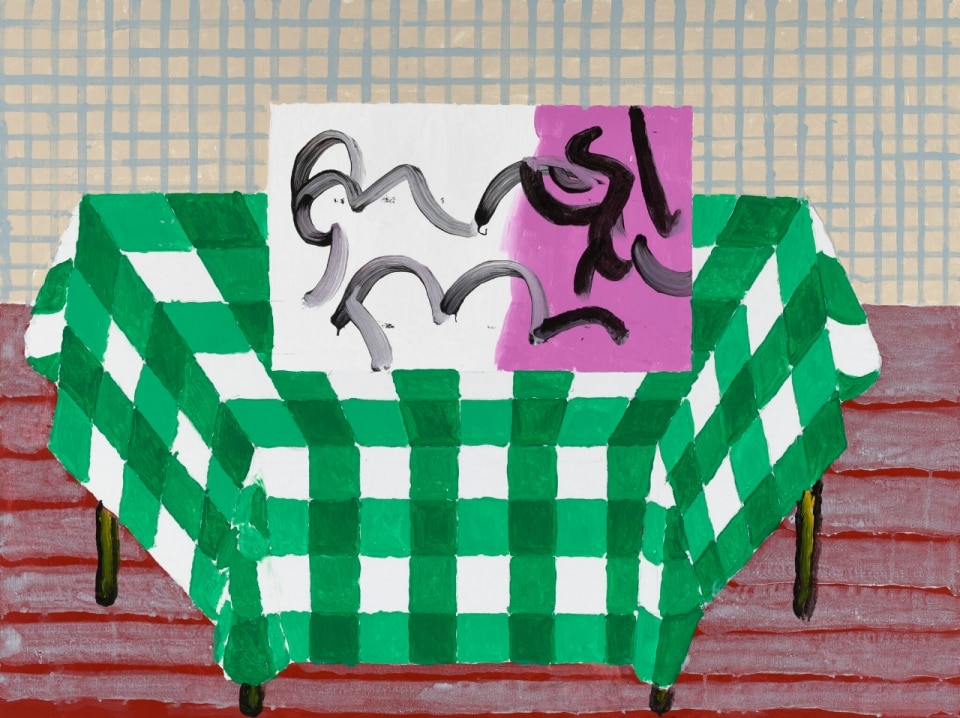
This spirit returns in the “some other thoughts about paintings” promised in the exhibition title: around a dozen new canvases that gently rescue the show from the workshop-like atmosphere created by the iPad drawings.
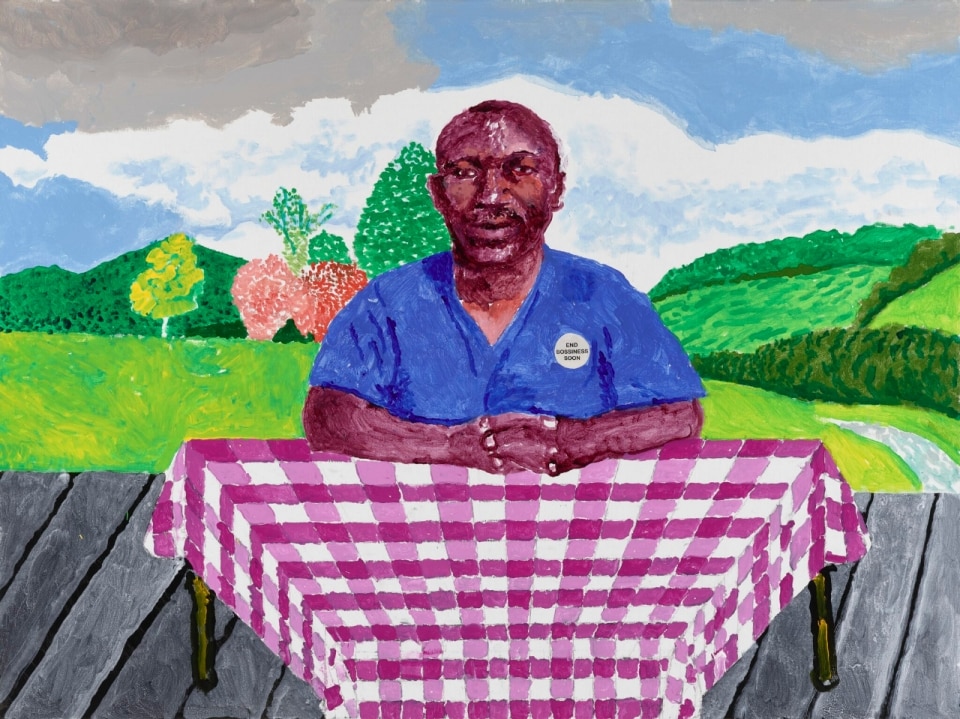
Normandy reappears in their rural settings, as do the checked tablecloths that serve as a recurring visual thread. Hockney’s view of the region remains disarmingly candid, if faintly stereotyped. Perhaps this explains why the vernissage crowd seemed to feature more half-zip jumpers in the style of Essex entrepreneurs and ruddy-faced men in flamboyant suits straight out of a Guy Ritchie caper than the usual congregation of art-world grandees.
British style on canvas
Beyond the landscapes, Hockney’s portraits reveal another constant in his work: a fascination with the evolving codes of British style. His canvases function almost as a visual logbook of the country’s evolution in style.
From the 1971 portrait of Swinging London designer Ossie Clark with his wife Celia Birtwell and their cat Percy, to the portrait of Harry Styles unveiled at the National Portrait Gallery in 2023. Among the portraits currently on display, however, there are no longer any socialites — a sign of the times. Instead, we find figures such as Hockney’s optician Jack Ransome and his carer Thomas Mupfupi, wearing a badge that reads “End bossiness soon” — another of the artist’s long-standing mottos, now also turned into merchandise in the gallery shop.
The portrait of his friend Richard, currently on display at the Serpentine, offers instead a perfect résumé of the contemporary creative type: boxy work jacket, thinning hair, baseball cap. In other words, exactly how Obrist dresses