


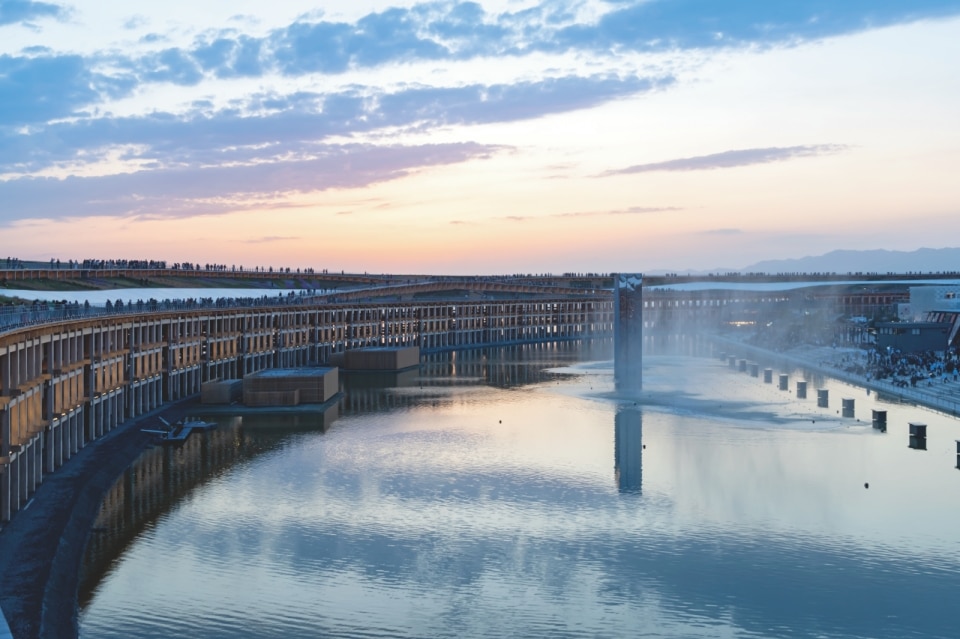
Ma Yansong: Your Grand Ring for Expo 2025 in Osaka feels like a direct test of your concept of “Primitive Future”, as well as the theme of this issue of Domus, “Architecture is Feeling Nature”. I’d like to start this interview with that project. When I visited the Expo, what struck me was the choreography of movement: the Ring is so large that people experience it across land and water, beneath and above its span. It becomes a kind of floating park. It reminds me of the Eiffel Tower. People talk about its height, its steel, its technology, but the desire is to climb it, to look back at the land from that altitude. I think there is something emotional in that act. What kind of feeling did you want to bring to the Expo’s visitors?
Sou Fujimoto: Feeling nature is a very exciting topic. As for the Ring, it’s part of the master plan, and originally it was more of an infrastructure for the circulation of people. Then I realised it’s not so good if it’s just like a raised highway. And, of course, the circular shape is a message for the world, especially in the current global situation that is so divided. I liked the idea of conveying a message about diversity, that many different people, cultures and countries can be united.
United?
Yeah, together. So diversity and unity can be realised in that place. That’s the meaning of the Expo. It was the starting point for thinking about the circle, with the national pavilions within that. The simplicity of the circle shape has many important meanings, for Asian people but also for people all over the world – unity, harmony and circulation. Early in the design process, I decided to use a wooden structure because, from a perspective of sustainability, wooden structures are becoming more important. We also have a long tradition of wooden construction in Japan. The influence is from China. A long time ago, we imported the technique, the technology, and then we developed the traditional Japanese way. In the Ring, we combined this tradition with the latest technology to create such a huge scale. But as you said, it’s really created something emotional because of the Ring’s size.
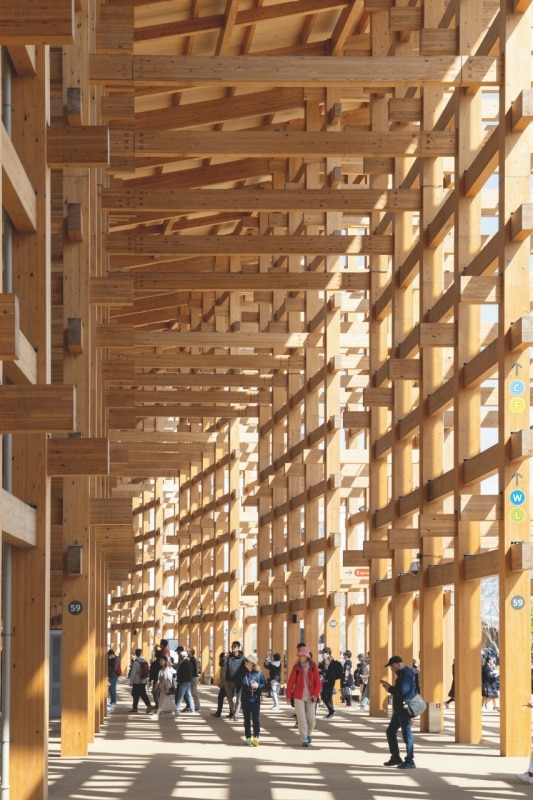
If you’re on one side of the rooftop, the people walking on the other side look tiny. It’s almost like you have the horizon of the entire Earth in front of you. But still, even though those people are far away, you understand that they’re connected in the same location, on the same structure. This feeling of the scale is like a part of nature, because this circle is also intended to make a circular cut-out of the sky as a main feature on the front ring. I was born and grew up in Hokkaido surrounded by nature. So, for me, nature was more like protecting you, and you can discover many different things when you walk through the forest. But what happened in the Grand Ring was something beyond that. It’s huge, but at the same time it encloses you, creating a place. It’s like you’re directly encountering and connecting with different layers of nature, but it’s not pure nature. It’s nature through the frame of architecture. And also, under the ring, it’s more relating to the forest buildings I’ve been developing. Although it’s huge, it also has a human scale, because of the wooden construction and the spans of the columns.
That’s fascinating.
Yeah, almost 3.6 metres. Those scales create a rather domestic residential human scale, but at the same time, the corridor is almost like an infinite building, like a cathedral. So that part is more like a reinterpretation of the forest. Maybe one more thing is the huge number of people. Especially in the latter half of the Expo period, there were so many visitors, and with those crowds, the architectural space itself was almost vanishing. You just felt a flow of people, and the whole view was created by the people. The architecture is almost just creating a place, a platform, or the basic frame to connect people and nature directly.
I think it’s obviously about people. There are two extremes of scale. Below, it is very dense, almost forest-like, and it stays close to the body – comfortable, legible, human. That matters because many of the pavilions around it are enormous structures. Above is the Ring park. It is vast, but up there one feels a kind of freedom. From that height, the Grand Ring begins to “speak” with the ocean – an even larger scale beyond the architecture. In that way, the Ring is not only an object, it’s also in dialogue with its environment. From your explanation, that sounds very logical. However, my first impression of the whole project is something beyond logic: it feels ambitious, almost as if it is trying to build a dream. That reminds me of some of your earlier work, like in Taichung, and in Shenzhen. You often begin with a vivid image, or a specific experience – sometimes an extremely ambitious one. Then you build a logic strong enough to make it real. But what finally stays with people is something beyond logic: it becomes fantasy, as if they are inhabiting a dream. In my first issue of Domus, our theme was “Architecture is Fantasy”, and I discussed it with Norman Foster. In the past, a lot of visionary architects also did some paper architecture. But I feel that architecture and the broader cultural climate are more conservative now. What do you think is the status of visionary architecture today?
I thought about this in the preparation of the Expo, because the Expo has been that kind of fantasy. For the previous Expo in Osaka in 1970, Kenzo Tange did a huge roof. In the current situation, the entire mindset of architects and people is getting more and more conservative. I did a solo exhibition last year at the Mori Art Museum. It went from my early works to the latest works, but for the last part, I did a proposal for a future city. It’s not only about a fantasy, but to analyse what is happening now. For example, modernism started about 120 years ago at the beginning of the 20th century. Le Corbusier or Mies van der Rohe created a new kind of architecture, simple, clean and functional.
We need to do fantasy things because reality is now drastically changing. We need to think about something completely different from the modern age.
Sou Fujimoto
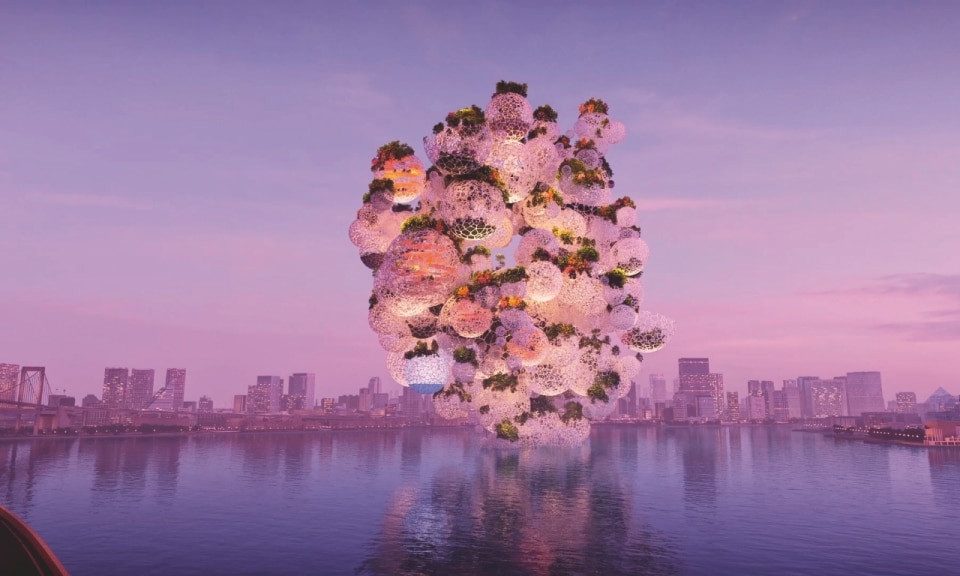
Of course, architectural style has changed, but I feel this kind of modern thinking still dominates our basic mindset. Roughly, if I describe that thinking, it’s like making the complexity of the world more simplified, standardised, taking some basic unit and then repeating it. For example, with high-rise buildings, all the floors are almost like repeating. So this kind of standardised unit was the right module to quite efficiently fit 90 per cent of humankind. But that leaves 10 per cent who don’t fit those kinds of standardisations. And even those 90 per cent of people still have diversities, so they have a kind of frustration at having to fit that standard. Now it’s the era of diversity. So those differences are more important than the same things repeating. That was the basic question. The point is, it’s not like repeating the floors, but more like having different scales, functions and programmes, different sizes of spaces connected to each other in unexpected and complex ways. Sometimes, a small space next to a big one, and then a big sphere about 200 metres in diameter. It’s completely opposite to the systematic modern city. So, for the era of diversity, we’re connected to many different things, almost simultaneously, physically as well as digitally. To answer your question, visionary things aren’t just about fantasy, but changing the fundamental thinking of people or society from such standardisation and repetition, to thinking about the philosophy of diversity.
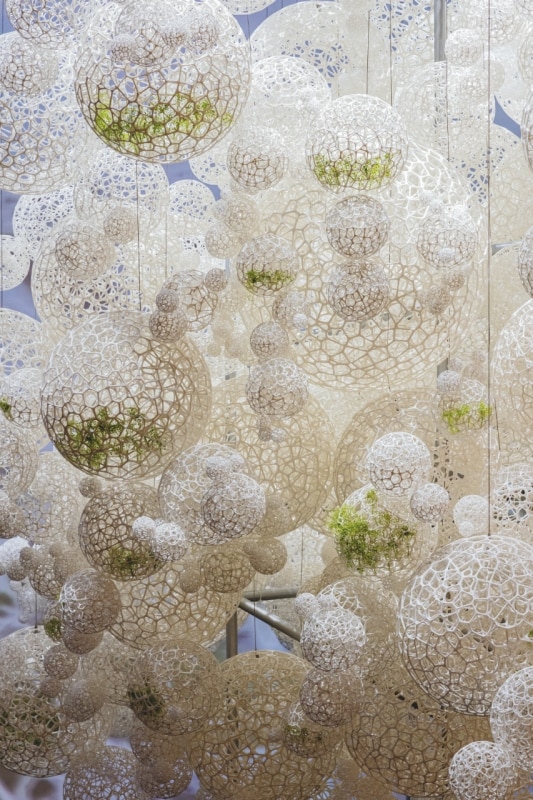
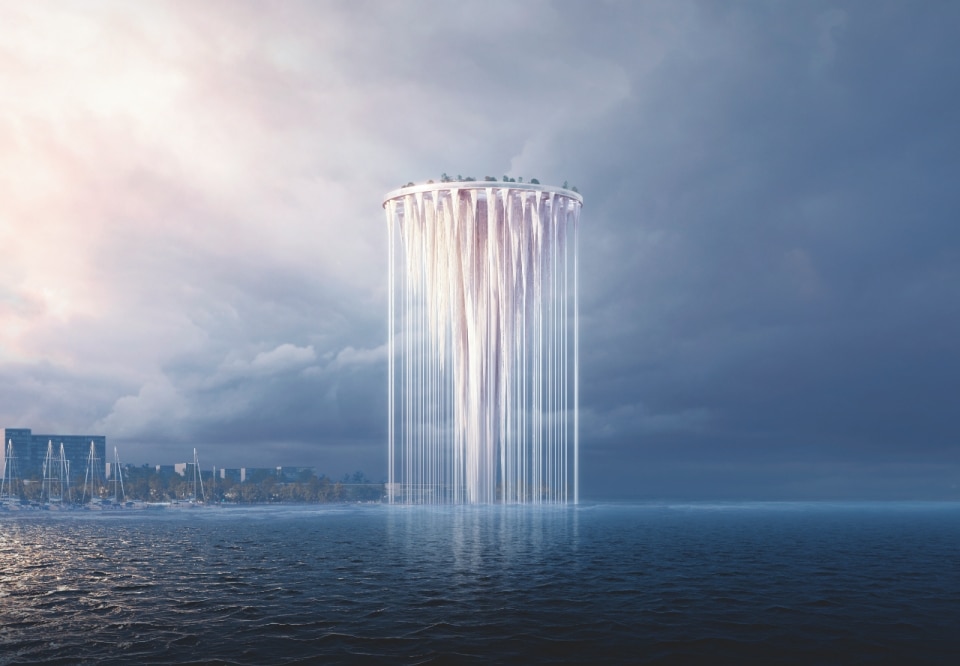
And I think those changes have already started. In a sense, we need to do fantasy things because reality is now drastically changing. We need to think about something completely different from the modern age. And it’s not only about shapes or styles. I don’t know what kind of time span it will take, because after making this bubble-like project, we thought it was maybe for the 22nd or 23rd century. In the 20th century, we had elevators for vertical transportation. But here, the elevator doesn’t work. So we thought about having drones to fly people to different places. It would change the entire basics of architectural design and other design. Technologically, these kinds of changes happen. So I feel we architects need more fantasy and imagination to catch up with reality and think about the future.
It’s very important because we already see reality demanding this change. People’s lives have already changed, but why does architecture stay the same?
That’s true. Architecture is always very slow to change. It will take, for example, 50 years, because all the construction systems, the construction economy and the developer economy are still old-style in a sense. We proposed using a flying drone 3D printer for the construction of this project, so it would be almost like growing the spheres.
May I ask something specific? I don’t see trees in this model. In many of your projects, natural elements are present.
Within this, the real city or architecture, there are many trees. For example, this sphere has a diameter of about 50 metres, and it can have a forest inside. Or we can put these kinds of trees above the spheres. But I feel it’s not essential to include real greenery. We can create a forest-like architecture or a nature-like architecture. But if you can combine real nature with nature-like architecture, then the synergy is stronger. That’s why I always try to bring physical greenery not as decoration or a signature of sustainability, but more like the real experience, the real feelings. I like to express how there’s less of a boundary between architecture and nature, almost like they’re melted to each other. In the modern age, architecture was more like an industrial machine, and nature was like an enemy. But now we understand that we need to have the ecosystems harmonised. For Asian people like us, it’s easy to understand that we can create this harmonised ecosystem, with artefacts and natural things together.
You kind of expand the definition of nature in architecture. Too often, when we talk about nature, it is reduced to greenery or sustainability metrics. But nature can also be the air and light, rocks and water, flowers and trees – the conditions that surround us and shape perception. Do you think that’s something we can draw inspiration from? And when you say this comes more naturally to Asian architects, is that a matter of culture, or of traditional architectural ways of living with nature?
Maybe the climate has helped to create our traditional cultures. In Asia, we generally have similar climate conditions, and the cultural things have developed through those. In those kinds of climate conditions and traditions, living with nature is more basic for us. We need to take care of nature, not fight against it. We’ve developed this culture that’s more like a harmony between nature, the earth, our culture and our lives. And it’s now finally fitting into sustainable thinking as a fundamental thing.
When we look at traditional gardens in Japan and China, the architecture works with the environment, with nature, but it also carries spiritual, artistic and cultural qualities. Because the experience is beautiful – often poetic – it becomes a ground for music, painting and other forms of culture. In many large cities today, modern architecture has lost that quality, so people look back longingly towards tradition and towards nature. For example, in Beijing, people once lived among gardens and courtyards. Now, we have better architecture and newer technologies. Everyone lives in towers. But if you ask people whether they want to return, not necessarily to inhabit the old buildings as they were, but to recover that beauty and that way of relating to space, many would say yes. How do you see that desire?
Maybe this is a period of transition, because we had such a beautiful traditional life. Everything was harmonised. Then, with population growth, for example, the high-rise was invented. But this is still an early phase of the high-rise, with a lack of beauty or integration of the whole of life and nature. But even with the high-rise and such urban density, we can crystallise traditional philosophy in a new way into architectural design, or garden design, to create a new way of life together with nature. It’s not only about the physical experience, but also a positive, abstract philosophy, and combining both of them to create a comprehensive understanding of the world.
I feel that talking about technology in modern times was quite abstract, but now, new technologies are really changing everyday life, and even reshaping how we experience emotion. The shift with AI is making machines feel like you can communicate with them, so people attach feeling to what is not human. Meanwhile, architecture still seems very cold. When people seek emotional connection, they often turn elsewhere. Now, architecture is about technology, material, space, function – everything but emotion, right? Competition juries seem to judge architecture in a very abstract way, through numbers and texts, but attraction is harder to measure. My worry is that we risk losing the capacity to feel architecture at all. Architecture has become just a functional space to use, but people aren’t depending on physical space anymore. Physical space is really powerful, and we should be responding to the emotional needs of human beings.
That’s true. Because of efficiencies and speed, architecture became really minimised. Post-modernism went against those really cold infrastructure-like buildings, and they added like strange decorations. It was an attempt to regain something emotional in architecture. It was somehow successful, but not fully successful. I think every time it’s like a back-and-forth: trying to achieve something more emotional, then going back to something colder or minimal. Now, I think it’s time to bring everything more to the emotional, maybe with materiality or a different way of space design.
I think materiality and physical space matter because, although everyone is talking about artificial intelligence, we’re dealing with the actual environment. But on the other hand, if we talk about emotion, feelings, the poetic quality of architecture, it seems we become more like artists, poets or writers. That possibility is precisely what draws many young people today. If everything is being rewritten by AI, what, then, should architectural responsibility become? People spend a lot of time making drawings, but everything will change quickly.
I don’t know exactly what’s happening with AI, but this drastic change could happen. But as you said, we still need physical space, physical experiences, and physical communication between people. It’s nice to create places where people can meet, or experience nature and the environment. Materiality and scale are also important for real experiences. In that sense, going back to the Grand Ring at the Expo, even though the structure itself is quite simple, the challenges of scale and materiality made something quite emotional and special.
A long time ago, you made the Final Wooden House, that cubic wood structure.
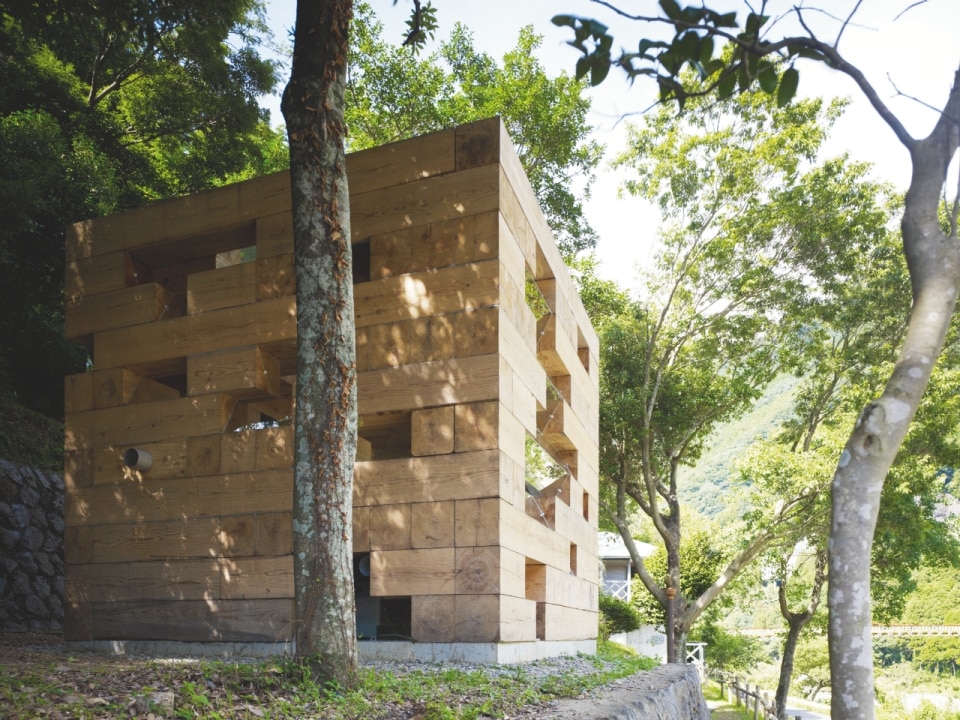
Yes, it’s quite tiny, 4.2 by 4.2 metres, but stacked wood.
It’s almost like a puzzle. It’s poetic, but at the same time, it’s dealing with the body. People feel the material, the space, the boundary and the behaviours the space asks of you.
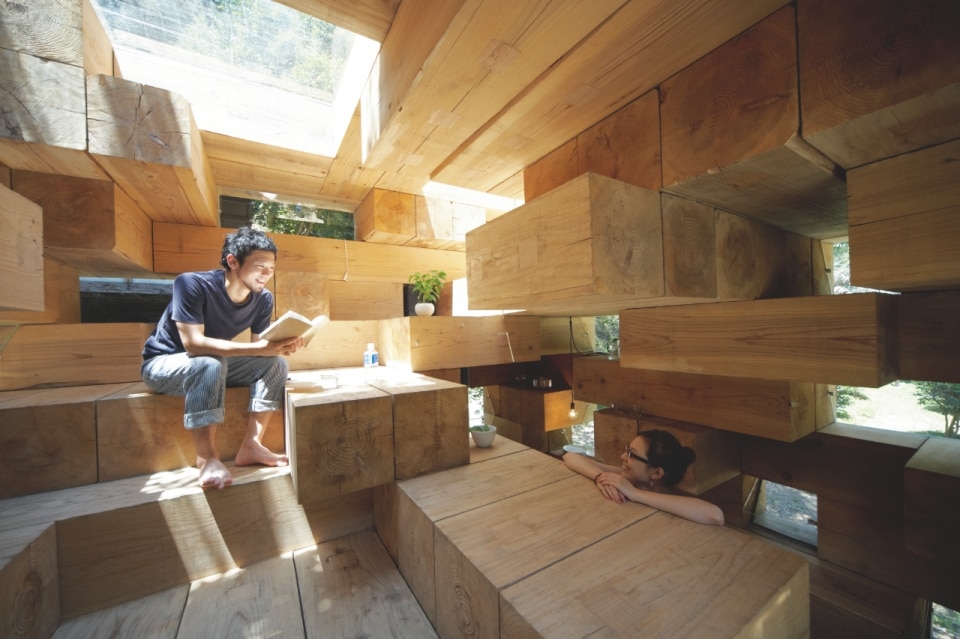
That competition was 20 years ago, and it was built in 2008. It uses massive timber, 35 by 35 centimetres. Each scale of the gaps is like a physical human scale. It’s almost an architectural cave, and you move around not only with your legs, but with your hands, so the experience is physical, and like an animal. It was one of my first attempts at reinventing materiality and skills.
That’s powerful because it means architecture is not only a service for comfort. It’s more interactive and even challenges people’s behaviour. And if we return to what you said about diversity and individuality, perhaps architecture should engage each person more directly, rather than addressing an abstract “user”.
It relates to my childhood memories of playing around in the forest. My early work was for my father, a psychiatric doctor. In the mental hospital, patients stay individually in the room, but sometimes they gather in one space. But the distances and relationships of each person are quite sensitive, so we respected each individual and their personalities by designing the mental, physical distances and relationships. Those were important basics for me to think about society and the diversity of personality, how we connect and make good relationships. The Final Wooden House was a result of combining these things with materiality and scales. The Grand Ring is also something like that, thinking about diversity and individuals, but at the same time, so many populations together. And this futuristic proposal is also based on that very humanistic, I can say maybe not the fantasy, but visions for future society.
That sounds like a future role for architects. You go into people’s minds.
Yeah, I think so.
And to translate that inner life back into the physical environment. Last question. In our generation, we talk more about nature compared to earlier generations. It’s becoming a more important topic. We are also trying to renew what “nature” means, and what we bring into architecture when we speak of it. How do you see this shift?
I agree. Our generation also tends to think of nature as an important part of architectural design. Since the end of the 20th century and the beginning of the 21st century, sustainability thinking has grown. But at the same time, designing architecture is not only about designing buildings, but designing the environment, the place, the landscaping together with the architecture. Therefore, the definition of architecture is expanding, or blurring, to include more and more things relating to people’s lives. Nature has been outside of architecture for a long time. So it’s nice to combine it or melt it into architecture.
Maybe our generation, throughout the world, is almost the first generation to think about nature and what happens when we integrate it in various ways. That trend is happening because the entire human mindset is slowly changing. And as architects, we’re following, or we’re in the middle of those changes. Many architects are talking and thinking about nature, but in different ways because, for example, I’m from Japan, you’re from China, and we have slightly different cultural backgrounds. And then in Europe, different countries have their own thinking about nature, and they have their own history. So, we’re now watching such a wonderful diversity of thinking about nature. And then, of course, the outcomes are also various. That’s why I think now is a very exciting moment.
Opening image: Sou Fujimoto Architects, Miyata Hiroaki, Resonant City 2025, 2020-2021., Photo SFA Courtesy Sou Fujimoto Architects