

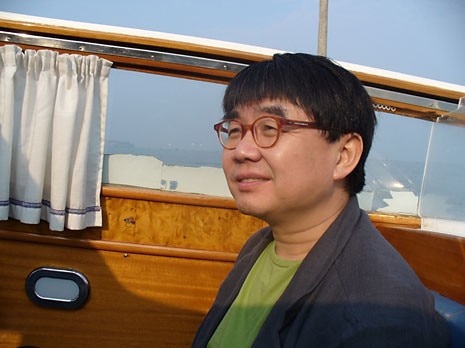
In a brief taxi ride in Venice, Chinese architect Yung Ho Chang, director of the architecture department of MIT in Boston, told Domus about his recent projects. The interviewer, Maurizio Bortolotti, asked him about his radiant city project, which he has been developing since the 2005 Shenzhen Biennial, his concept of micro-urbanism and the relationship between his work and contemporary art.
Maurizio Bortolotti: The “New Radiant City” is a project that you’ve been developing since the Shenzhen Biennale, which you curated in December 2005. You told me that Shenzhen is a Chinese city which seems like an “Instant City”. Starting from this definition can you tell me about the entire project?
Yung Ho Chang: Shenzhen or the “Instant City” was built very quickly (this is where the name is from) and only partially worked. It worked in terms of economic development but it looks more like a “Spontaneous City”. The “New Radiant City” is a new town located on the outskirts of Shenzhen. This project will be the subject of a design study that is equally ambitious and optimistic but begins to ask the question: “How do we really want to live in the city of the 21st century?” or in Shenzhen after 25 years and 7 million people. In essence, it is about the Ideal City. I am teaching on this topic at MIT with two colleagues, Alexander D’Hooghe and Mark Jarzombek, as well as at Tsinghua University and the University of Hong Kong. Earlier, MIT and Tsinghua formed an entity for collaboration called Urbanization Laboratory or UrbLab.
MB: Another concept that you use for your architecture is “Micro-Urbanism”, a way to deal with the contemporary Chinese town. Is it more a concept to build buildings or a strategy to deal with the complexity of the modern town?
YHC: It is both. First, it is a manifestation of the mixed programmes and the in-between relationships in building design; second, it suggests a city design process that goes from the micro to the macro. The Hebei Education Publishing House is an example of “Micro-Urbanism”. The building's extremely rich and diverse programme, which includes offices, an exhibition and convention centre, hotel, restaurant, cafe, bookstore, art gallery, basket ball court, etc., inspired us to design it as a miniature, twelve-storey city and to create the different mini-buildings, urban spaces or gardens in between.
MB: An interesting point in your architecture is the vicinity to contemporary art. You have often worked with artists and in artistic situations. It seems that the artistic approach is more deconstructed than architectural, and more similar to an event in a specific context. Why is art important for your work?
YHC: All I do is architecture, the architecture of a building or an installation. I don’t see the need to differentiate between art and architecture because it is impossible. Olafur Eliasson just gave a lecture at MIT. Is he doing art or architecture? That is perhaps not so important. I'm in a similar position but coming from the other side.
MB: During Domus Academy's event at Venice in September 2006, you showed pictures of your architectures intersected with pictures taken from the popular Chinese movie Infernal Affairs. This idea to create a connection with the present time using the movie seems to be a way of connecting architecture with time. Can you explain this connection?
YHC: The notion of context includes time, space and event, thus experience. Time is movement. Time is movie, even though my so-called movie does not really move. However, presenting architecture in the context of a popular gangster film has more to do with uncertainty regarding the line between fiction and reality.
MB: Is your architecture closer and open to the everyday experience of people in the modern city or – if you like – Megacities, where the border between art and architecture, reality and fiction has lost meaning?
YHC: I think the kind of architecture that I make can be plugged into either a modern or a traditional city because it is like an extendable fabric if not a virus, so that it can grow into the existing context.
http://architecture.mit.edu