
Photographs by Makoto Yoshida
In the Tekuto Atelier, image becomes built project, each time a new technique is explored in an approach that is both constant and tireless. Each design represents a chance to fabricate and often pre-fabricate using different materials; experiment with new technologies, that are never ‘high’ but rather fascinating and effective mechanisms, such as children’s toys that challenge structural convention, with simplicity and without prejudice; questions and simple answers on the functioning of things, that in making use of industrial and technical materials, a crafted quality is always brought to the architecture, a sense of working with the hands that is not literally physical but sometimes just mental in the way it moves over the construction a step at a time, prefiguring it piece after piece.
Atelier Tekuto’s practical innovations seem on a conceptual level to follow the same principles that fuelled the development of technology in Japan during the Tokugawa period (1603-1868), described so well by Tessa Morris-Suzuki, a path punctuated by a constant flow of micro-innovations based on invisible technology matured in the minds of the artisans, rather that through the introduction of large machines and sophisticated methods.
Yasuhiro Yamashita, aged 45, leader of the studio, was not born in Tokyo, the city where he works and where almost all his architecture has been built; his childhood, spent at Anami-Oshima, an island south of Kyushu, left him with the dreams and inspirations of a child, hints of landscapes. In his work, these dreamlike evocations, these free inspirations, find expression in an “architecture of the possible” that is devoid of utopia but not for this bereft of poetry. Each house has its own name, that contains within it the root of each inspiration, the dream, different each time. This name accompanies the entire process, rather like a note to keep constantly in mind, a dream to share with the clients and engineers, to confront with building costs and programming, an architecture that is measured against reality and where the enthusiasm to design is found in the technical difficulties, such as economic obstacles, fertilizer from which it takes nourishment.
Yamashita shares this notion with Masahiro Ikeda, architect/engineer, or rather as he himself loves to define himself ‘integrator’ who, trained at the ‘school’ of the Sendai Mediateque, has collaborated since 2000 in the design of some of the buildings created by Atelier Tekuto. For him, architecture is “a non linear integration of materials”, in which the concept of materials encompasses not just the substance from the building is made but also its environmental qualities (light, air, temperature) and external factors (clients, architects, consultants, builders).
Both therefore work on a careful reading of reality. Yamashita observes it with ingenuous eyes, registering what at times is taken for granted by common sense, and translates it by drawing on a highly varied construction vocabulary from which he then detaches himself in order to obtain innovative solutions, develop imaginary technologies that are the result of a knowledgeable mix of available ‘materials’.
This much comes through in the series PC Project, the conventions of prefabricated and pre-compressed concrete are used, the same used by Maekawa and Masato Otaka in the past and more recently reinterpreted by Riken Yamamoto with renewed vitality, but Yamashita strips them of cultural meaning, historical legacies, traditions and conventions; firstly through a process of learning by doing, typical of Japanese culture, developing and experimenting with designs in reinforced concrete, such as the Jyu-Baco House, then reinterpreting them completely in a continual run up to the dream that brings him to apply pre-compression to modular components in extruded aluminium (aLuminum House, 2004) or prefabricated panels in wood (Ref-ring, 2004).
A reinterpretation of an industrial method, in some respects taking a craft like approach, with the application of the pre-compression directly on site even though the components are factory produced. The Skin-House series, of which Cell Brick and Layers are part, brings the whole sense of the building into its skin: sometimes it appears completely opal, as in the extreme, Lucky Drop (2004), sometimes more scintillating, as in the glass block surfaces of Cristal Brick (2004). Even in these small houses the technical aspect is fundamental but can always be transformed into poetry. Once again the creative process begins with known building technology but is transfigured to the point of making them completely unrecognisable and able to evoke imaginary worlds.
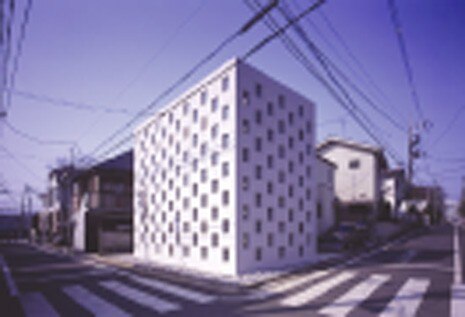
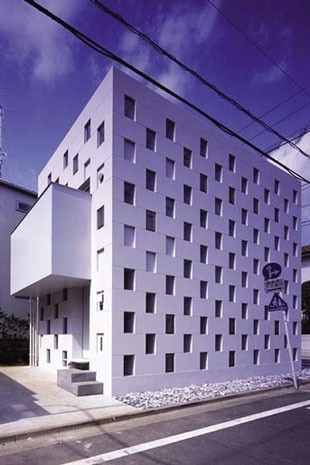
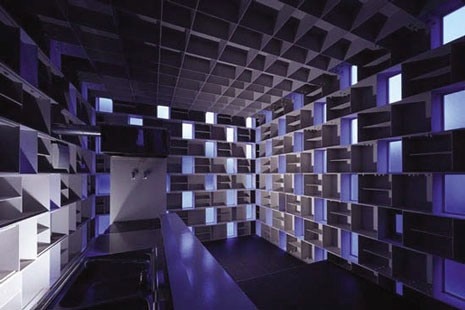
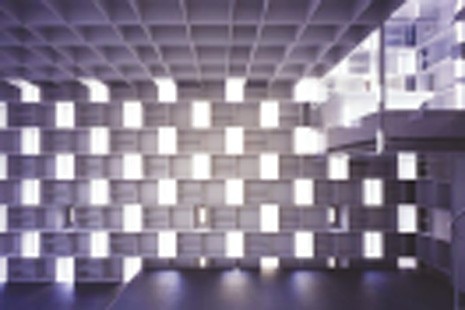
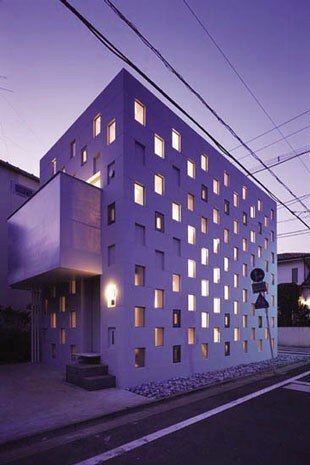
In Cell Brick (2004) the block is transfigured in its material, weight, size and volumetric consistence to the point of becoming a load bearing box in steel measuring 900x450x300mm, that constitutes the minimal component of the load bearing wall. As in the architecture of the Buddhist temples, where rhythmic systems of always identical shelves support jutting out roofs, the figurative nature of the building is given totally by its structure, there is never a dualism between what is necessary and what is decorative, but rather the search for an aesthetic all contained within the technical component. In Layers (2005), the wood structure, a derivation of the American two-by four, changes in size (two-by-eight, two-by-twelve) and becomes the ‘armature’ of a large size prefabricated panel in mineral wood fibre. In both one and the other, the envelope is not just the covering of the building but is both structure and furnishing, recalling that strong integration between small and large scale that has characterised domestic Japanese architecture since the sixteenth century.
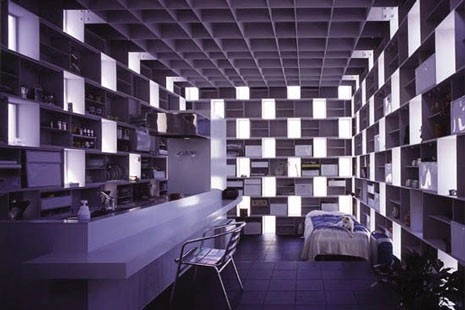
The surfaces of these two buildings are on the one hand silent emitters of light and shade in movement and on the other, receivers of the life of those who inhabit them, technical and poetic diaphragms that place the everyday life of the inside in fleeting contact with the random goings on of the city. Structures - so slender as to appear fragile in Cell Brick, so spartan as to seem unfinished in Layers - transform the walls into accumulators of the everyday, the shelves that they are made up of become gradually colonised in a process that brings the inhabitant to take over the architecture bit by bit, turning the confine of the domestic space into a living diaphragm that narrows the distance from the outside world.
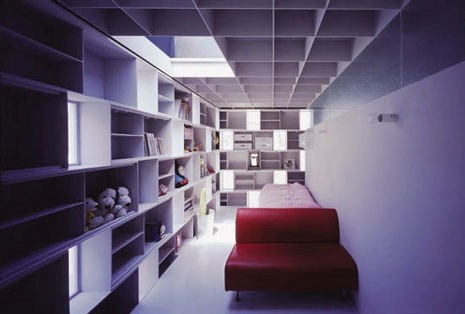
Cell Brick and Layers, in some ways so different, are however chapters in the same story, they could be defined as complementary, two successive musical scores. Cell Brick is mathematical: a summation of basic elements, each the same size, put together according to a recurring rhythm (a-b-a-b), the external texture and the internal partition coincide exactly. Layers is disarticulated as are the actors, the chorus and the orchestra in a no work. Its structural epidermis breaks up into different epithelial layers that are superimposed at random and do not coincide. Here inside and outside appear deliberately uncoordinated, but if in the no theatre the lack of the anaphoric is constant throughout the narration, in this small building, it seems to be rediscovered, if only for a moment, in the single window on the principal elevation. The outside is broken up in a patchwork of corrugated metal, panels in white vetroresin, transparent glass.
The external volume seems like the recomposition of sheets in an okoshiezu: in Layers, as in the models of folded paper on which are drawn Japanese tea houses, each elevation appears like a totally two dimensional composition, each of which is characterised by a different score whose continuity is given only by a few interrupted lines. The inside is complicated by shelves and supports, perforated surfaces, opaline panels. Surfaces without hierarchy or symmetry, that reverberated also in the floors, create enveloping spaces in which the walls are confused with the ceilings, offering those who live in it the pleasure of discovering an unusual experience. Cell Brick succeeds for the elegance of the absolute white of its walls punctuated by rectangular openings like small lanterns and the refined nature of the alternation, without uncertainty, of transparent and opaque. Layers is rough, artisan, anti-graceful, its attraction is in the unexpected surprise; the discovery of small appearances in the secluded recesses of its infinite shelving, never the same; the unexpected apparition of opalescent windows that light up at sunset with an uncertain glare, like glow-worms, on continuous white sheets of vetroresin.
In Cell Brick, everything seems clear: the perimeter wall is also the separation between inside and outside, between public and private space, the circular stairwell, completely inside the building, provides communication between the various levels of the house, without ambiguity. Layers continually confuses and surprises. It enchants with its staircase that is totally internal and then unexpectedly opens up to the sky, it unsettles with its distribution on three and a half levels, corresponding to two dwellings. In Cell Brick the envelope is structure and interior decoration, made only of steel, that thanks to the use of a special ceramic paint developed by NASA, does not overheat in the sun. The four layers of Layers, each in a different material, make up an envelope that not only separates, furnishes and supports, but also becomes the mechanical system for the circulation of air conditioning and heating.
In each of these houses designed by Yamashita, technology and imagination blend together admirably, these unusual buildings are not isolated exercises in skill, but ground for experimentation, prototypes that enrich the study of new experiences and project them in different directions: on one side conventions are decomposed and reorganised in the very long series Project 1000, low cost houses, fruit of a constant collaboration between industrial manufacturers and artisans; on the other they make for fertile ground in a new approach towards international competitions in which Atelier Tekuto have already demonstrated that they can transfer imagination, creativity and competence, for example in the winning project for the Eco-Center at Busan (Korea 2004), where the dream of a large space in which walls, floors and ceilings are transformed into enveloping multi-sensorial surfaces, is once again cultivated by technology, with the used of pre-compressed timber panels.