Périgueux is a small hilltop town in south west France. Its cobbled streets, museums and 12th century Romanesque cathedral make it popular with the mostly British and Dutch expatriates who have homes in the area. Away from the centre and down the hillside is a sprawling, decidedly unpicturesque hotchpotch of residential and office buildings that characterise contemporary development here, as everywhere.
It was while digging foundations for a low-cost housing development that the first signs of the Roman town house, or domus, that forms the core of Perigueux’s expanding Gallo- Roman museum, surfaced. Archaeologists began the process of unearthing the rest in 1959. Two domus, one built on top of the other, would eventually be discovered. Over successive decades reception and bathing rooms, kitchens, two peristyles, central garden or courtyard, and wall paintings were uncovered.
To make them accessible to a growing audience, shelter the excavations, and show off and interpret the discoveries yielded by the site Jean Nouvel has designed Perigueux’s Gallo-Roman museum. Nouvel won the local authority’s open competition to build the museum in 1993. As such it has features in common with the architect’s work from the same period such as the Cartier CTL training centre in Saint Imier, Switzerland, and the Hôtel des Thermes in Dax, France. The outsized eaves also appear in the 1999 Reina Sofia Museum extension blueprints.
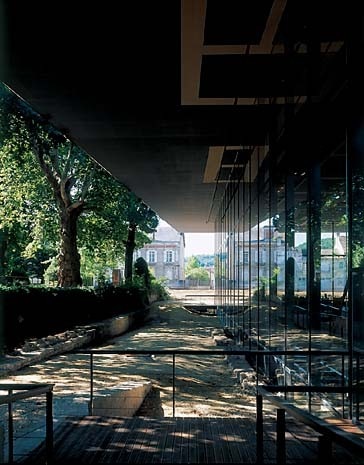
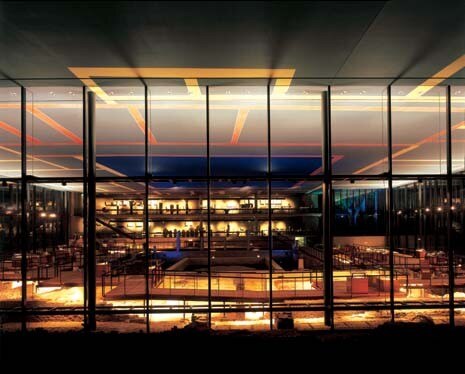
Another recurring element in his work, seen in the Cartier Foundation and unrealised Richemont Headquarters, is the use of reflections to blur the boundary between juxtaposed glass and vegetation. And so too is the use of clear glass hung on a steel skeleton to express a sense of architectural lightness. Nouvel refers to the Cartier Foundation as a “phantom in the park”; while through its present-day architectural language the Gallo-Roman museum conducts a dialogue with “ghosts from antiquity”. Using a wide swathe of greenery to screen off roads and passing traffic – and to allow the gradual unveiling of the building to the approaching visitor – is a strategy also found in the plans for the future Quai Branly Museum of Early Arts in Paris, due for completion in 2005. Whereas the domus would have been enclosed and inward looking in appearance, relatively closed off to the street but open to a central garden, Nouvel’s building is transparent and outward looking.
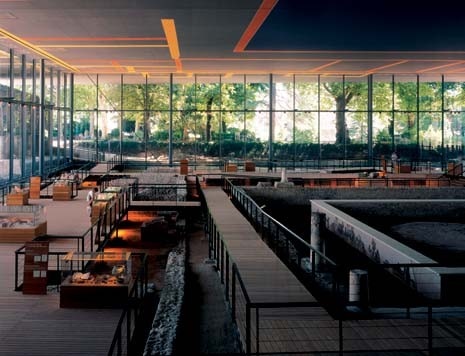
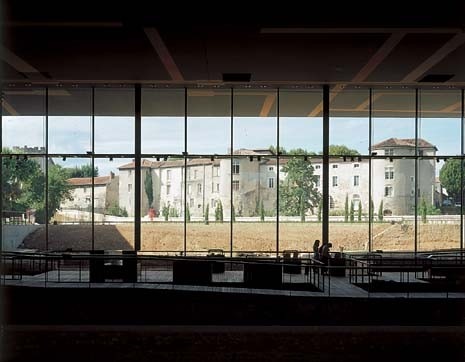
Framed by the museum’s north wall and easily capturing one’s attention when inside are the Renaissance and medieval buildings across the rail tracks, which slice along the northern edge of the museum grounds. The 27-metre high Vésone Tower, just visible through the trees to the east, was formerly the centrepiece of a Roman temple to the goddess Vesunna. It now signals the museum entrance. To the south, trees are being planted to conceal a row of white terraced houses.
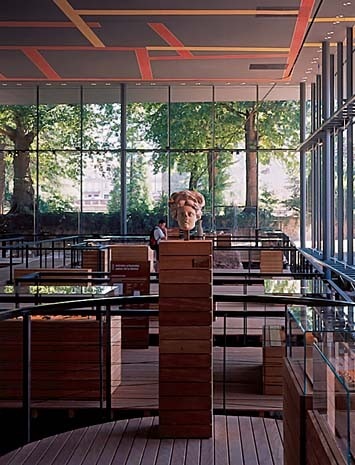
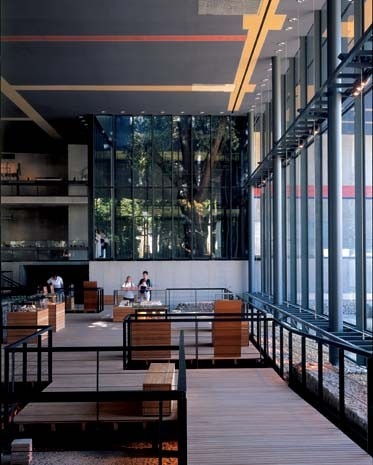
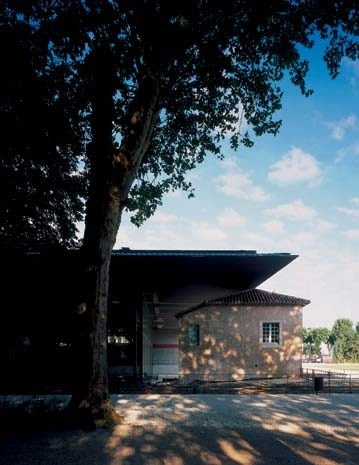
The museum has an expansive feel about it. Nouvel compares the wide-brimmed roof to a parasol, protecting the interior from direct sunlight. It also overhangs and shades a 17th century house that accommodates the museum’s administration offices. The solid steel main door swings out in a wide arc. Dominating the glassed-in entry hall is a four hundred-year-old evergreen-oak that punches up through the floorboards and out through the roof.
At night French lighting designer Yann Kersalé’s uplighters in the floor project shifting blue and green lights into the foliage. The Gallo-Roman museum’s T-shaped design is slightly skewed in plan. The principal glass box that shelters the archaeological site has been rotated by a few degrees relative to the longer concrete box oriented north-south. And rather than give the external concrete surface a uniform texture and colour, Nouvel produced a layered finish. The rough and smooth bands separated by a red and blue stripe allude to archaeologists’ professional concerns with chronology and soil stratification.
A windowless and horizontal wall of concrete forms the rear of the museum. It is Nouvel’s symbolic rebuff of the red-tile pastiche of two nearby government department buildings. The red line works as a metaphor, underlining his message of rejection. The idea of bringing light into the museum’s personnel-only spaces through translucent windows was considered, then dropped. Nouvel seemingly did not wish to accept a compromise, yet by giving the architectural equivalent of the cold-shoulder to the neighbouring buildings, the absence of fenestration has produced some sombre interiors, lit by a single skylight, for the staff. Black lacquered steel panels line the ticket hall and museum bookshop.
At the far end, a floor-to-ceiling window focuses one’s attention on the ruins of the Renaissance château beyond, whose foundations are built on the third century city wall that is itself a conglomerate made from the domus and other buildings of the time. Many objects on display in the museum were in fact recovered from the ramparts. From the outside, the darkened bookshop window resembles an enormous flattened version of a Claude-glass, a hand-mirror invented by the 17th century landscape painter Claude Lorraine, which enables the viewer to better judge proportion and visual contrast. In this case the skin of the museum works as a tool for weaving virtual images of architecture from an earlier age into itself.
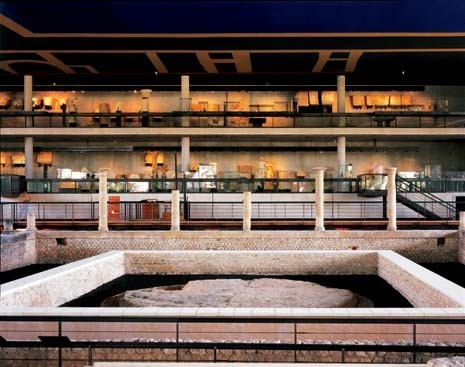
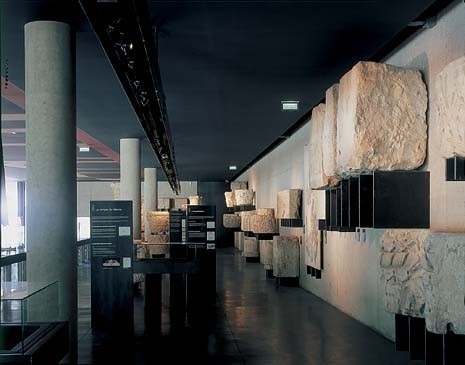
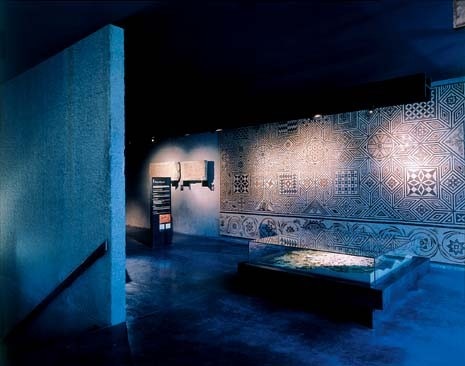
Since classical orders were taken up in Renaissance architecture, one is also nudged into reflecting on a chapter of architectural history. The exhibition begins on the first floor. An eye-catching object on the wall opposite the head of the stairs draws the visitor upwards. It is a lintel, engraved with ‘Pétrocores’, the name of the Celtic people that occupied the region before the Roman invasion. Massive artefacts such as this rest on wall-mounted steel slabs. Metal pins that hold them in place pass through the concrete, held secure by metal plates on the outside back wall of the museum. The view over the excavations from the first floor is impressive.
Red and yellow lines painted on the ceiling mirror the trace of the metre-high walls of the domus below. The earliest walls (dating from the middle of the first century) are mapped out in red, the later ones (mid second century) in yellow. Metal staircases lead down to the museum’s ground floor mezzanine.
From there one steps onto a ramp made of billinga, an African hardwood, supported by a metal frame. It zigzags around the site, and from down here, looking north, the building once again seems to become an optical device for framing the picturesque scene outside. Objects – metal ware, jewellery, pottery, statuary – are tastefully exhibited inside glass display cases that reflect the historical backdrop of wide-angle cinematic proportions.