Chernobyl – its name features on that grim list of poisoned places that includes Bhopal, Hiroshima, Nagasaki, the harbour at Minsk and the advancing coastline of the shrinking Caspian Sea – is very nearly emptied of people. Those remaining, chiefly the elderly, have nowhere else to go. Those who left have been told that they should never have children, for radioactivity is an invisible twister of human fate. It can wait generations of lives before its effects are delivered.
Looking at the ungrazed fields, the unshorn hedges and rampant gardens, it seems hard to believe that you now walk cursed earth, rich with strontium, caesium and other hideous members of the periodic table. Lenin’s intellectual head still thrusts its granite profile into the sky beside the arrival centre at the nuclear power station. Seen against the crop of electricity pylons that surround the complex, whose wires have been silent for 17 years, the head asserts a purposeful ideology, one in which energy was once so central. Its narratives are still read in the stained-glass windows that meet each landing on the stairs leading to the conference hall on the first floor: spacemen loom in shades of blue, maidens bearing palms of fire flash in oranges and reds. The glass moustaches of attendant engineers and scientists bristle vigorously in an opportune silica wind. But nobody believes these stories anymore, and one doubts if they ever did.
Reality intervenes at the entrance to the conference hall, where a contamination monitor waits to measure how radioactive you have become. Hands clamped to the pads at the side, your feet standing on scales, you are weighed, detected and assessed before proceeding further.
In Chernobyl, everyone is a carrier. It’s a question of degree. In the conference hall’s anteroom, a spliced-open model of a nuclear reactor stands politely to one side. The reactor core has been gently anatomized for visitors to better understand its inner workings. On April 26, 1986, however, the real-life version of this delicate device was ripped apart by an explosion that sent 30 to 40 times more radioactive pollution into the air than the atom bombs that exploded over Hiroshima and Nagasaki.
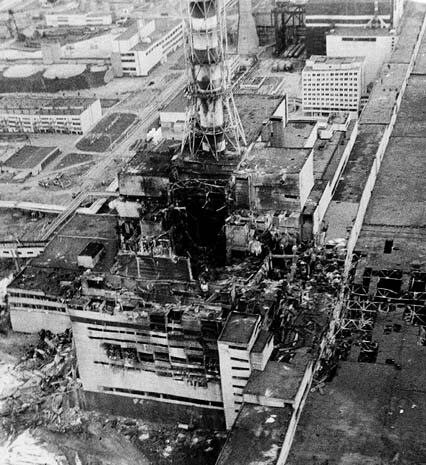
The resulting cloud, which sprinkled its dust over hundreds of thousands of people in the Ukraine, Belarus, and much of the rest of Europe, has long since dissipated, but the stories of Ukrainian and Belarussian families dealing with its effects have yet to be told in full. Amazingly, when you study photographs of Reactor 4 after the explosion, you see how the adjacent Reactor 3 is almost untouched. What camera-toting helicopters captured as they hovered fatally over Reactor 4 was a vast gaping hole: the roof gone, the sides of the walls melted, the velocity of the explosion there for all to see. The immediate death toll was low, just 30 workers plus an uncertified number of firemen who were first on the scene, tackling a blaze that, like a cruel decoy, brought them only certain death and an ugly figurative memorial beside the main road in Chernobyl.
At first, people in the town were unsure what to do. Stirred by the enormous explosion, villagers in the small settlement of Prybat, located just in the path of the growing cloud, gathered at their back doors to watch the strange sunset that had arrived several hours too early. Some even climbed onto the roofs of their homes for a better view. Later they would be told to run, leaving everything behind. Seventeen years on, Prybat is a rural Marie Celeste, with washing still hanging in the gentle wind, open doors banging and children’s toys strewn in the garden.
It is a ripe Hitchcockian setting that delegates attending nuclear-safety conferences at Chernobyl now get to see on specially organized bus tours. As people left, new chemical combinations were born inside Reactor 4. Known as fuel-containing materials (FCMs), they come in the shape and colour of broken molasses. Various parts of the reactor have produced unique forms: brown ceramics from the blubber pool, black ceramics from room 304/3, melded metal lava from the steam distribution corridor and brittle glittering slag everywhere. Other more sinister formations, categorized as lava-like fuel-containing materials (LFCMs), require further extensions to the forcibly syncretic vocabulary that has been created by the scientists as they try to describe what they find. Chernobyl has spawned a new and intensive form of specialist geological, archaeological and taxonomical studies. Photographing these chemical chimaeras in situ has proven almost impossible, as film develops itself inside the camera after only a few seconds inside the broken building and after a few minutes inside Reactor 3.
Measuring the effects of the explosion inside these spaces is a difficult, if not lethal, process. The photographs that have survived this exposure bear warning blooms of red and pink across the frame in deadly mimicry of the amateur holiday snap. The changes wrought by the explosion inside Reactor 4 have transformed a vast and regulated machine into a speleological nightmare. With fallen interior beams the size of buses welded into broken heaps by the force of the blast and entire sections of the building reduced to a set of sore cavities, it has been impossible to measure accurately the continual possibility of nuclear chain reactions within the molten mass.
As the fizzing soup of concrete dust, fuel, metal and other assorted substances has cooled, cracks have appeared in the ceramic lava that covers much of the more dangerous radioactive material. Penetration by rainwater has also worked to make these cracks larger and larger, revealing yet more dangerous FCMs whose precise makeup is still unknown. Monitoring these changes has become increasingly urgent. The Chernobyl nuclear power station, along with the San Andreas Fault, has thus become one of the most carefully surveyed places on earth. But, one by one, the various surveillance systems implemented to monitor the structure have begun to crackle, whine and die under the invisible onslaught of combined high temperatures, gamma radiation and neutron flux.
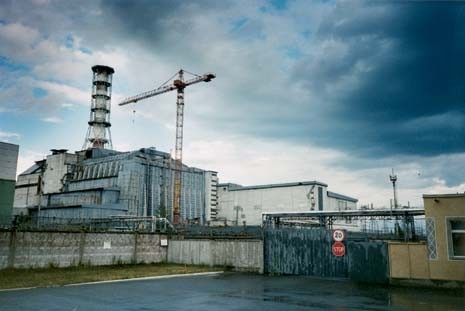
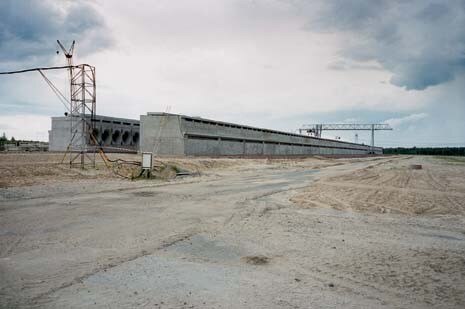
The radioactive mixture, it seems, prefers not to be watched. Like a medieval dragon, the estimated 200 tons of uranium, one ton of plutonium and a mongrel mix of fuel and debris lurk inside a cavern, brooding, unknown and fearsome. But here there is no roar, scraping tail or clinching claws. At first, they tried to lock the beast in. The emergency structure built around the ruins of Reactor 4 in the years following the explosion was achieved through the extraordinary bravery of a selfless workforce. An entire buttressing wall was erected on the reactor’s west flank; when seen in profile, another cascading wall built on the north side resembles a section of a stepped pyramid.
This cascading method allowed the builders to gently close the gap in the reactor while lessening their exposure to the intense radiation. A new roof was slung over the ruins. The term ‘sarcophagus’ began to be used to describe this process, as if in recognition of the mighty power entombed inside and the pharaonic efforts involved in sealing it in. The Ukrainian authorities now prefer to call this structure the ‘shelter object’ – a description of deliberate blandness that does little to disguise its unique character.
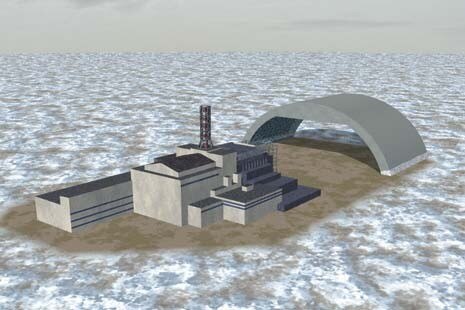
The ‘object’ itself is ugly, of course, but then nuclear reactors are not known for their beauty. It has been given a freshening coat of pale anticorrosion paint, but one suspects that this is as much an aesthetic whitewash designed for the media’s cameras than any real preventative measure. But now a much bigger plan is being considered. Designs for a huge confinement structure to be built around the entire reactor are now in their final phase.
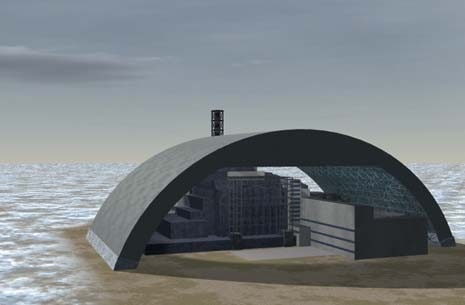
Consisting of a huge hangar-shaped arch with a span of 260 metres and a height of 100 metres, the confinement structure will also be the world’s largest moveable building. Since it will not be possible to erect this structure directly over the reactor, it will be built adjacent to it and slid over using a combination of greased steel plates and hydraulic systems. The arch will be covered by a sandwich arrangement of metal sheets – an aluminium alloy is the current favourite – and the open ends sealed with further walls of metal. Inside, new monitoring systems, robotic cranes and, where possible, live workers will then start the tricky task of dismantling the wreckage inside the reactor.
Rusting beams will need to be cut, radioactive material removed and stored and the various FCMs parcelled neatly into canisters. Work on stabilizing the existing shelter prior to the erection of the giant arch will be completed within the next 12 months. The entire project will be as much a dismantling of an identity – disaster is spelled ‘Chernobyl’ – as a radioactive hellhole. The world seeks an assurance that hell can be beaten. Destruction, emergency construction and now further construction in order to deconstruct – Chernobyl’s rhythms are unique.
The deconstruction process may take years, perhaps even 100: this is the minimum life expectancy of the new confinement shelter that is due for completion in 2008. The projected cost of the operation is currently at $717 million, funded by grants from more than 20 nations in Europe as well as the United States – Italy’s contribution of $16 million is the same as the UK’s – and funds managed by the European Bank of Reconstruction and Development. The engineers leading the consortium designing it – the American construction giant Bechtel International Systems Corporation and the French firm Electricité de France are leading partners – believe it could survive for 300 years. But even then, this gigantic tomb will not be permanent.
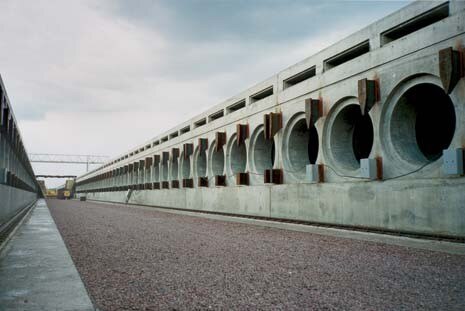
Just as Egypt’s pharaohs thought their final resting places would remain inviolate, only to have their bones scattered by succeeding generations of tomb robbers, so Chernobyl’s remains will be exhumed. The confinement structure is in fact temporary, designed to keep out water and dust in for as long as it takes for the Ukrainian government to designate a permanent storage facility. Science and political consensus do not currently have an answer to this most pressing problem, one that afflicts numerous countries around the world. We have created a form of energy that we cannot see, the waste products of which we do not know how to make safe and which, when all-too-human error is factored in, will kill us. It is telling that our response to the explosion at Chernobyl is to build and build again. Architecture reaffirms our belief in answers, even if these are revealed to be increasingly hollow.