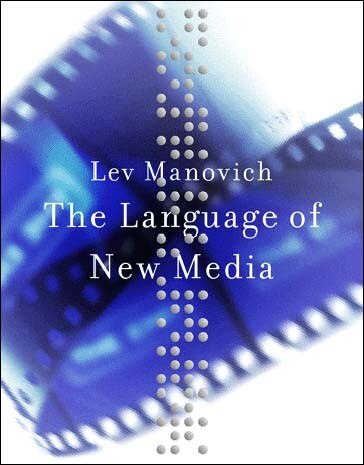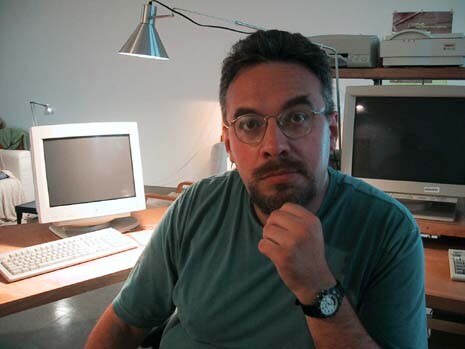
Lev Manovich, Russian by birth, American citizen, author of “The language of new media”, is certainly not someone a la Negroponte, nor an ascetic scientist at ease only in a laboratory: he associates himself rather in the precision of a definition to the artistic vein of an avant garde film director. His biography is in itself an example of a harmonious combination of technology and the humanities. Manovich, born in 1960, studied fine arts, architecture and information technology in Moscow, after which in the eighties he entered an American computer animation firm. Here he began to ask himself some questions on the nature of the synthetic image, one that is reconstructed totally inside the computer, an image which is not drawn from any existing reality.
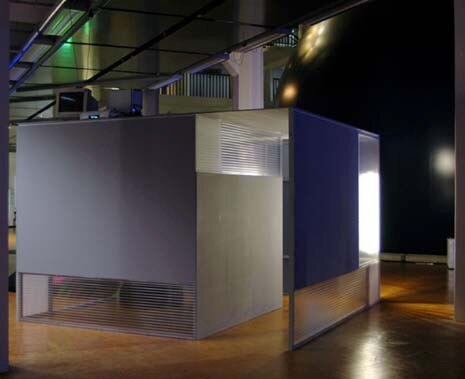
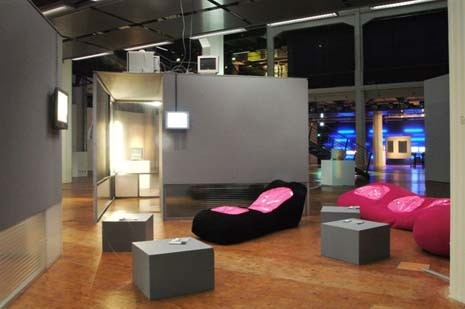
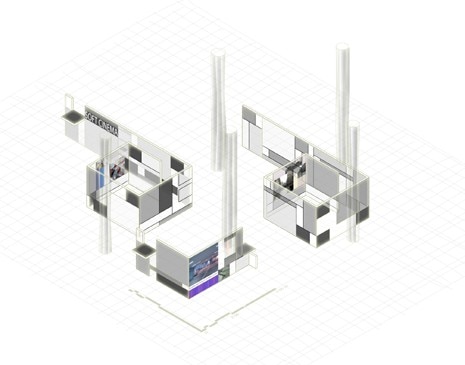
In the meantime he specialised in cognitive sciences and visual arts until he reached the level of associated professor of New Media Art in San Diego. Manovich is also an artist and experiments first hand with his theories. His latest installation “Soft Cinema” was presented in November at the ZKM in Karlsruhe, one of the major European centres for the study and production of interactive art. His book, also translated into Italian by Edizioni Olivares, is the first systematic essay on a particular theme, that of the new technologies of communication, onto which over the years a number of different theories have been layered, from the prediction of an unstoppable development and the benefit of digital, to extreme theorisations by groups of artists active on the web on the revolutionary impact of internet. What is there that is useful in all this for a serious analysis on the language of new media? To answer this question, the author invites to leave the view of the overall, the abstract theories, and examine instead the minimal elements, in particular, “the equivalent – reads the beginning of the book – of the framing, the phrase or even of the letter”.
“The method followed – explains Manovich – could be defined as ‘digital materialism’, in which the theory of new media is non a priori, or imposed from above, rather constructed from below. To discover the nature of the new cultural logic and how it works, it is useful to examine in detail the principals on which are based the hardware, software and the operations which concur to create cultural products by computer”.
The language of new media, as Manovich clarifies, is important to study not so much for its purely technical aspects but because it is “the” language of our times: it is the vision of the world of contemporary society. As such, for example, when the author describes the new digital creativity as “chosen from a menu”, a combination of existing alternatives and not new production, it is easy to associate a broader consideration to the purely technical analysis: “What to wear, how to furnish an apartment, what to order in a restaurant, how to spend your free time – writes Manovich – the daily citizen passes through life coming into contact with an infinity of menus”. In the same way the central theme of interactivity receives an interpretation which is new and filled with repercussions in other fields. When interacting “the user is activating only a part of a piece which already exists”. His activity has nothing of the creative. It is an adaptation of one of the possible routes predetermined by the author. “Paradoxically – writes Manovich – following an interactive model, the person does not create a unique self, but instead adopts pre established identities”.
It is exactly this continual game of deferment, from the specific to the universal, from the details of the functioning of more widely used programmes to the logics of behaviour in contemporary society which makes Manovich’s work both fascinating and innovative.
Cyber-architecture
The details – according to the author’s method – are to be found in the territories which lie on the confines between new media and traditional forms of communication, in particular cinema, but also architecture or music. “I find it very useful to concentrate on disciplines which have a tradition behind them of an in depth study of their expressive forms and that today make use of the computer as a necessary support for creativity. Instead one often starts by analysing technology and technological art and you don’t get very far: you end up concentrating more on the technical aspects than language”, explains Manovich, who we met recently at Linz during the recent Festival Ars Electronica.
“In particular I am very interested in relationships with architecture. Now practically all the major architects design with the computer. Just like what happened in cinema and in other fields, that which up to around ten years ago was new and unusual has now become the norm. It would be impossible to sum up the different ways in which the computer is used in the design, construction and presentation of projects. But one can say that an effect visible to everyone is the adoption of forms which are increasingly soft and fluid. What which seems interesting to me is that now these kind of shapes appear in projects by architects of every generation, characters of calibre such as Zaha Hadid and Eric Moss have already developed their own personal language.
There are then architects, such as Greg Lynn, the group Asymptote or UN Studio who have been working on and reflecting on the role of the computer in their work for years. The debate regarding architecture is for me something of great interest also because it connects up to another theme which I am studying for my new book on Info-aesthetics, in other words ‘how can you represent the information society in a symbolic way? Are there spatial forms which can efficiently represent it such as the forms of Bauhaus did for the industrial society?’ My intention is to analyse some new concepts of form in the information society: changing forms, form as a representation of distribution, form as an emerging element, form as a signal in opposition to noise. I have examined these concepts by observing the way in which computers and networks represent, organise and communicate information. Naturally the forms which I have described cannot be materially constructed: they remain suggestions which inspire the most creative authors, able to combine traditional architecture and representations based on the web and the computer”.
The great builders of multimedial language, those who will be able to give life to new styles and to write the grammar of this language, such as Dante did with Italian, or Griffith with cinema, will come, according to Manovich, from fields connected to technology, not directly from it. “Already many of the most celebrated cultural objects have been created thanks to the computer, the architecture of Frank Gehry, the choreography of Merce Cunningham, the photography of Andreas Gursky are just a few examples. Many artists use the computer as a tool even though they don’t talk about “new media” in defining their work. The fact remains that without the computer they couldn’t complete their aesthetic discoveries.
Info-aesthetics
So what are the fundamental elements in the language of the computer? To describe the characters of the creations realised with new technologies of communication, Manovich introduces the concept of the “new media object”, within which fall the man-computer interfaces, but also video games or virtual three dimensional worlds.
“Now the interfaces which we use for entertainment coincide with those for work and vice versa. The industrial society was characterised by a clear separation between work and entertainment. For work you had a certain kind of interface, then you went to the cinema and you dedicated yourself to another entertainment activity and it had another. In the information society it is no longer like this. An example is web browsers, the programmes for exploring the web: you have the same interface for working, playing, listening to music and other things”.
The analysis of the interfaces and the reasons for which they are realised in a certain way can therefore bring us to understand a number of deep mechanisms actually in our relationship with reality. “I think for example of the interface of the operating system OS 10, the latest created by Apple: the icons are activated by the simple passage of the cursor, the windows open with a little dance and there are many other effects of this kind. This interface is not purely functional as was that of the first Apple Macintosh computer, which came out in 1984, minimalist, clean, purely at the service of information. In this case pleasure of use prevails, the various functions take account of the sensibility of the user and attempt to satisfy it.
Today there is more attention to the aesthetic aspects. We could say that to have access to a computer becomes a purely aesthetic act. This tendency is demonstrated also by the increasingly accentuated attention to sinuous anthropomorphic forms in the design of the computer and other information tools or domestic appliances. The aim is to create an emotional response in the users comparable to that one has before a work of art or in a relationship with a person. I introduced the term ‘info-aesthetics’ exactly in reference to this increasingly close relationship between information – and the interfaces for accessing it – and the element of form. I think that it is something of a key moment in our culture”.
If then the data with which we will be dealing with will tend to have an increasingly elegant form, also the theme of usability, or rather accessibility and functionality of everything we explore on the web will be affronted in a different way. “I am somewhat diffident towards the extreme conceptions which regard usability – maintains Manovich – I think that the problem is badly posed. In reality today when one talks about communication one isn’t referring to the pure access of data, but rather to the logics of persuasion, in which emotiveness plays a fundamental role: therefore the aspects of graphics and presentation make an important contribution”.
The computer director
According to Lev Manovich interactive cinema will probably never exist. But it remains interesting to look at the infinite compositional possibilities allowed by the intervention of the computer on video images. This is one of the objectives of Soft Cinema, the latest artistic work by Manovich which makes use of a vast database of moving images and a software which allows them to be combined in real time. In practice, the making of the film in its definitive version is done by the computer: the software decides what appears on the screen where and in what order, on the base of a set of rules imposed by the system.
The screen is subdivided in various sections, on the model of the interfaces man-computer (like Windows) or financial TVs. “In a small window, for example – explains Manovich – we can show the memories of a person or the alternative possibilities for the narration”. It is a different way to narrate, which sees in the screen not so much a point of view of a world, rather a support for information which is layered, which coexists in the same space. Soft Cinema also tells us something else about its author. Aside from the analytical intention, which prevails in the book, Lev Manovich has a much more ambitious purpose: “Using the computer to represent our subjectivity and our personal experience in the world”. Images disconnected, fragmented, which are combined according to a spatial montage which no human technician has planned. The “flow of consciousness” of a machine.
http://www.manovich.net