Photography by Satoru Mishima
Yokohama International Port Terminal is the calling card of new generation of architects. Like, in its own time, the Pompidou Centre in Paris, it is the consummation and statement of this generation’s concerns. Farshid Moussavi and Alejandro Zaera-Polo of Foreign Office Architects were in their early 30s when they won the international competition to design it in 1994, and the project has been famous ever since, hovering over the architectural world throughout its gestation and construction. Its making was a particularly epic process. For four years nothing happened, while some in authority hoped the project would die. Mayors came and went; the national economy fell, and fell more. The official in charge covered the model in his office with a blanket to stop people getting too excited about it. It took two years to finalize a contract for a three-month feasibility study, the sticking point being FOA’s refusal to hand over the copyright. Cost-saving measures were proposed that would have wrecked the design, such as inserting columns or replacing half the boarding with carpet. ‘We have never worked so hard’, say the architects at FOA, ‘and we may never work so hard again’.
Although the generation of architects that includes Frank Gehry, Robert Venturi, Piano + Rogers, Rem Koolhaas and Daniel Libeskind is heterogeneous, running through its work is a common fascination with clash, juxtaposition and disjunction, an understandable reaction against the later manifestations of the International Style, the smooth and seamless architecture of commercial globalization. Mies van der Rohe, who designed a memorial to the communist revolutionary Rosa Luxemburg in the 1920s, built for banks in the 1960s. American practices like SOM honed modernism into statements of corporate power, as smooth and impassive as a multinational’s logo.
There is also a tendency, Gehry apart, to write or draw before building. Libeskind and Leon Krier both made themselves famous with paper projects and expressed doubt that they would ever build. Hadid, less willingly, grew famous on drawings. For Venturi and Koolhaas books preceded buildings: Complexity and Contradiction in Architecture for one, Delirious New York for another. Architects of this generation are also often missionaries, regarding architecture as a thing of supreme cultural, artistic and social significance, sometimes almost a religion, which the compromised, brutal field of commissioning and constructing buildings could not accommodate. Aldo Rossi and Krier declared that modern society made real architecture impossible. Koolhaas says that he needed to write his book in order to create the culture in which he might be able to practice. Clash and disjunction are an expression of the collision between aspiration and context as well as a celebration of non-corporate multiplicity.
But now global finance wears different clothes. It professes multiculturalism and love of the planet. Clash and juxtaposition are the artistic devices of theme parks and shopping malls. The face of big money is no longer the suave front of a plate-glass office block, but rather the grinning mask of a Las Vegas resort or the faux folksiness of Starbucks.
And thus, since it seems that part of the architect’s job is to offer resistance to the status quo, the Yokohama generation looks for a conceptual armature and physical integrity that resist the shopping mall’s cut-and-paste approach to making places.
The terminal cannot easily be made into a commodity or a themed version of itself. FOA has retained Koolhaas’s fascination with complexity and the dynamics of modern cities, but the architects also have, as they say, ‘a sensibility that goes back to Mies van der Rohe. We make projects that order the world in a consistent way’. The younger generation is also suspicious of the myth of the architect as genius, as the single artistic superstar, that has grown up around figures like Frank Gehry and Richard Meier. Whether they like it or not, these stars are always in danger of becoming logos themselves, brand names whose familiar look comes to dominate the underlying talent.
So the younger generation forms practices led by two or more people with names that sound impersonal and businesslike, such as Foreign Office Architects. Their position is less missionary than that of previous generations: they are interested in building first and theorizing later.
Architects are always poised between resistance and compliance, between the values of the culture that commissions them and their own creative conscience. Figures like Libeskind offered extreme levels of resistance early in their career, followed by greater levels of compliance. FOA has been compliant enough to start building young, but with Yokohama it has devised a way of building resistance into the fabric of construction.
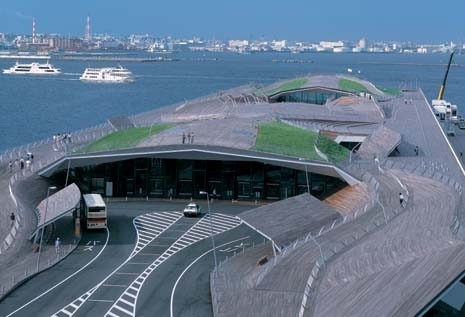
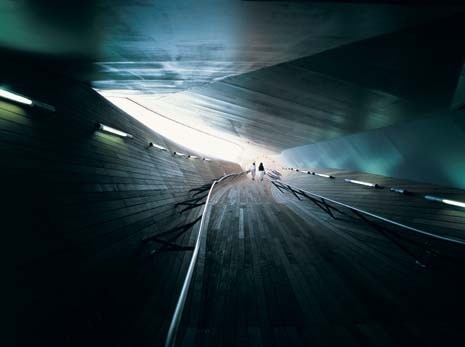
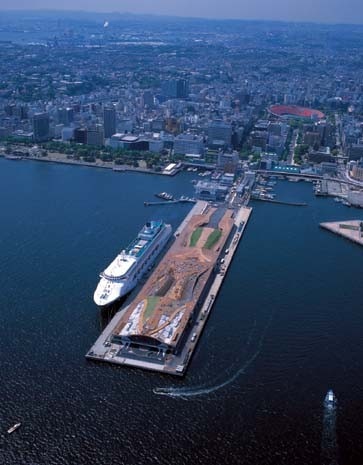
The Yokohama terminal is a transport building, a place of flux. Its design is based, in the architects’ accounts, on the dynamics of movement. It has no walls, just floors that curve up at the edges, ceilings that curve down and glass. It is built over water. A long oblong pier, it is a territory between land and sea, between the city of Yokohama and the international populations of the cruise ships and ferries that dock there.
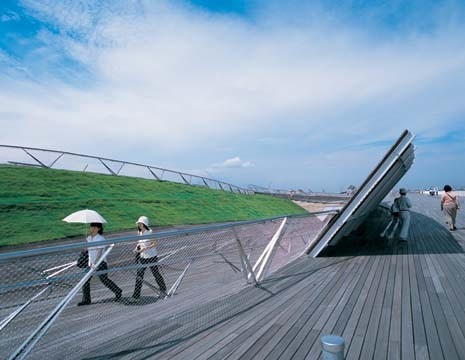
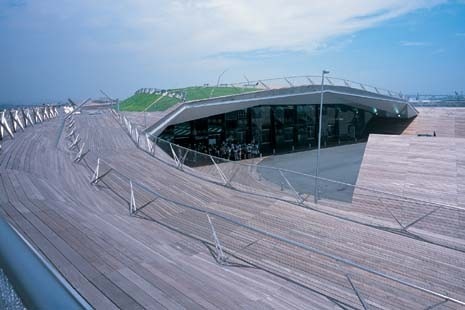
Yet, beside the disposable construction of a Japanese city, where houses are made of flimsy materials and signage commonly overwhelms architecture, the terminal is a work of solidity and substance. There is no concealment. Its mighty steel structure is also its surface, only clad in wood where it is meant to be walked on. Along its 450-metre length are consistency and economy of material and detail: steel, wood, glass, steel handrails and tarmac in the car park.
A comparable stretch of a Japanese city would be a riot of different images, materials, details and levels of permanence. It is physical and bodily: steel bones and wooden skin with sunshades, railings, lights and seats that are equivalent to hair and nails. Like a body it has an inside and outside, and the exterior surface becomes interior without a precise boundary between the two. It has near symmetry around a single axis, and its surfaces undulate and fold. It has visceral passages and chambers like bellies. Its smooth skin wrinkles and is sutured and tattooed.
It is, paradoxically, here on the water, a point of stability and stillness for the unstable city. It has a consistency and integrity that in a time of disposability is almost quixotic.
It doesn’t resemble Japanese architecture so much as Japanese infrastructure, especially the mighty multilevel concrete highways that are the armatures of the big cities.
Of course, as a transport building, it is infrastructure, but not in the same way as the highways. Its might is surplus to its strictly functional requirements; as its architects note, a building of one-tenth the 23.5 billion yen budget (and therefore a fraction of the terminal’s scale, ambition and elaboration) could have performed its duty, which is to serve 60 cruise-ship moorings per year as well as some ferry traffic and boats offering tours of the Yokohama harbour. Unlike the highways, it does not have to have this muscular structure.
But it is also a civic space, a town square or park thrown across the water or, as its architects describe it, an artificial beach where people can promenade, sunbathe, canoodle, picnic, attend festivals and watch fireworks. This is a not-uncommon fantasy that architects have for their buildings, but here it has already happened. It is hoped that floating additions will be moored nearby – stages, hotels, driving ranges –for which the terminal will act as a magnificent foyer.
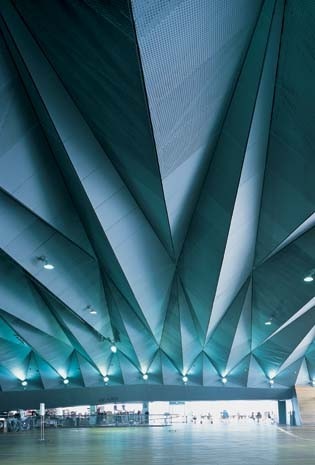
Its dual role as transport equipment and civic space, as John F. Kennedy Airport and Central Park in one, is served by two great vaulted spaces, one the Departure and Arrivals Hall for the ships and the other the Salon of Civic Exchange, a place for public events. The salon is placed counter-intuitively at the end of the pier, the farthest distance from the city it serves, while the Departure and Arrivals Hall is close to land in order to make the two worlds overlap. An undulating tissue of floors, ramps and roof connect the two halls.
The terminal is a prestige project, intended to bring fame to Yokohama. The third largest city in Japan, Yokohama is continuous with Tokyo’s urban fabric; it is therefore anxious to assert its independent identity. This puts it in the same category – that of transformative civic emblem – as Frank Gehry’s Guggenheim Bilbao, to which it has a superficial resemblance. It has the irrational double-curving elements and the apparent freeform planning that since Bilbao have become the ubiquitous signs of civic ambition. It seems susceptible to the view of architecture as built travelogue, whereby its wave-like forms would be deemed most appropriate to its maritime location.
But it is too simple to label it as yet another of the exercises in boostering expressionism that have followed Bilbao. It resists the temptation to be an icon or a postcard view.
Seen across the bay it is nothing in particular; approached from land it presents itself as the portal and drop-off of a fairly familiar type of transport building, although intriguing outgrowths suggest something unusual is afoot. It is only through penetrating and using the building that you discover its qualities. When you are there, it does not occur to you to think of the building’s waves as metaphors for those of the sea.
The point is that it is both infrastructure and prestige project, and neither. It is a monument, and not. While it has a monument’s distinctiveness, it is experienced as a network of sequences rather than as a single iconic object. Beneath its extravagant shapes is a deadpan design strategy: principles are established at the start, and then implications are allowed to develop through the long process of design, detailing, building and use. The structure is a ‘a hybrid of landscape and building’ in which an element of the initial brief, a public garden or meeting place of 500 square metres, has been expanded to take over the entire design. All 27,000 square metres of the terminal are now considered as public garden, park or landscape. Landscape and borderlessness gave rise to the ideas that ‘the ground should be continuous’ and that ‘the conventional division between levels, and between inside and outside, is blurred’. Hence the floors that bend, slope, curve and grow seamlessly into ramps and the use of the same materials inside and out.
The desire to blur borders generated the pattern of circulation. ‘Piers and terminals’, according to FOA, ‘usually have a linear structure. You go in or out along a single route. They are like gates between one country and another. But people are now crossing borders all the time, so projects like this should no longer function as gates. We wanted a non-oriented space that would be part of the city. We wanted to make the infrastructure disappear, so that it would be more like the relationship between a typical city and its metro system. So we made the circulation a series of interconnecting loops’. Throughout the building the user is presented with choices of left, right, up or down; there are many different ways of moving through it and many intersections of routes taken by passengers and citizens.
Finally, the building has ‘tectonic presence’. Using a structure based on folding steel, it is a ‘a hybrid between ship-building and origami’. The intention was not to make the terminal look like a ship, but to ‘give it the physical qualities, rather than the forms’ of the harbour landscape that surrounds it.
Taken together, these intentions combine with external pressures to create the dynamics that shape the building. The off-centre position of the foundations on which the terminal is built generates an asymmetry in the otherwise symmetrical plan. Practical restrictions require an ambitious 25-metre cantilever on one side, while the ramps, encased in sinuous steel tubes, also act as giant beams that support the vaults of the columnless halls, resulting in sections of steel of geological might. The roofscape is ‘the consequence of what is below’, flowing up and down to cover and connect the two halls. The boarding, cut to fit the terminal’s geometry and embedded with gratings and access hatches, becomes an intricate marquetry of intersecting patterns.
Yet, as Moussavi and Zaera-Polo insist, none of these striking consequences are based on decisions of taste or aesthetics; they are rather the outcome of principles and conditions pursued, albeit with an underlying sensibility, to their logical outcome. They call this ‘a structure for surprising yourself’, ‘an alienating artistic technique’ comparable to Dadaist automatic writing. They also speculate that the technique is a response to the fact that they are two architects working in collaboration. ‘Decisions have to be justified. It is not just a question of “do we like it” or “do we not like it?”’
This technique is a kind of functionalism, but not of the prosaic kind for which the modern movement was attacked. It does not imply a surrender of values and desires but a belief that they are embedded in functional decisions rather than imposed on them. The approach, says FOA, ‘absolutely represents desires, but formulated at a different level’. Fundamental to Yokohama are certain beliefs about the nature of contemporary public space and the culture of transport, and these have been encoded in the DNA of the design from the outset.
This article was commissioned by the British Council on the occasion of the 2002 Venice Architecture Biennale.