

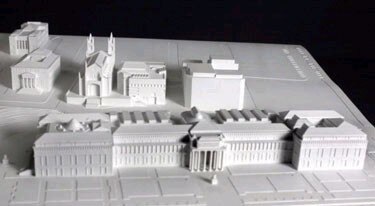
The most acrimonious part of the polemic concerns the fate of the historic 15th-century cloister of Jerome, which the Spanish architect had planned to dismantle and rebuild within the new structure. The accusations concern not only the concealment of the cloister, as if in a game of Chinese boxes, but above all the proposal to radically distort its character. With its ambulatory demolished and its garth covered by a skylight, the Renaissance building would be turned into a reading room.
The association’s general secretary, Paloma Gómez Embuena, has expressed her satisfaction with the court’s decision. Meanwhile the museum’s neo-director Miguel Zugaza is deeply concerned (“The extension to the Prado Museum is indispensable to the picture gallery and to stop work now would have dramatic consequences. There is a lot of ignorance about the new project. The cloister of Jerome will not in fact be destroyed. On the contrary, it will be enhanced by the new building”, he told to the El Mundo newspaper).
Moneo’s plan is part of a wider scheme of works approved by the Spanish parliament in 1995, with a budget of 330 million Euros. This would add 17,000 square metres of space to the exhibition rooms whilst also doubling the pedestrian area, designed by Alvaro Siza, in front of the museum. For the construction site to be effectively blocked it is now only necessary for its opponents to pay the security money stipulated by the court at 1.25 million Euros. This would cover any possible financial damage that might be incurred by halting the operation. Though ‘astronomical’, the amount has not alarmed the association, who have already opened a number of current accounts and hope soon to collect the necessary sum.
http://museoprado.mcu.es