“Landscapes, buildings, streets, service stations, railway lines and terminals, are for me things that deserve consideration. These places need the same consideration that we give to actors. In general, cinema doesn’t care about places, it recognises only the story, more so even than the characters. For me, the primary element is the territory of the characters.”
Wim Wenders, interview with D. Bossière and D. Lyon in "Cahier du cinéma", January 1986
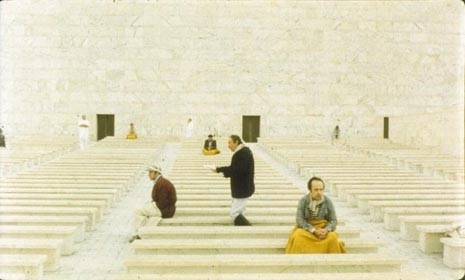
Miracle in Milan
Italy 1951, Vittorio De Sica, Cesare Zavattini, b/w, 100’
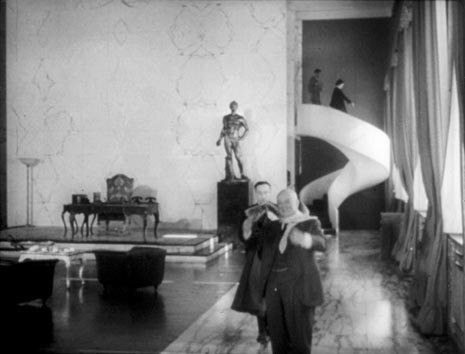
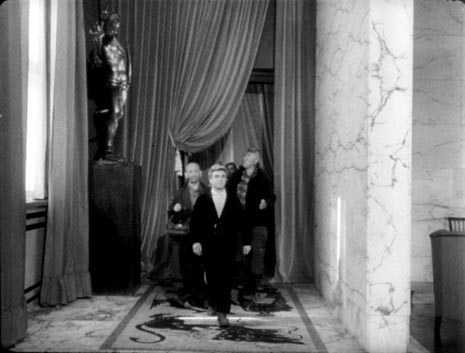
After checking from the window that the local officials who have been evicting the inhabitants of the nearby shanty town have departed, Mobbi, a property developer, puts on a show of welcome to the delegation of homeless who arrive at his office to put forward their case.
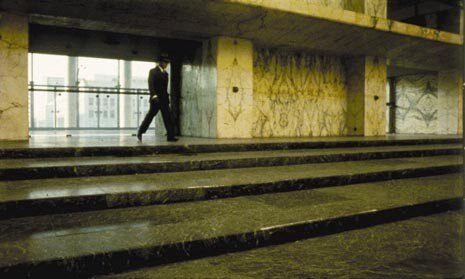
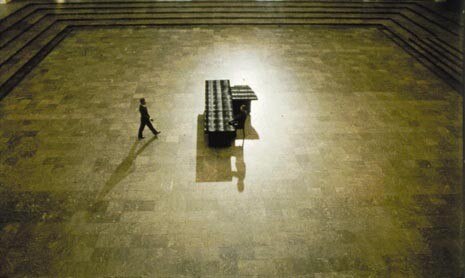
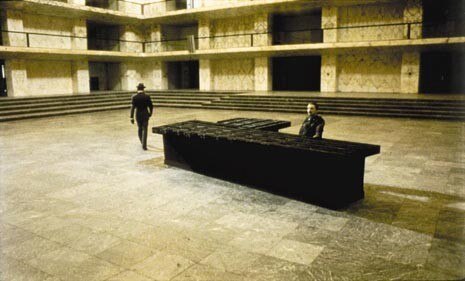
This passage which occurs at the beginning of the second half of the film, has been set by De Sica and Zavattini in one of the most classic and distinct spaces of modern architecture, the Palestra del Duce, by Luigi Moretti, it is constructed in an atmosphere which is totally surreal, underlined by the syncopated rhythm of the music and the quick pace of the butlers and waiters which contrasts with the awkwardness of the delegation.
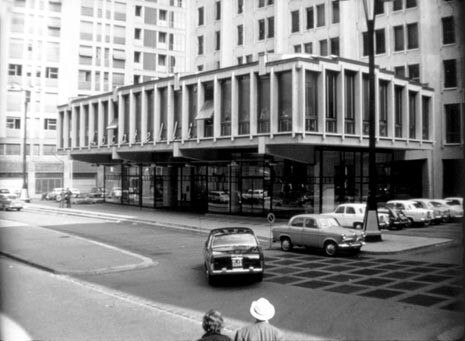
The setting of some scenes is particularly interesting, such as those of the external entrance to the office and the shot from the window of the departing officials, filmed in the impluvium and in the portico of the Palazzo della Triennale in Milan.
Il vedovo
Italy 1959, Dino Risi, b/w, 100’
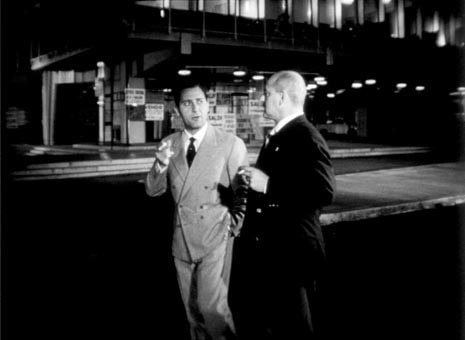
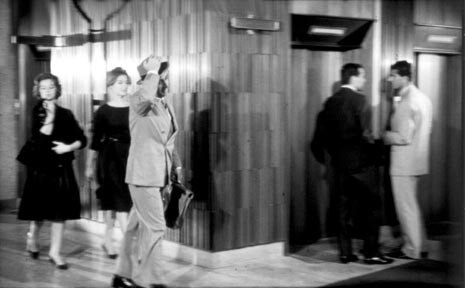
Before the title sequence appears, the leading character, Alberto Nardi (Alberto Sordi) is taking a stroll with a companion in the piazza at the foot of the tower block where he lives, the Veladca Tower, by BBPR Studio, wickedly planning the elimination of his wife.
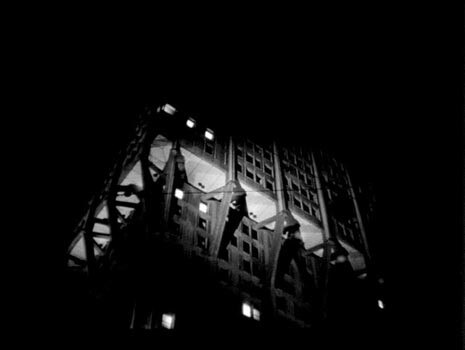
The night scene which moves up to the upper storeys of the tower block seeming to accompany his return home then creates the background for the opening titles.
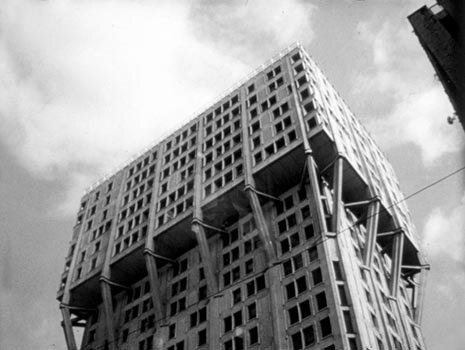
The next shots which begin the film return to the same part of the building but by day and a sequence in reverse moves down to the piazza below and sees the protagonist going out to work.
“My dear Elvira, where are you having breakfast, in a villa or a tower block?” The question that Nardi puts to his wife (Franca Valeri) is paradigmatic of the choice of this building, at the time recently completed, a new element of the Milan skyline which was among the chosen haunts of the city’s middle class businesspeople during that period.
La Notte
Italy 1960, Michelangelo Antonioni, b/w, 122’
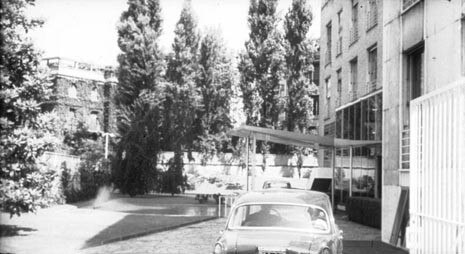
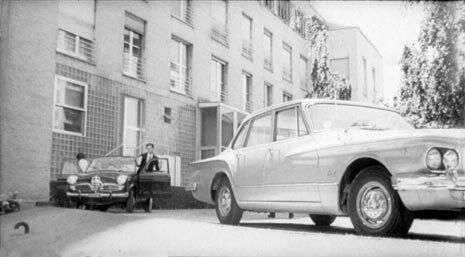
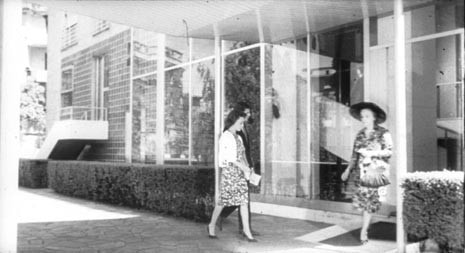
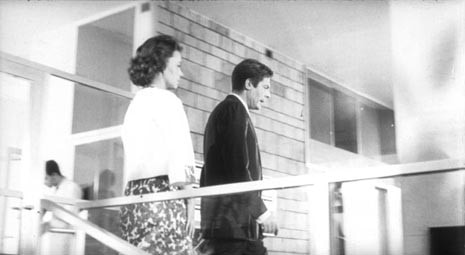
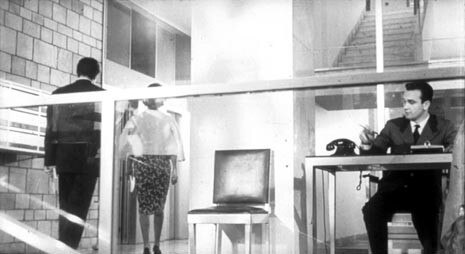
The clinic where the writer Giovanni Pontano (Marcello Mastroianni) and his wife Lidia (Jeanne Moreau) go to visit a dying friend, was filmed on location using the external areas and entrance hall of an piece of post war Milanese architecture, the "Condominio XXI Aprile", by Asnago/Vender.
The succession of spaces is described very precisely by the route taken by the two main characters: they arrive by car at the gate, they enter underneath the canopy, go up the stairs behind the window then turn right where the caretaker points them to the lifts.
The entire sequence takes place with very little sound with dialogue reduced to the bare essentials, emphasising the uneasiness of a couple in crisis.
The wards are set in the Pirelli Tower. On the windows of the tower block run the opening titles, announcing a strong presence of Milanese architecture in Antonioni’s film, seen also with the hotel and complex in corso Italia by Luigi Moretti, and a villa in Brianza by Luigi Vietti.
Le Mépris (Contempt)
France/Italy 1963, Jean-Luc Godard, colour, 84’
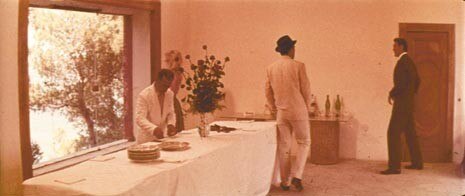
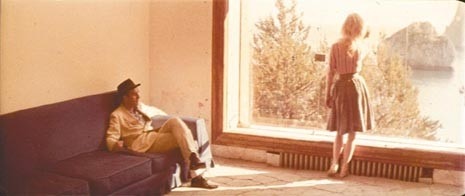
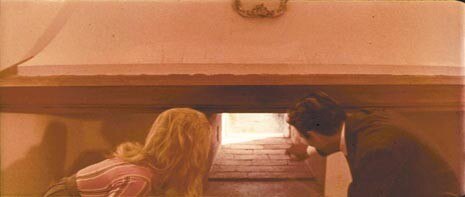
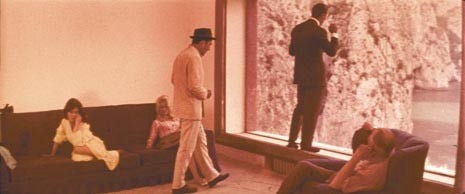
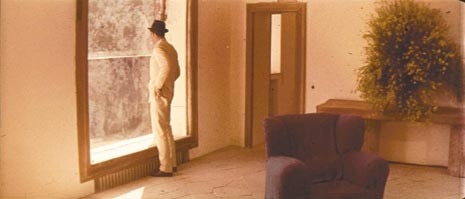
The final part of the film is set on the roof terrace and in the large living room of the Capri villa of a cinema producer (Jack Palance), the Villa Malaparte, by Adalberto Libera, who plays host to the shooting of a film about the Odyssy by the director Fritz Lang (who plays himself). Amongst the team are the screenwriter (Michel Piccoli) and his wife (Brigitte Bardot). The actors go round in a complete circle backwards and forwards along the sides of the rectangular space, stopping each time to look outside, magnetically attracted to the landscape which is framed by the large openings and the small fireplace window.
It seems that each time the actors are posing, turning their shoulders to the camera, that turns on itself at the centre of the room. In this way, the whole of the living room is never completely seen.
The horizontal nature of the filming, accentuated by cinemascope, skims the feet and head of the human figure, as do the windows that are slightly raised from the floor and detached from the ceiling.
Il conformista
Italy 1970, Bernardo Bertolucci, colour, 116’
Marcello Clerici (Jean Louis Tritignant) is a young member of the bourgeois who offers himself to the political fascist police to find and assassinate the professor Quadri (Enzo Tarascio) intellectual refugee at Paris and his old teacher.
The whole of the first half of the film is told through Clerici’s recollections whilst in the car travelling towards Paris.
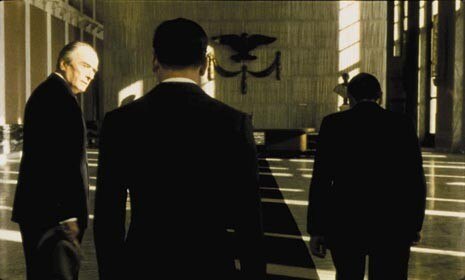
As a setting for the interviews with “the colonel” (Fosco Giachetti) and the introduction to the Head of Cabinet Office, Bertolucci chose the central space of a building whose construction was interrupted in the 1940s and was not completed until after the war, prolonging in time the characteristics of monumentality associated with the air of dictatorship, the "Palazzo dei Ricevimenti e dei Congressi", by Adalberto Libera.
The unreal space in which Clerici and his mother (Milly) go to visit the father who is afflicted with madness originating from syphilis, is non other than the stepped part of the outdoor theatre on the roof of the same building.
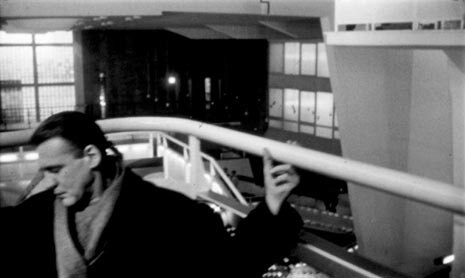
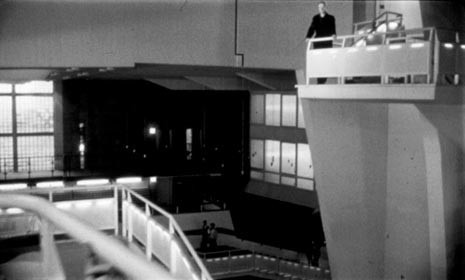
Wings of Desire (Der Himmel über Berlin)
Germany 1987, Wim Wenders, b/w and colour, 130’
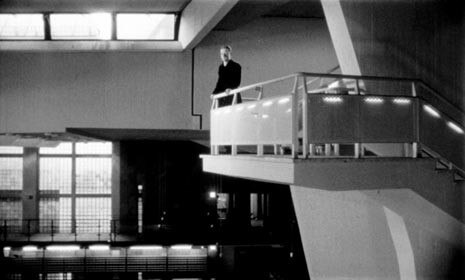
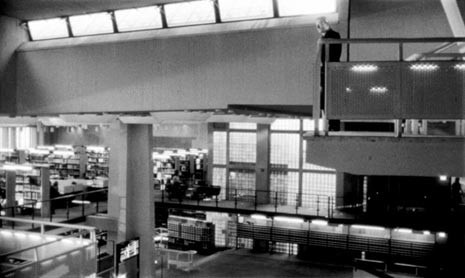
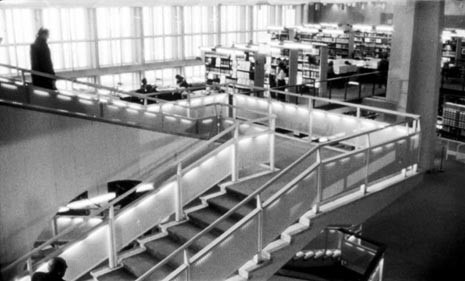
Daniel (Bruno Ganz) and Cassiel (Otto Sander) are angels who have free access to prison cells, hospital wards and library spaces, in the Staatsbibliotek by Hans Scharoun.
They do not see in colour (hence the black and white) but can tune in to the silent thoughts of men; they are not visible except by guardian angels who acknowledge them with a complicit greeting.
The soundtrack is a crescendo of whispering voices and classical choruses, which resembles a radio continually changing station.
The sequence in the first part of the film is the a fine homage to the spaces of Scharoun.
“… the way to translate that which could be the view of angels has been obtained turning often from a slightly elevated point of view, with planes that link together with great fluidity. We had use of a 35mm cine camera and the tricks of the cinema to create the lightness of the view of an angel.” W. W.