

Its name is gallium nitride, abbreviated to GaN, and despite being relatively unknown it is the element of the future. It is in fact a semiconductor that is attracting the attention of technology companies from all around the world. GaN seems to be an example of Columbus’s egg: it offers increased power density compared to its competitors, above all silicon, and is more efficient, heat resistant, carries more current more quickly and is more reliable. It is so reliable that even the aerospace industry is heralding it as its standard-bearer. GaN is now cropping up practically everywhere: in blue lasers for Blu-Ray players, in LEDs for lighting, in laser car headlights and military radars.
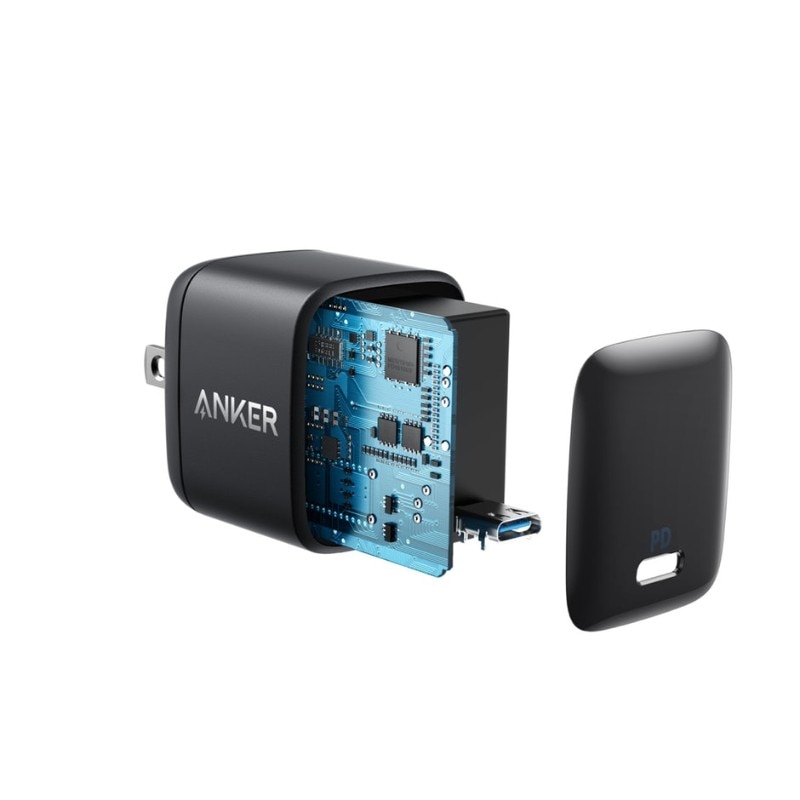
However, in order to really understand the potential of this material and the impact it is having on our daily lives, all you need to do is take a look at a battery charger, such as the Anker Atom PD1. It is tiny (4 x 4.5 x 3.8 cm, like the one for the iPad Pro), it fits in a pocket, more or less like a smartphone charger, but it has an output of 30 Watts and can charge a laptop, substituting the enormous chargers we are currently used to. All of this, of course, without overheating and by losing less current than silicon. Anker’s competitor, RavPower, has responded with 45W. It is slightly larger than its competitor but still smaller than a pack of cigarettes and is even capable of supplying continuous current to a 15-inch laptop at full power.
There is still much progress to be made. For the moment the two models only offer one USB-C port, but more powerful chargers are already in development which have more ports and are smaller and lighter. Anker, for example, has already announced the 60-Watt Atom PD 2 with two USB-C ports, and the Atom PD 4 which combines 100 Watts of power with 4 ports: two USB-C and two USB-A, in other words the standard port type. However, the nitride challenge has only just begun. At the moment, silicon continues to dominate the scene, seeing as it costs less and no reconversion of manufacturing plants is necessary in order to use it but, according to analysts, sooner or later we are going to have to get used to GaN. It is just a matter of time.