


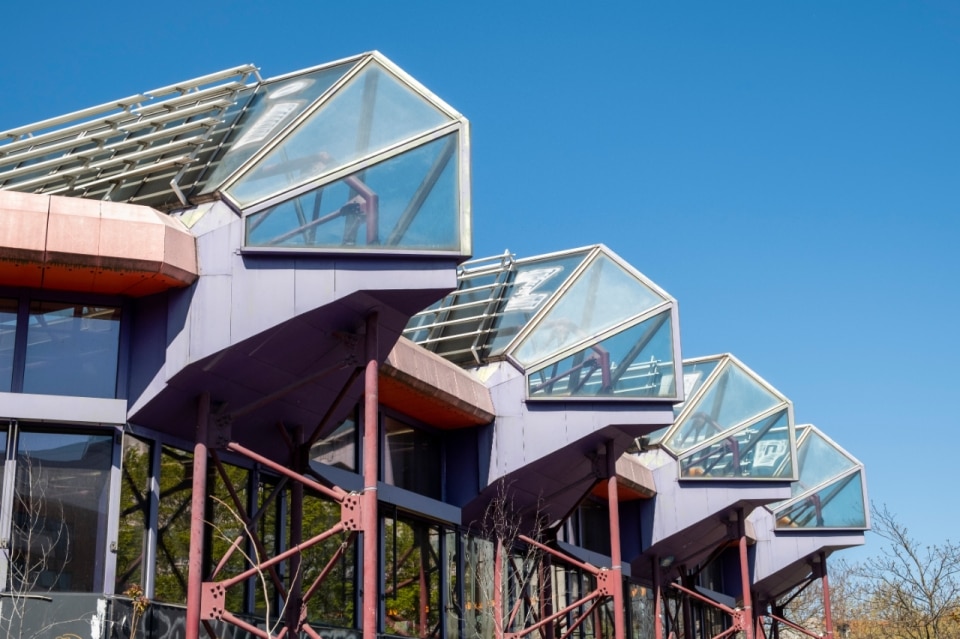
Landsberger Allee is one of those oversized boulevards found throughout what was once East Berlin. Enormous sidewalks, four lanes of asphalt, the rattling of trams: a straight line launched towards the promises of real socialism.
To walk Landsberger Allee is an exercise in urban archaeology. We start at Platz der Vereinten Nationen, once known as Leninplatz: before 1991 it was home to a colossal Lenin statue carved from Ukrainian red granite, today replaced by a monumental fountain marking the void of an inconvenient absence. We pass alongside Volkspark Friedrichshain with its artificial hill built from Second World War rubble, walk past the Friedhof der Märzgefallenen – the cemetery of the martyrs of the failed revolutions of 1848 and 1918 – and at the intersection with Petersburger Strasse we finally catch sight of the skeleton of a peculiar building, abandoned for years.
Among the ruins of the future
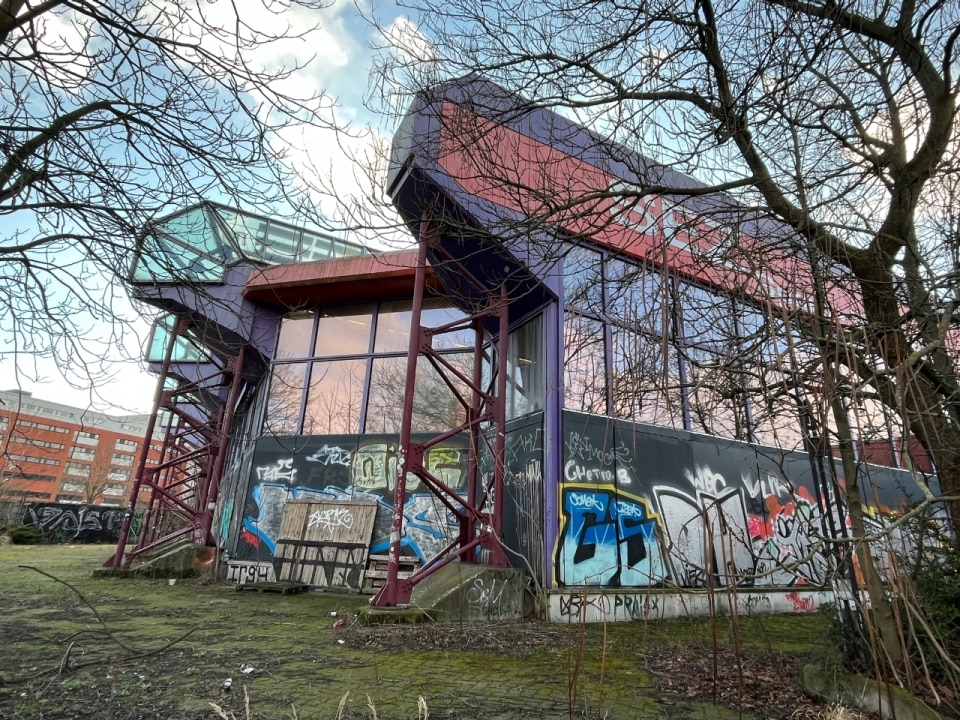
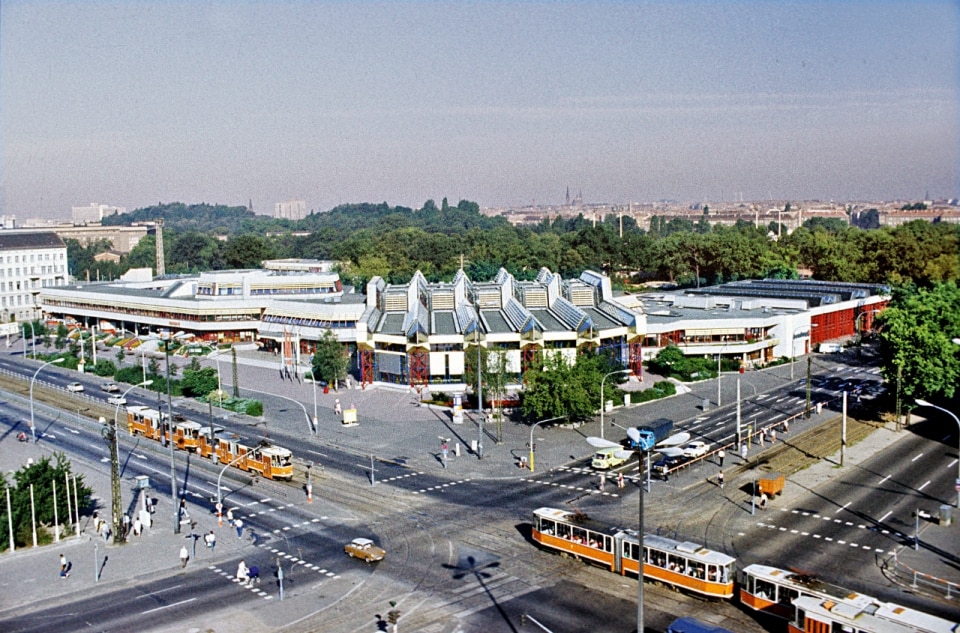
We are standing before the SEZ: the Sport und Erholungs-Zentrum. At its inauguration in 1981, the East German regime hailed it as the largest recreational and sports center in the world: 15,000 square meters of glass and steel, swimming pools, gyms, concert halls, a theater, bowling alleys, and much more. At its peak, it drew up to 22,000 visitors a day. Then, after reunification: closure. Officially due to maintenance costs, perhaps also the result of a silent damnatio memoriae of everything that smacked of the GDR.
Its retrofuturistic forms still hint at the naive optimism of a regime that, even in its final years, kept believing in its own future.
Today the SEZ looks like a cross between a wrecked spaceship and the husk of a water park, its face disfigured by years of waste and vandalism. Its retrofuturistic forms still hint at the naive optimism of a regime that, even in its final years, kept believing in its own future.
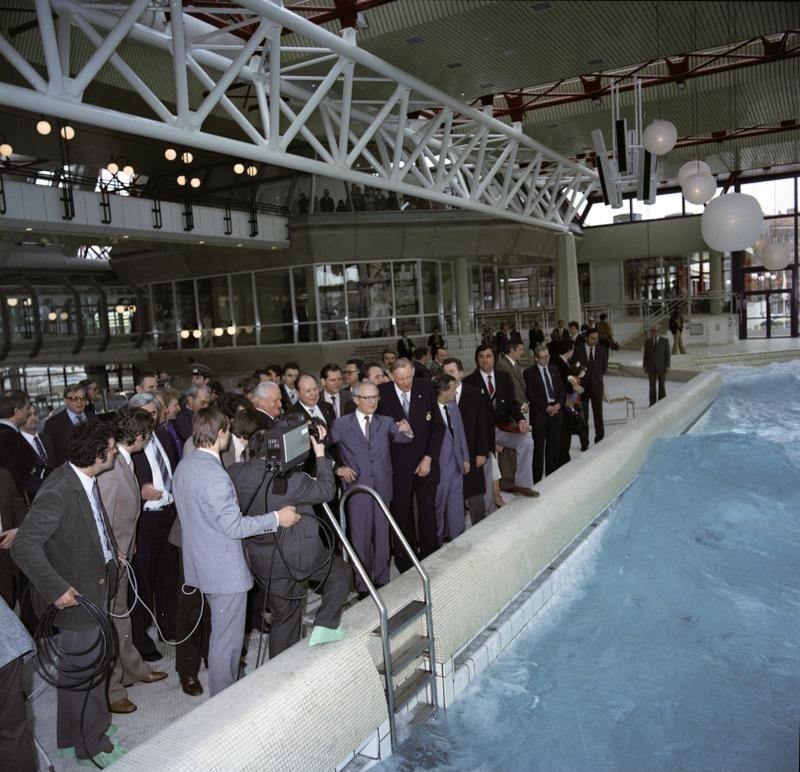
After serving as a venue for exhibitions, temporary events, and the occasional rave – this is Berlin, after all – the ruins of the SEZ have become the center of a heated dispute: on one side, the administration of the Friedrichshain-Kreuzberg district and a diverse group of activists; on the other, the city government (known here as the Senate), which acquired the property through a public housing company and has made clear its intention to demolish what remains, replacing it with apartments, a school, and green space.
@susanne.l6 Demo-Parade am 01.09.2024 mit “Medizin nach Noten” mit Karl-Heinz Wendorff, Aktionsbild Menschenkette, Kiosk of Solidarity, Protest-Rave und vielen informativen Beiträgen zum #SEZ. Das war megagut 😍 Danke an alle, die dabei waren 🥰 @SEZ Berlin 1981 ♬ Originalton - Susanne L.
A few years ago, the activists might have had an easy fight: until the mid-2010s Berlin was famous for its abundance of space, often repurposed through grassroots, DIY initiatives. Today the picture has changed drastically: between 2015 and 2025 rents more than doubled – a grim record among German cities – and the pressure to fill the few remaining urban voids has become increasingly unsustainable. The housing shortage is real, and Mayor Kai Wegner has pledged to ease it by building as much as possible. If necessary, by demolishing the remains of buildings like the SEZ.
Four wooden towers sgainst the bulldozers
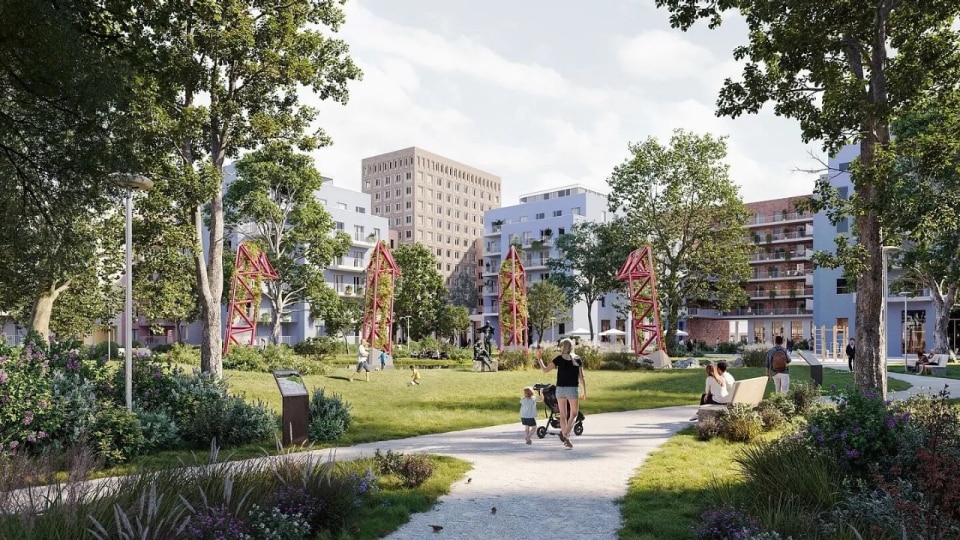
In early March 2026, just as the bulldozers were already gnawing away at the metal bones of the ruins on Landsberger Allee, a dramatic turn of events unfolded. Florian Schmidt, the urban planning commissioner for Friedrichshain-Kreuzberg, unexpectedly presented an alternative plan developed in collaboration with activists from the SEZ-QUARTIER neu Denken initiative: four wooden high-rises capable of housing up to 600 affordable apartments. What remains of the futuristic GDR buildings would be preserved and repurposed using an approach that minimizes costs and environmental impact, transforming them into a recreational and cultural center open to public participation.
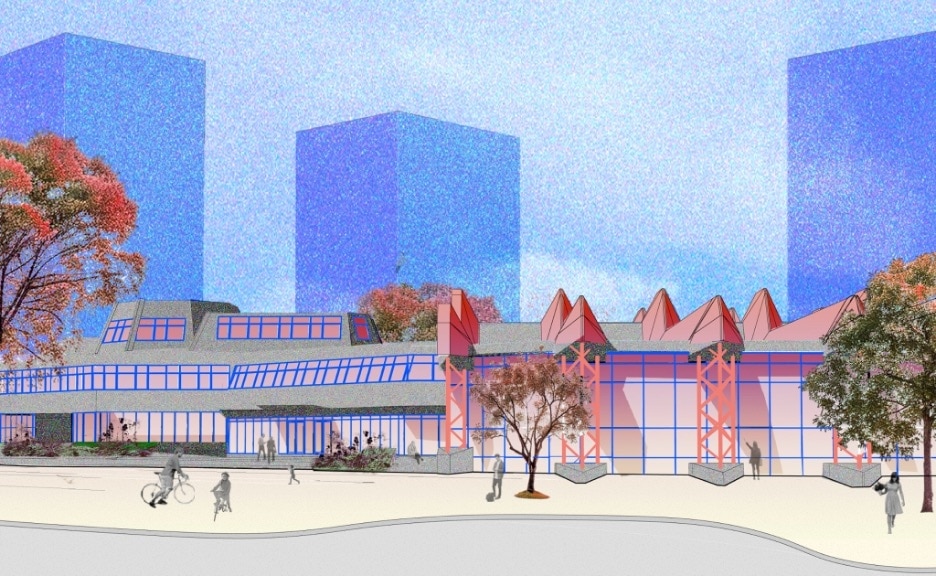
Around the SEZ, two visions of the city’s future thus converge: the institutional one, embodied by the CDU-SPD-led Senate and the interests of large real estate companies, and the alternative one, represented by the red-green neighborhood of Friedrichshain-Kreuzberg and the many associations that have been fighting for years for a participatory and sustainable development model. In theory, both sides want to lower rents and improve the quality of urban life. In practice, these are two mutually exclusive models, and the conflict they embody extends beyond Berlin.
Berlin is still a laboratory city
The story of the SEZ echoes a question that has long been at the heart of international architecture and urban planning: who determines the trajectory of urban transformation? Is it really necessary to start from scratch in order to “redevelop”? In an era of climate crisis and housing shortages, does demolishing buildings that could be repurposed still make sense – economically, energetically, or humanely?
Berlin offers a range of concrete answers in this regard. The Haus der Statistik, near Alexanderplatz – a colossal GDR office building, also slated for demolition before being saved by a grassroots initiative – is now at the center of a restoration project based on the concept of “urban commons.” This project, together with the Floating University in Tempelhof, earned the Berlin-based studio raumlabor a Golden Lion at the Venice Architecture Biennale. Pro-SEZ activists look to this precedent with hope that is far from unfounded.
Around the SEZ, two visions of the city’s future thus converge.
Then there is the ZK/U, the Zentrum für Kunst und Urbanistik in Moabit: a decommissioned railway building transformed into a cultural center, which between 2019 and 2025 was the subject of a project by Peter Grundmann Architekten, awarded by the DAM in Frankfurt for its participatory approach and sparing use of materials. And the so-called Dragonerareal, also in Friedrichshain-Kreuzberg, where an effective grassroots campaign prevented a predictable commercial redevelopment: the area is now the subject of a participatory process, with the initial works entrusted to the architects &mica and Kaden+ starting in 2026.
The WBM paradox and a future yet to be written
There is one detail worth noting: the owner of Dragonerareal is WBM, the same municipal company that owns the SEZ. The same institution that, in one case, advocates for participatory redevelopment, while in the other, pushes for demolition. This contradiction is not unique to Berlin: it reflects the dilemma faced by public administrations that must respond to pressure from the real estate market while also fulfilling the rising demands for participation coming from their communities.
If we add to this the fact that most of the abovementioned places share significant overlaps in people, ideas, and informal networks among the initiatives driving them, it becomes clear that what is being built in Berlin is more than just the sum of local battles. It is an alternative urban practice that is taking shape project by project, victory by victory, construction site by construction site. Whether it will manage to survive the bulldozers, literally and politically, remains to be seen.
Opening image: Tobias Seeliger from Adobe Stock