

Relational dynamics in contemporary metropolises cannot be separated from their spatial infrastructure: the city, in fact, organizes the conditions of contact between people, regulates their distance and determines the form of the encounter. Urban studies including those of Richard Sennett and Henri Lefebvre have shown how the physical configuration of spaces influences the quality of interaction, while the "generic city" of Rem Koolhaas is now the image with which we represent the contemporary spread of environments predisposed to neutrality and reversibility. In this scenario, Tokyo, the megalopolis par excellence, constitutes a case in point: compartmentalization, verticality, typological precision, produce highly interchangeable spaces within which affective modulation is inscribed.
And the Tokyo of Rental Family, a film by Japanese director Hikari - stage name Miyazaki Mitsuyo - currently in Italian theaters, can be read precisely from this perspective, inscribing itself in a constellation of films (and not only films) that, through different registers, have interrogated the city as relational infrastructure.
Rental Family (2025)
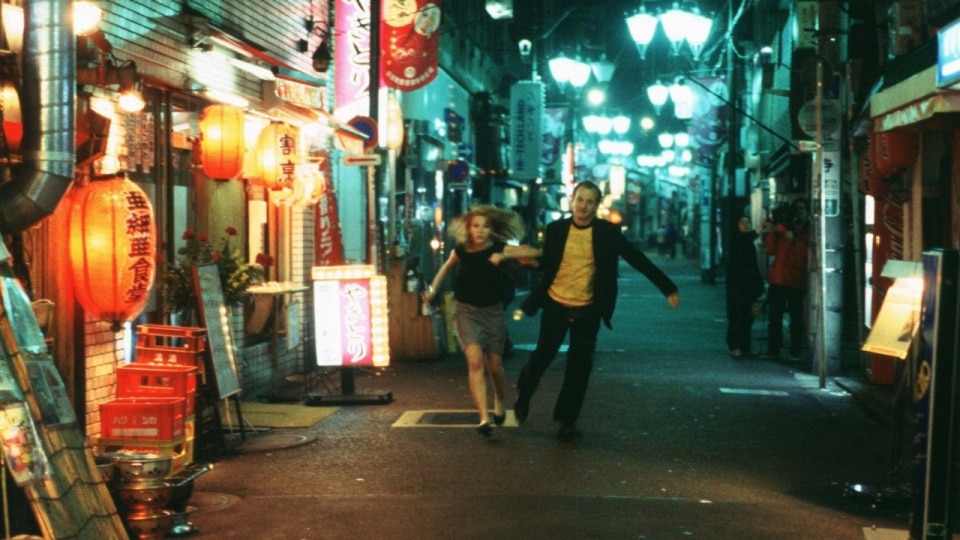
The film--starring a reborn and exquisite Brendan Fraser--takes the phenomenon of relationships for hire and situates it in a defined urban morphology. Simulated presences and temporary ties take root in environments through which the Japanese metropolis emerges as a machine for managing a system of affect where intimacy takes designed form. In his first work experience, Phillip is sent to a funeral to move among those present as if he were part of the mourning.
This moment is important spatially because it takes place in a codified ritual environment in which presence and absence are measured through postures and looks. This space, which is strictly regulated by cultural protocols, provides the first context in which the character perceives how simulation is possible precisely because of the environment that welcomes him or her. By way of counterpoint, at various points in the film, we see Phillip alone in his small apartment, overlooking a landscape of closely spaced buildings: in these sequences, urban architecture enters the visual field as a grid of windows, walls, and repeated geometries that reflect isolation and density. The room in which she lives, the stairs of surrounding buildings, and the view of other housing units visually restore Tokyo as a set of overlapping envelopes in which the individual is part of a regulated web of proximity without full contact.
Family Romance, LLC (2019)
If Rental Family observes the delegation of intimacy from within a controlled fiction, Family Romance, LCC, by Werner Herzog radicalizes the issue by shifting it to an almost documentary-like terrain. Herzog films a real agency that provides relatives for hire by following its founder as he plays the role of father to a child who has never known the biological one. The focus is on the repetition of encounters and the quality of the spaces that accommodate them. The sequence in the automated hotel with robotic receptionists makes explicit the logic that runs through the entire film: affective simulation is grafted into an environment already programmed for absence. Herzog also insists on urban displacements - parks, streets, pedestrian crossings - filmed with shots that emphasize the discipline of flows within which the body fits according to defined trajectories.
In Family Romance, LLC, Tokyo appears as an infrastructure capable of sustaining fiction without forcing it. The simulated presence does not conflict with the urban order, but is integrated into a city built on environments ready to accommodate temporary ties. Herzog records this condition with a dry gaze, letting the city tell the contemporary form of delegated affect.
Relational dynamics in contemporary metropolises cannot be separated from their spatial infrastructure: it is the city that organizes the conditions of contact, regulates its distance and determines the form of the encounter.
Lost in Translation (2003)
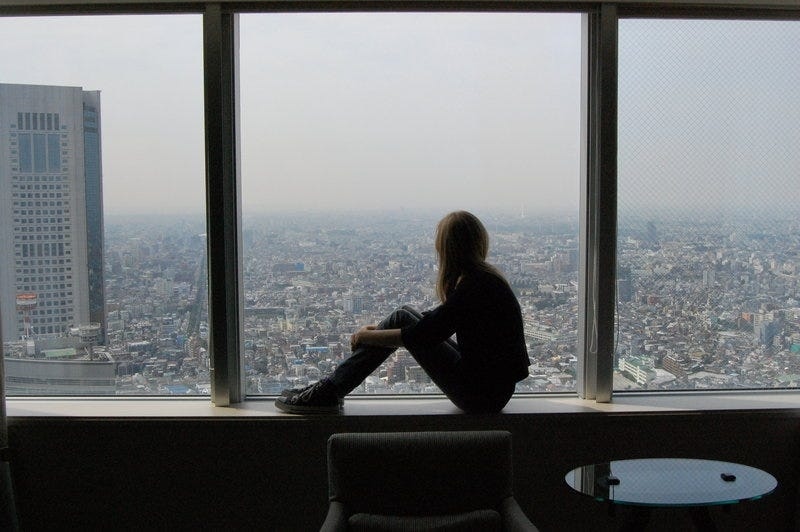
Talking about hotels and Tokyo, our mind cannot help but go to the film that consecrated Sofia Coppola, Lost in Translation. Here the hotel appears as a vertical capsule that filters the urban experience. Hotel architecture actively regulates the perception of the city and conditions the quality of the bond between the characters. Much of the film takes place inside the Park Hyatt in Shinjuku, a volume suspended above the metropolitan density. The sequence in the rooftop bar is exemplary: Bob and Charlotte sit in front of a continuous glass window that transforms Tokyo into a bright, distant surface.
The city is visible, but the glass attenuates its sound and movement, allowing the encounter to develop protected from urban friction. When the film leaves the hotel capsule and descends to street level, the city not only produces perceptual friction: the excess of stimuli interrupts the continuity of the hotel experience, and Bob and Charlotte stop being isolated individuals and transform into a small unit. Karaoke and bars function as micro-interiors of proximity: compressed, saturated spaces where sharing takes place in being together within the same threshold.
Shoplifters (2018)
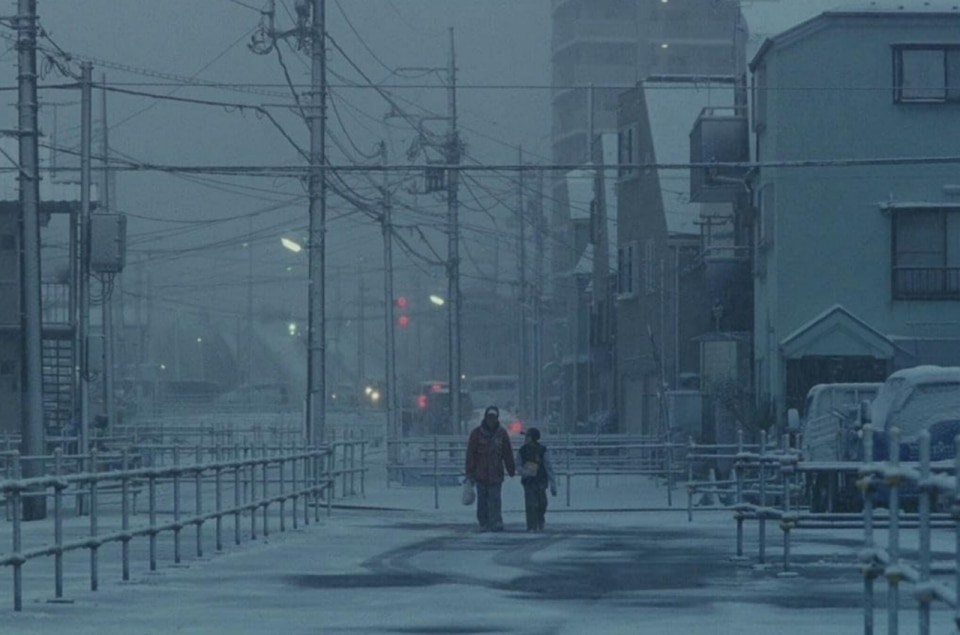
With Koreeda Hirokazu Hirokazu's Shoplifters we enter the interior of a compressed domestic cell. Koreeda's Tokyo is not observed from above but inhabited in its most minute form. The traditional house in which the family lives-a precarious nucleus composed of individuals bound more by necessity than biological kinship-is a layered environment, filled with adapted objects and furnishings, living in the form of sharing: the camera remains at a low level, accentuating the sense of density. The internal distribution does not separate the functions of the rooms; rather, the living room is also a dormitory, the closets become beds, the kitchen is a common area, and so on, in a continuous renegotiation of space.
Konbini and supermarkets are filmed according to logics of consumption and control, which contrast with the domestic improvisation of living space. These places, designed for anonymous circulation and the repetition of the act of purchasing, become for the protagonists a daily resource, a functional extension of the home that reveals the economic precariousness on which their coexistence rests. Affection, far from being delegated or suspended, is rooted in the concrete materiality of an architecture that cannot guarantee neutrality, and which, on the contrary, imposes adaptation. The home thus becomes a protected microcosm that organizes itself against the rigidity of the hectic urban context.
In the domestic sequences, the city enters the frame as a grid of repeated windows and geometries, visually restoring a condition of contactless proximity.
Tokyo Sonata (2008) and Pulse (2001)
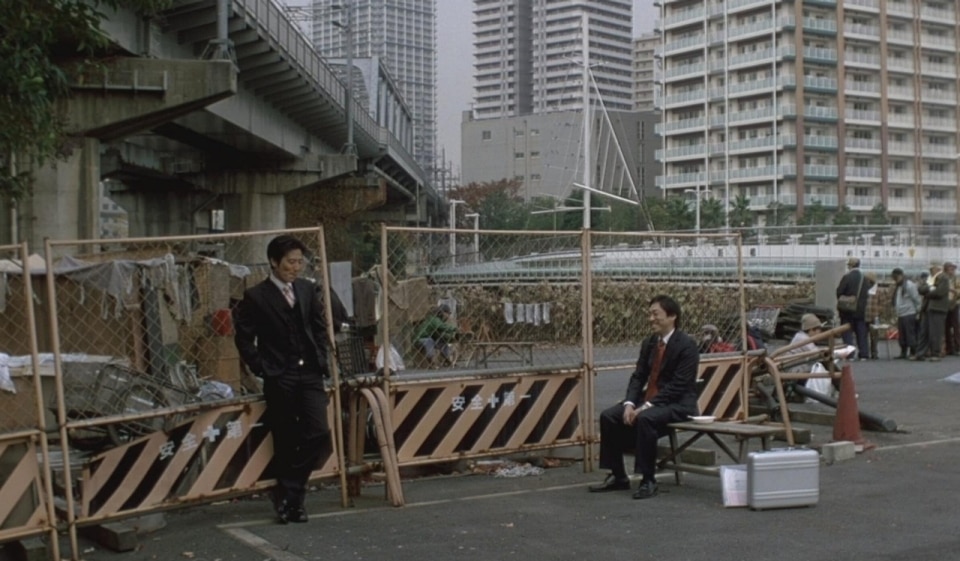
In Tokyo Sonata, by Kurosawa Kiyoshi, the trajectory of the unemployed father traverses ordinary urban spaces: the entrance to the apartment that he crosses every morning in a suit and tie to maintain a fiction of normality; the waiting rooms and employment offices, sober and administrative environments in which the loss of role becomes a collective but silent experience. The city appears dense, efficient, organized, punctuated by protocols, making visible the gap between individual and system: architecture remains stable while identity falters. Domestic thresholds, street intersections, and common rooms maintain a distributive clarity that contrasts with the increasing opacity of family relationships.
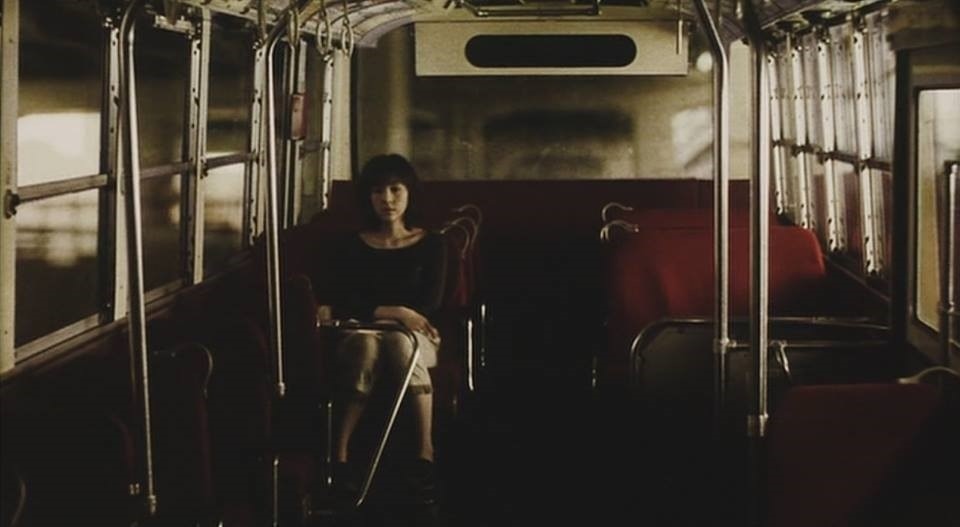
In another Kurosawa film from a few years earlier and considered a cornerstone of J-Horror, Pulse, the walls of homes and offices occupy the frame with an almost physical presence. Ghosts appear against the walls, distant from the center of the image, as if space has taken over the body. Here the architecture dissolves the relationship, not only with others but also with respect to the subject. The Tokyo of Pulse, increasingly deserted as the story progresses, loses the usual density of the hyperefficient metropolis by registering the rarefaction of affect in a sequence of environments that retain only the traces of evaporated presences.
What about the future?
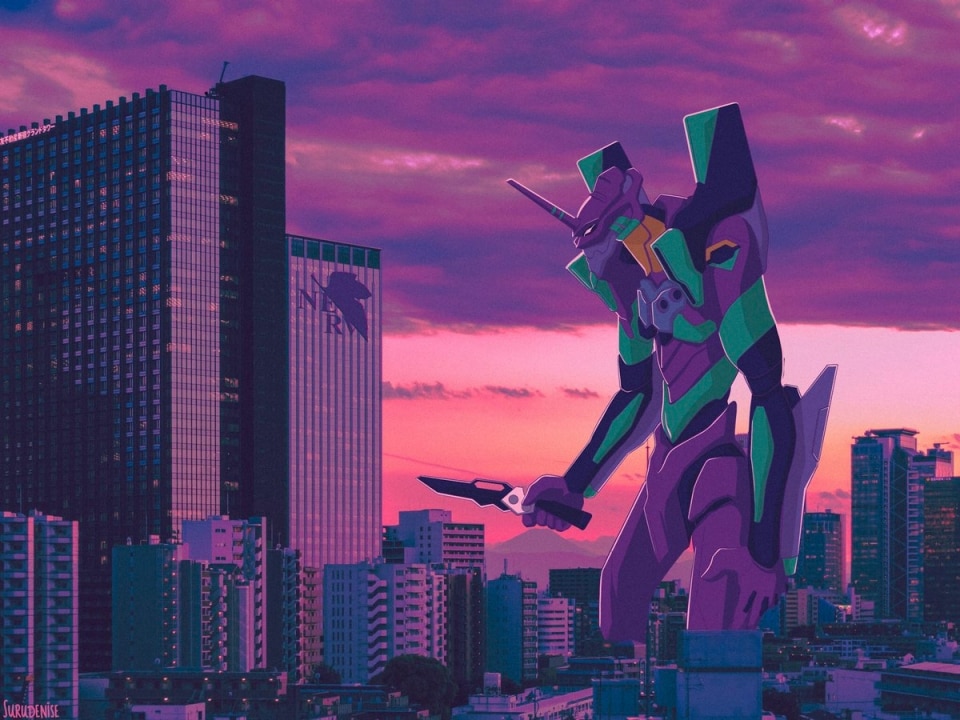
How to read the regulation of affect in the megacity of the future? If we move from live action to the world of anime-and speaking of Japan it seems beyond plausible to us-the most emblematic example can only be that of Neo Tokyo-3, the Tokyo of Evangelion (of which a new series has recently been announced).
The animated imagery of Neon Genesis Evangelion takes us to the extremes of our reflection: Neo Tokyo-3 is a city designed for menace, built on a system of moving platforms, vertical elevators, surfaces that close in, buildings that retract by plunging underground at the first alarm. Urbanism is conceived as a defensive device, arranged for the rapid emptying of environments. In this arrangement, loneliness appears as a structural condition: the protagonists' apartments emerge as solitary cells in uninhabited buildings. Even the headquarters of Nerv, the paramilitary organization that defends the city from Angel attacks, with its monumental corridors and oversized operations rooms, stages a vertical distance between individuals and the system.
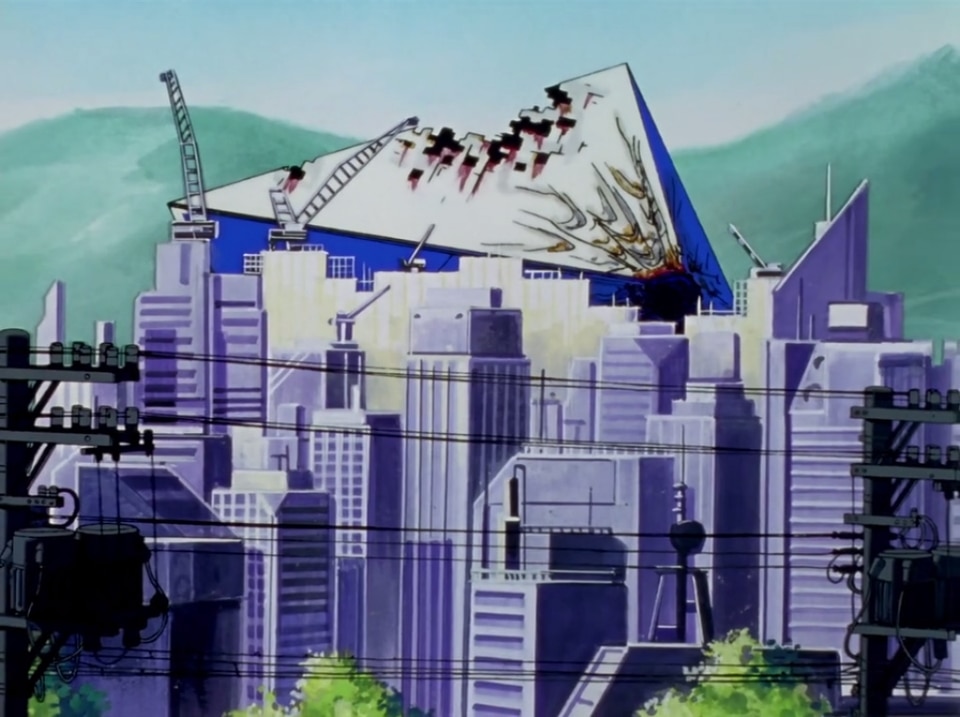
The megalopolis of the future therefore radicalizes a trend already visible in the present: the relationship is inscribed in an environment designed for other purposes. Architecture registers the vulnerability of bodies by framing it in a larger machine. If contemporary Tokyo appears as a system of environments that regulate distance and proximity, Neo Tokyo-3 constitutes its extreme projection: a city that functions, protects itself, and encloses itself, while the individual remains exposed to his or her own interiority. In this perspective, the architecture of relationships certainly finds its most accomplished and restless form.