

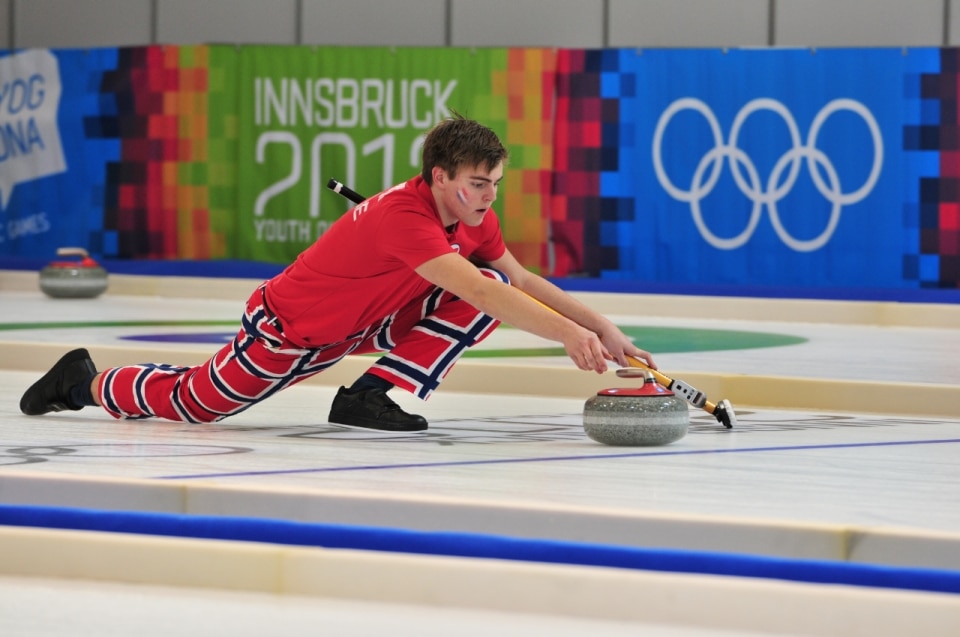
Perhaps you’ve noticed that — more than the Essential Olympic torch designed by Carlo Ratti, more than the medals that reportedly keep breaking — the design drawing the most enthusiasm during the Milan-Cortina Olympics is the curling stone, that peculiar object unlike anything else, used in the sport born on the frozen lakes of Scotland.
Its shape is intriguing, but its history is even more so. All stones used in Olympic competitions must meet non-negotiable specifications: the weight must not exceed 19.96 kg and must not be less than 17.24 kg, with a height of no less than 114 mm. Above all, every single one must come from a small, little-known Scottish island called Ailsa Craig. Hands up if you’ve ever been there.
The island’s single square kilometer is essentially one vast granite quarry. Its stone is extremely fine-grained and compact — therefore solid and capable of guaranteeing strong thermal resistance. Kays Scotland, the small company founded in 1851, has been producing curling stones since 1924.
Two types of granite are used: Common Green and Blue Hone, layered within the stone so that a slice of the former is sandwiched between two of the latter. The green granite is more impact-resistant; the blue has a finer grain, retains very little moisture, and therefore performs better in direct contact with the ice.
Sealing this stone “sandwich,” a handle ensures maximum ergonomic performance. Its soft shape makes the curling stone a surprisingly gentle object within the semantic universe of competitive sports equipment — almost toy-like. A toy that has, in fact, inspired design.
A clear reference appears in Bulbul, the kettle designed by Achille Castiglioni for Alessi. The designer, known for translating tools and machinery into everyday domestic objects, recognized in the curling stone an archetypal quality: that compact, almost primitive mass topped by a handle that invites action.
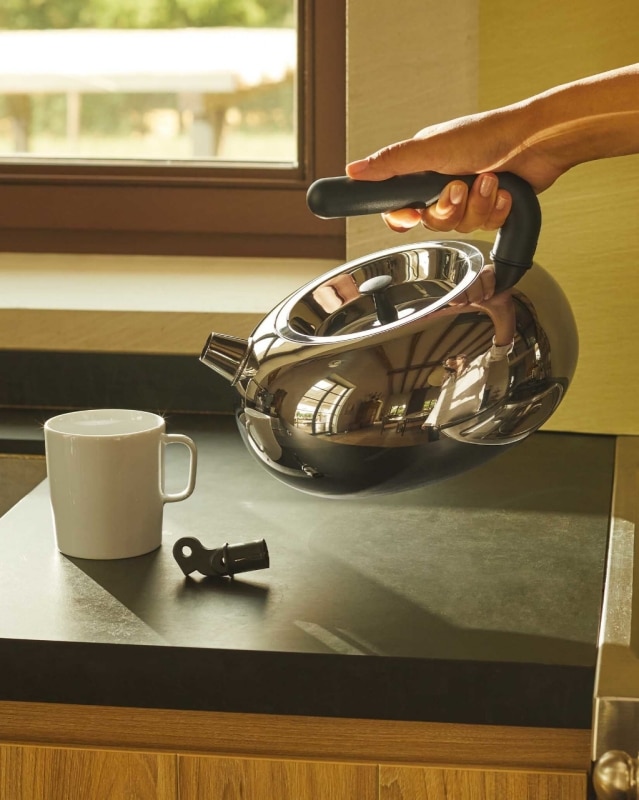
Castiglioni reprises the characteristic inward-oriented handle — a grip that is not only functional but almost “strategic,” as in the launch on ice — and transforms the bulbous granite body into a polished steel water container. The shift is subtle yet radical: from a sporting object designed to slide and strike to a domestic utensil meant to boil and pour. The logic of the tool remains, but domesticated; the gravitational force of the stone is lightened into a reflective surface that dialogues with the contemporary kitchen.

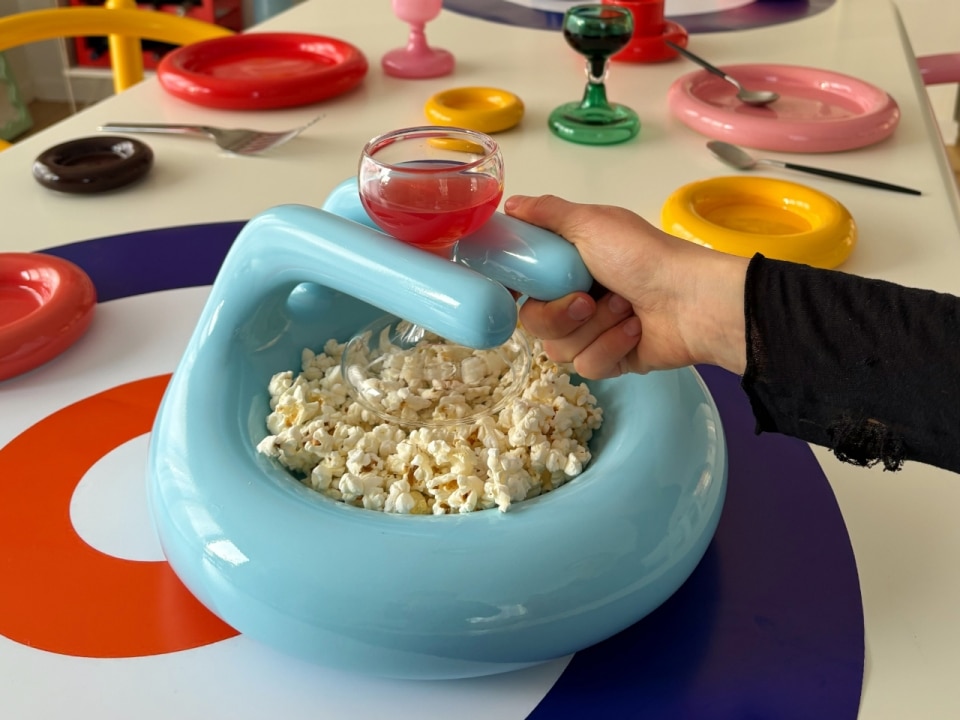
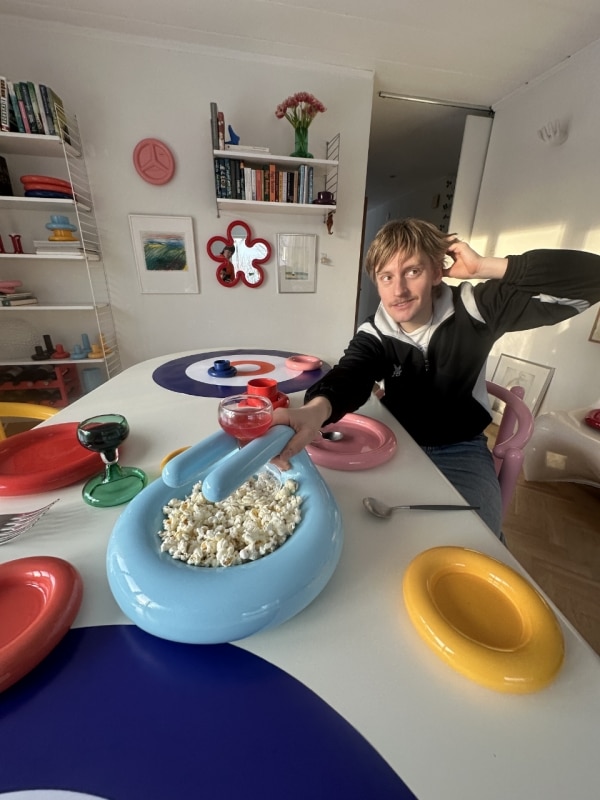
More recent — and even more pop — is the Curling Bowl by Gustaf Westman. The Swedish designer, who reinvents tableware by turning it into deliberately naïve forms and coloring it with a fresh, vibrant palette, captures the iconography of the stone and pushes it into post-Instagram territory. Presented on his social profile, the bowl preserves the rounded silhouette and the idea of an oversized handle, but reinterprets it as a playful gesture.
This time the handle splits into two and becomes a glass holder: no longer a lever to impart direction and trajectory, but a convivial device designed to stabilize a drink. The competition stone thus transforms into an ironic centerpiece — an object that references a precision sport to celebrate, with lightness, the domestic ritual of the aperitivo.
Opening image: Photo Gustaf Westman team. x Beata