


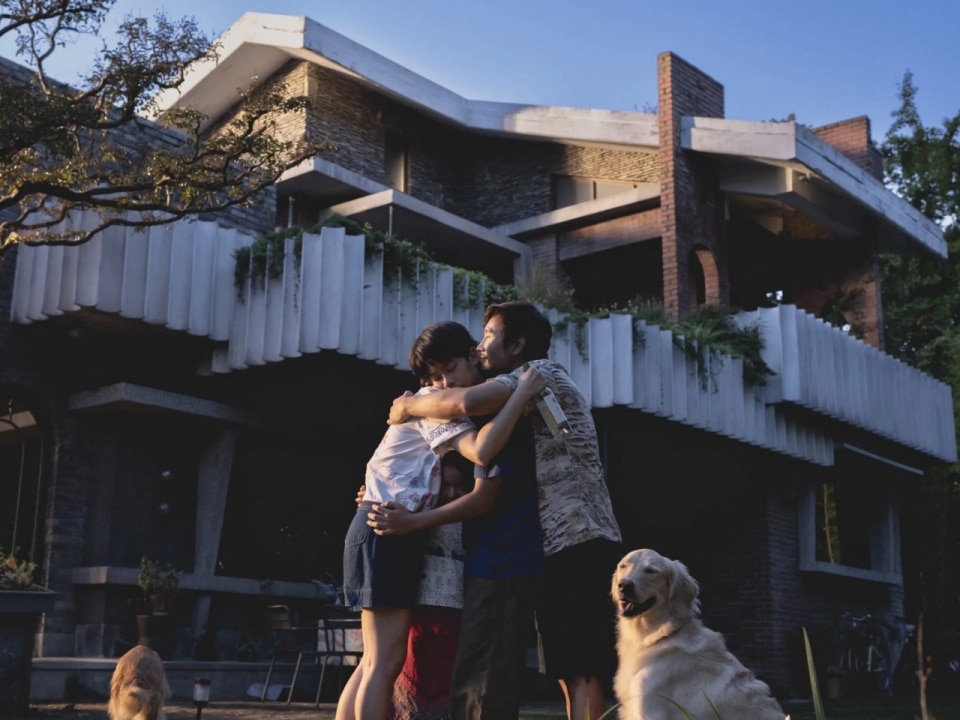
The use of violence as a tool to address political and social issues is certainly nothing new in the cinema of South Korean director Park Chan-wook, and No Other Choice, released in Italian cinemas last week, is no exception. Based on Donald E. Westlake’s novel The Ax, previously adapted in 2005 by Costa-Gavras, the film tells the story of an executive at a paper production company who, after being laid off in a saturated and fiercely competitive job market, decides to physically eliminate the strongest candidates in order to regain employment and maintain his standard of living.
The film has largely been interpreted as a parable about precarity and social pressure in contemporary Korea. Yet architecture also functions as a narrative device, as well as the ideological motor driving the action, shifting the discourse toward a broader reflection on space as a form of control and destiny.

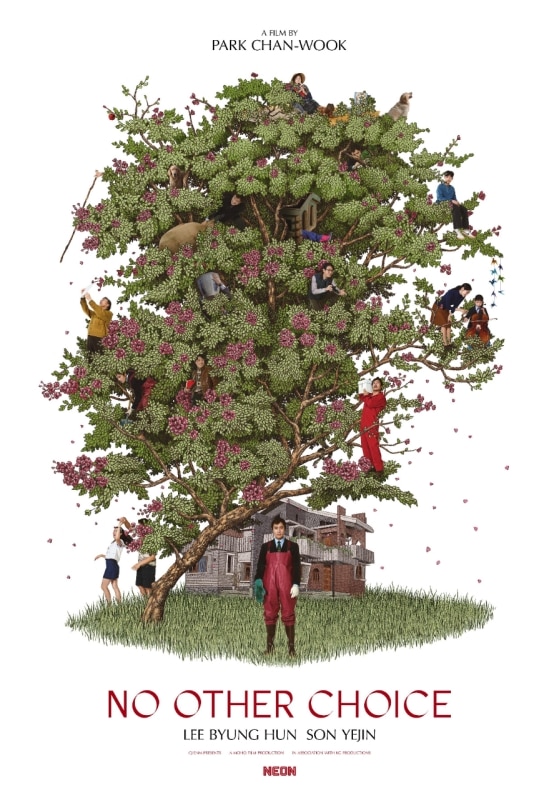
The rural cottage where the protagonist spent his childhood—repurchased and rebuilt by him alone according to his own taste, needs and ambitions—is the true object of the film: more than a site of memory, it is a promise of self-determination. It is to protect and reclaim that space that the man ends up killing. In wide shots of the Korean city, the single-family house appears as a foreign body amid identical urban apartments compressed into enormous residential eco-monsters. The contrast between sterile workplace interiors and warm, welcoming domestic spaces overturns the usual reading: it is not the home that oppresses, but work that denies the possibility of truly inhabiting.
Architecture is thus transformed into the place where freedom, ownership and obsession coincide, making domestic space no longer a promise of emancipation, but a moral justification for murder.
In the background, No Other Choice seems to dialogue with a long Western theoretical tradition (not by chance the film was initially conceived primarily for the US market).
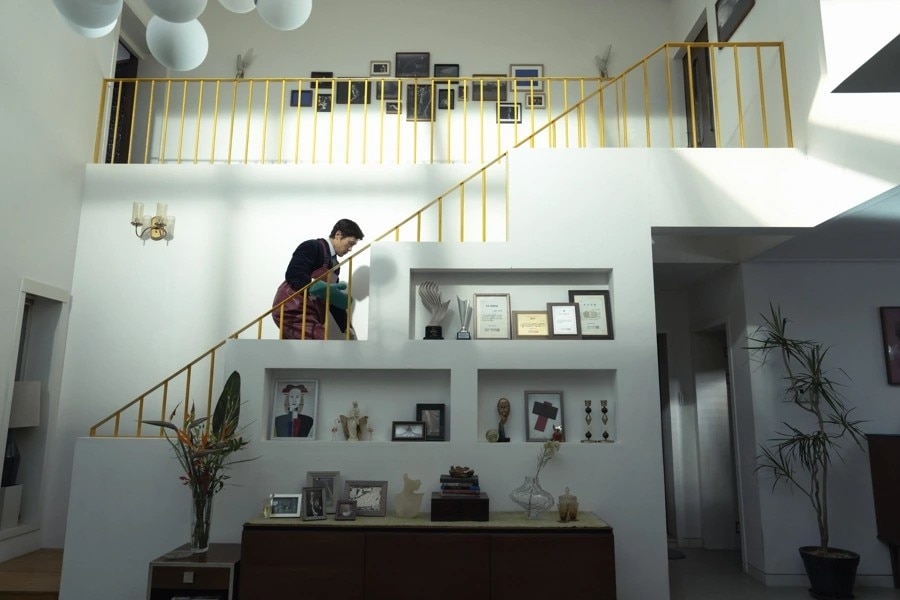
Locke’s idea of property as an extension of the self—grounded in labour and in the ability to shape the material world—runs through the film without ever being made explicit: owning space means reaffirming one’s dignity and social identity. At the same time, the radical individualism evoked by the American philosopher Robert Nozick takes on an extreme form here, where everything becomes morally justifiable in order to regain what is perceived as “rightfully mine.” Reinforcing this idea is the fact that, in this locus amoenus, even the corpses murdered by the protagonist’s own hands are buried.
The cottage thus proves to be both a status symbol and an asset that generates further pressure—a continuous performance of individual survival—not far from the “generic city” described by Dutch architect Rem Koolhaas, where singular space resists as the last bulwark against the serialisation of dwelling. In this way, the home of Man-soo, played by Lee Byung-hun, becomes the performance of his survival—of the survival of his professional role and therefore of his individual place in society—at the expense of anyone who might stand in the way.
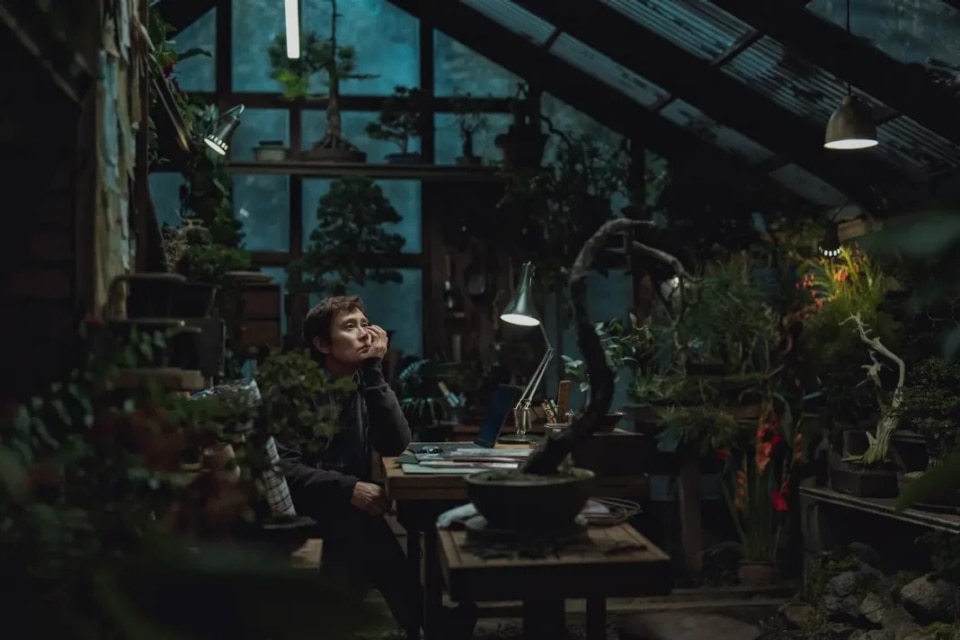
The direction insists on overlays that interrupt and multiply points of view, and on precise, ordinary architectural elements, transforming them into a visual grammar of constraint.
The diamond-shaped slit in the roof is not merely a set design gimmick, but a perceptual filter. The rhombus distorts vision, introducing the idea of oblique surveillance and of a reality that is always mediated.
In shots that pierce through it—allowing the viewer to peek into the space below—the theme of surveillance is not so much collective as intimate, almost paranoid and internalised: a gaze from above that seems to anticipate guilt and suggest that the protagonist is always one step away from being discovered in his phantasmagorical plan. It is not the system that controls the subject; rather, it is the subject who lives under a constant gaze.
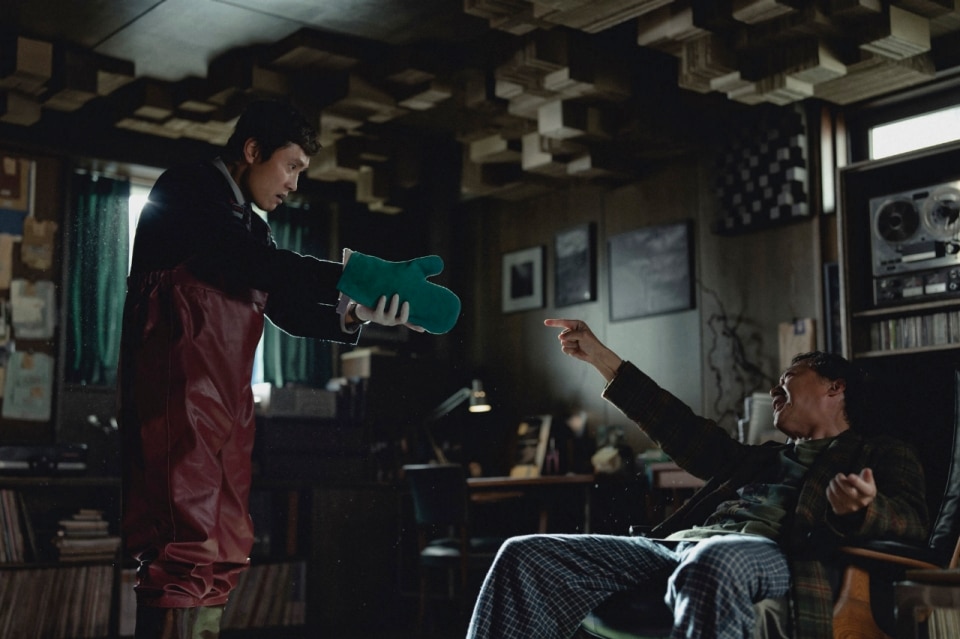
At the same time, stairs and level changes are never neutral, but suggest movement without real progress. Going up and down does not amount to emancipation, but to remaining trapped within the same system—and to confirming that this aspirational freedom is nothing more than a fictitious one. After all, it is the male characters themselves who repeatedly define themselves throughout the story as slaves to work.
Comparison with Parasite is inevitable: if in Bong Joon-ho’s film architecture unmasks collective violence and the rigidity of class struggle, here it becomes the pretext for a violence claimed as an act of individual freedom.
Parasite uses architecture—particularly the contrast between the Kims’ semi-basement and the Parks’ minimalist villa—to expose social inequality, where every space (from stairs to light) symbolises hierarchy, secrets and the distance between those “above” and those “below.” The 2019 film, through sets specifically designed for the production, demonstrates how environments reflect psychology and social condition, turning architecture into a true character that reveals masks and social fictions, culminating in the discovery of an underground bunker that amplifies the class drama.
Likewise, in No Other Choice spaces do not serve as a backdrop but structure the story, defining hierarchies, constraints and obligatory routes.
Architecture thus becomes the place where freedom, property and obsession coincide, turning domestic space no longer into a promise of emancipation, but into a moral justification for murder.
All images: Man-soo's home in No Other Choice, 2025. Courtesy Lucky Red