The exhibition will not try to compare two styles or two formal types, but to understand what work relationship links this American artist – one of the most important abstract painters in the world, since the end of the 1940s when he lived in Paris – and the French painter, once director of Villa Medici, whose work inspired academicism as well as the most innovative of modern art.
The exhibition will present recent works by Ellsworth Kelly, which have never been shown before as well as a selection of his plants and figures drawings, together with a selection of Ingres’ drawings and pictures. Ingres’ works have been specifically selected by Kelly in the collections of the Musée Ingres of Montauban, the Musée du Louvres and the Besançon Musée des Beaux-Arts.
As an institution deeply anchored in the past by virtue of its own history and the major artists it has always welcomed while opening its programs to the future, the French Academy in Rome – Villa Medici, is the perfect place for such an exhibition, the first in as series of summer exhibitions.
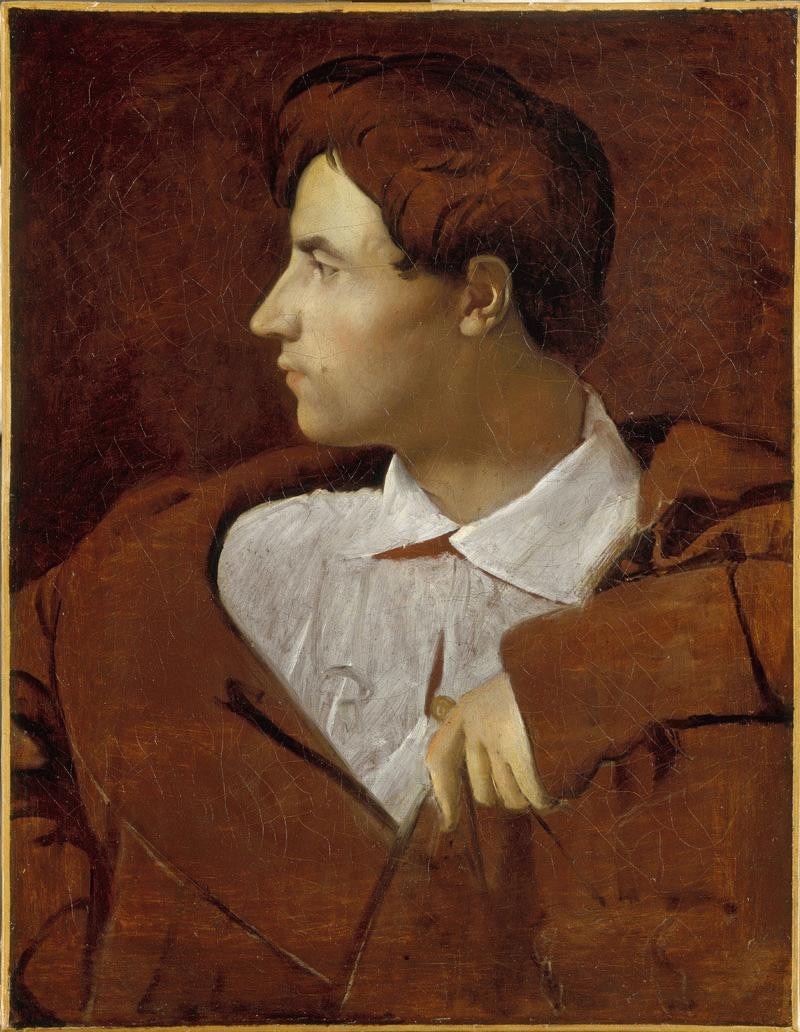
The exhibition’s layout was conceived jointly by Kelly and Éric de Chassey, director of the French Academy in Rome, who had already exhibited the artist’s works in several exhibitions such as “Henri Matisse – Ellsworth Kelly. Plants drawings” (which he curated with Rémi Labrusse, in 2002 for the Centre Pompidou and the Saint Louis Art Museum). It is less organized as a direct confrontation than as an organization supporting the enrichment of the visitors’ vision. The first room will show three Ingres’ portraits, one of which will be the Portrait de Desdéban (ca 1810, Musée of Besançon), painted in the Villa Medici, confronted with a 2009 painting by Kelly, Blue curves. The three following rooms will show the most recent series of the American artist: six monumental reliefs whereof the quasi-identical composition varies along with the colors (Curves series).
The rest of the itinerary will be structured along the two artists’ drawings, in divided groupings. Thus, the visitors’ eye and spirit will successively be confronted to one artist and then to the other, in such a way that the memory of one inhabits the look upon the other and vice-versa. The exhibition will go across three aspects inherent in Ingres’ work, which are also possible to recognize in Kelly’s.
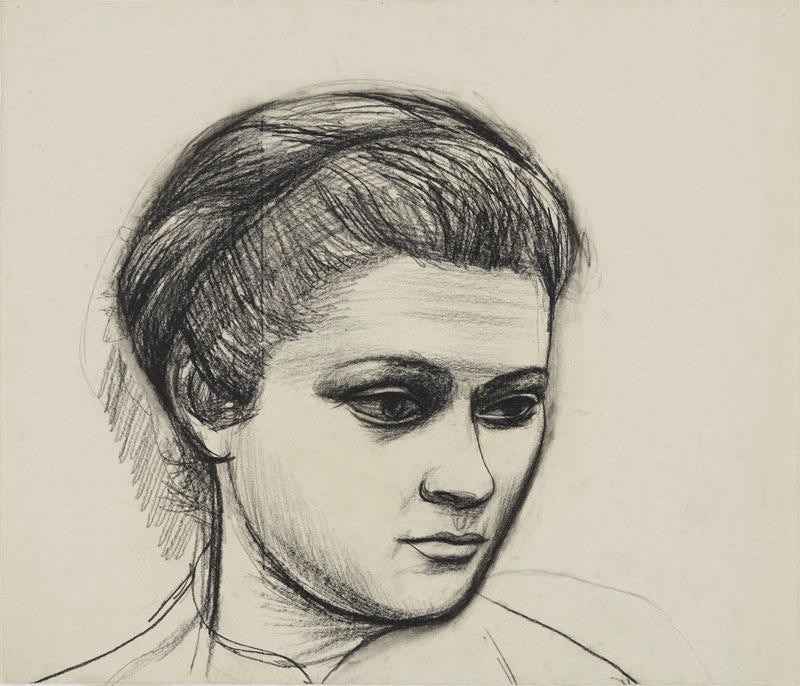
? Connection of outline and form: Ingres, like a sculptor, took first of all great care of the form of the characters he depicted (“we are not materially proceeding like the sculptors, but we have to make sculptural painting”). Kelly emphasizes the form and the outline up to his 2009 Curves series. It is also possible to find this emphasis in his plants drawings and in a series of portraits, striking in their linear character, which will be exhibited for the first time.
? Serialism and the search for the “good form”: Ingres’ drawings often create a good occasion to observe the way in which the final composition is arranged through moves and attempts, especially for limbs. As in Kelly’s work, the reason for this serial process is neither guided by iconography nor by an expressionist will, but by the search for a work that is formally right, in a complex autonomy towards the material world.
? Duality between fragmentation and unity: In both artists’ work, the ability of visual efficiency is striking the works are reaching vision and spirit in a single blow. Nevertheless, it coexists with a construction by addition of different elements which keep their individual readability.
Images, from top to bottom: Ellsworth Kelly, Marie, 1948, Private collection, © the artist); Ellsworth Kelly, 2009 (Spencertown © Jack Shear); J-A-D Ingres, Portrait de Jean-Baptiste Desdéban, vers 1810 (Musée des Beaux-Arts et d’archéologie, Besançon; © Charles Choffet); Ellsworth Kelly, Blue Curves, 2009 (Private collection; © the artist); Ellsworth Kelly, Green Curve in Relief, 2009 (private collection, courtesy Matthew Marks Gallery, New York; © the artist); Ellsworth Kelly, Yellow Curve in Relief, 2009 (private collection, courtesy Matthew Marks Gallery, New York; © the artist); Ellsworth Kelly, Alain Naude, 1951 (private collection; © the artist); Ellsworth Kelly, Mike Tulychevsky, 1948 (private collection; © the artist).