


But, wait a moment. “Problem-solving is the driving force”. Actually, this sounds quite similar to the old “form follows function”. So, what’s the difference?
According to Patrick Schumacher of Zaha Hadid Architects, author of the above quotation the difference is in the direction of the design intervention. So far we’ve juxtaposed Eucledian structures in order to create space or harness portions of it into environments. The rationale of the design is in the concept that links these solids. The reader may be familiar with the house Ludwig Wittgenstein designed in Vienna in 1927 for his sister, today seat of the Bulgarian cultural institute. There is maybe this concept expressed at its best, mind you, by a non professional architect. Volumes in Wittgenstein House develop from each other in an orderly albeit ambitious manner, as in a logical deduction. It’s like shedding light in the dark and acknowledge space.
A variation to this deductive way to building was dubbed “deconstructionism,” and consisted in disassembling these configuration of solids before they were even erected, to show their relations in a more honest way.
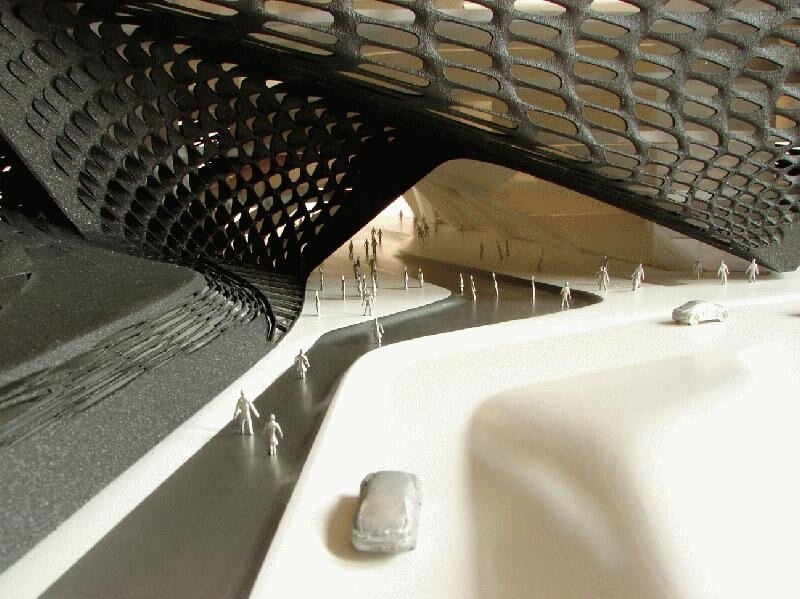
Parametric design, on the contrary, is nothing about deduction. It is an attempt to let structures grow systematically, according to their relation with the environment, as a living organism would do in order to survive. Everything is interconnected, and to take into account everything, sophisticated softwares are necessary and do much of the work. Instead of “spaces,” Schumacher actually speaks of “fields,” which fluidly articulate themselves to accomodate the complexity of contemporary life.
Parametric design therefore bears a striking resemblance to organic forms. Curiously, it’s visually very close also to surrealist decoration patterns. Both styles share an oblique, decadent appeal. This is because organic structures are economical: organisms – as also computers if they are so programmed – always try to find the shortest way between A and B. This is why living forms are usually curvilinear and not square, Cartesian or Euclidean. A parametric city would resemble a circulatory system, rather than a modernist grid. Every element would be interconnected and the complexity of functions would lead the growth of the system.
Transition and fluidity are greatly praised by Schumacher. This makes one remember of the “natura non facit saltus” (nature does not make sudden jumps) motto by Lucretius. Also Gaudì’s architectures were supposed to imitate nature – and in the process praise divinity. The Sagrada Familia designed today would look a lot like a building by Zaha Hadid.
I like the idea of an architecture whose form develops according to fractal geometry (the geometry of leaves, plants, clouds and all natural structures) instead of being constrained by platonic solids. And yet, all this organic matter makes me feel like a virus, a parasite, as though I shouldn’t be walking along these circulatory systems. Or, in the best case scenario, I feel like a part of the system, inextricably linked to it and forced to give away some individuality.
I’ve taken some time to reflect upon this, and now I think the underlying reason for this awkward feeling is that this ideal biomimicry in architecture eventually eschews one crucial aspect of design I am otherwise used to. This is: confrontation between built space and human being, borne exactly of the artificiality of the constructed space.
This is a structural confrontation in which one usually develop a critical, informed understanding of things. It may just be premature to say, but parametric architecture to me feels like being sucked back in an ideal utero, in which the spatial sense that characterizes human beings as a species is dimmed and left unripe. No wonder it is actually the favourite style for international airports, the most iconic non-spaces around these days.