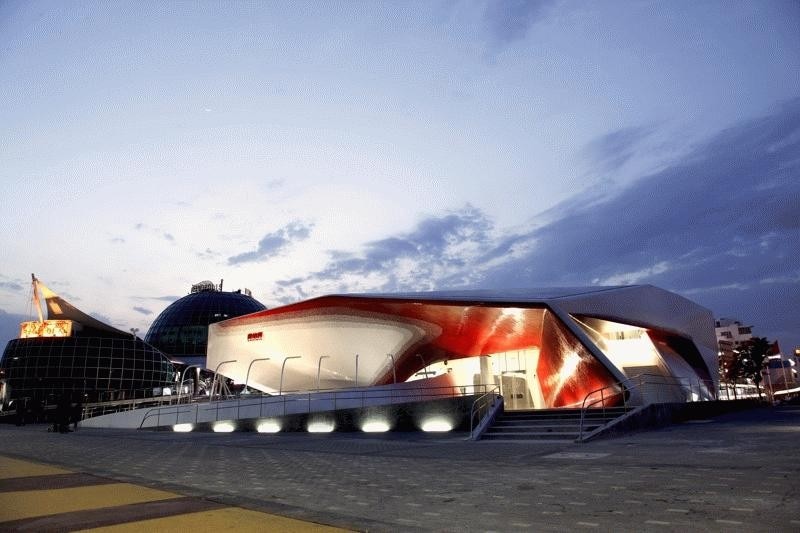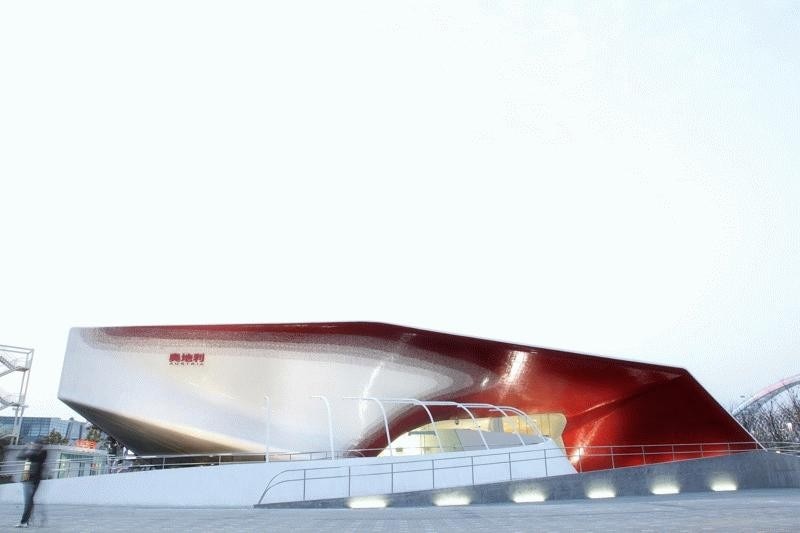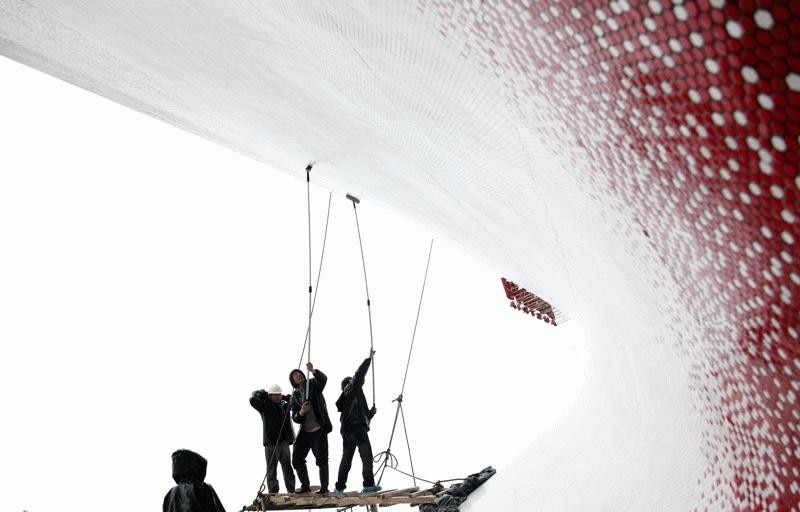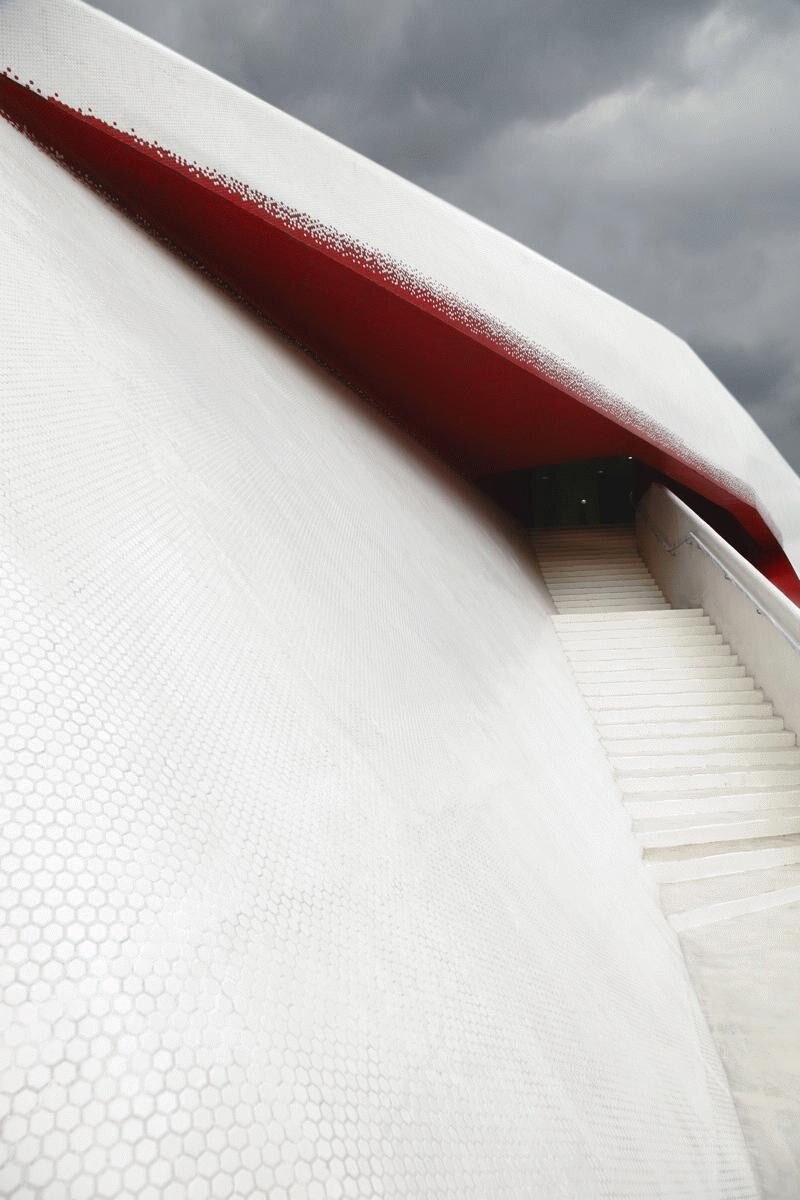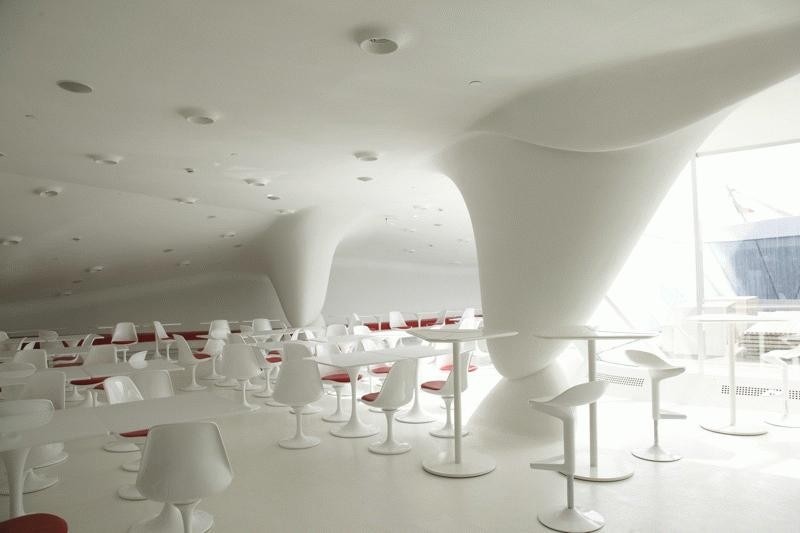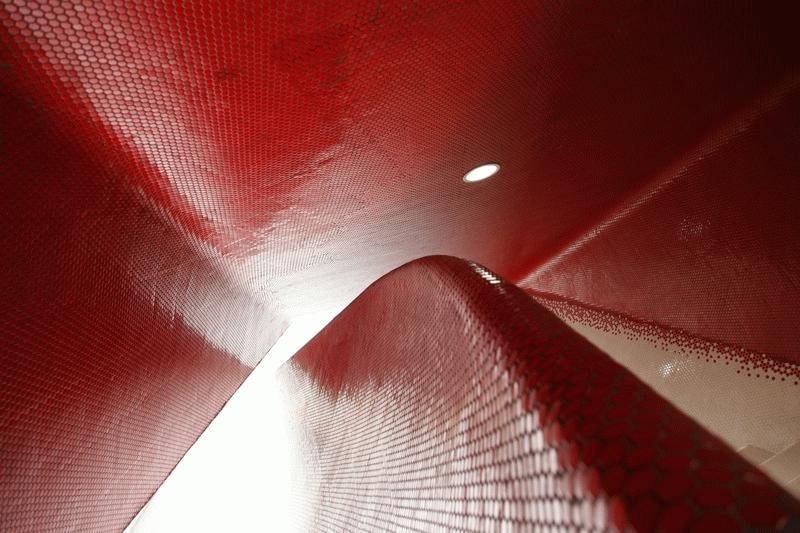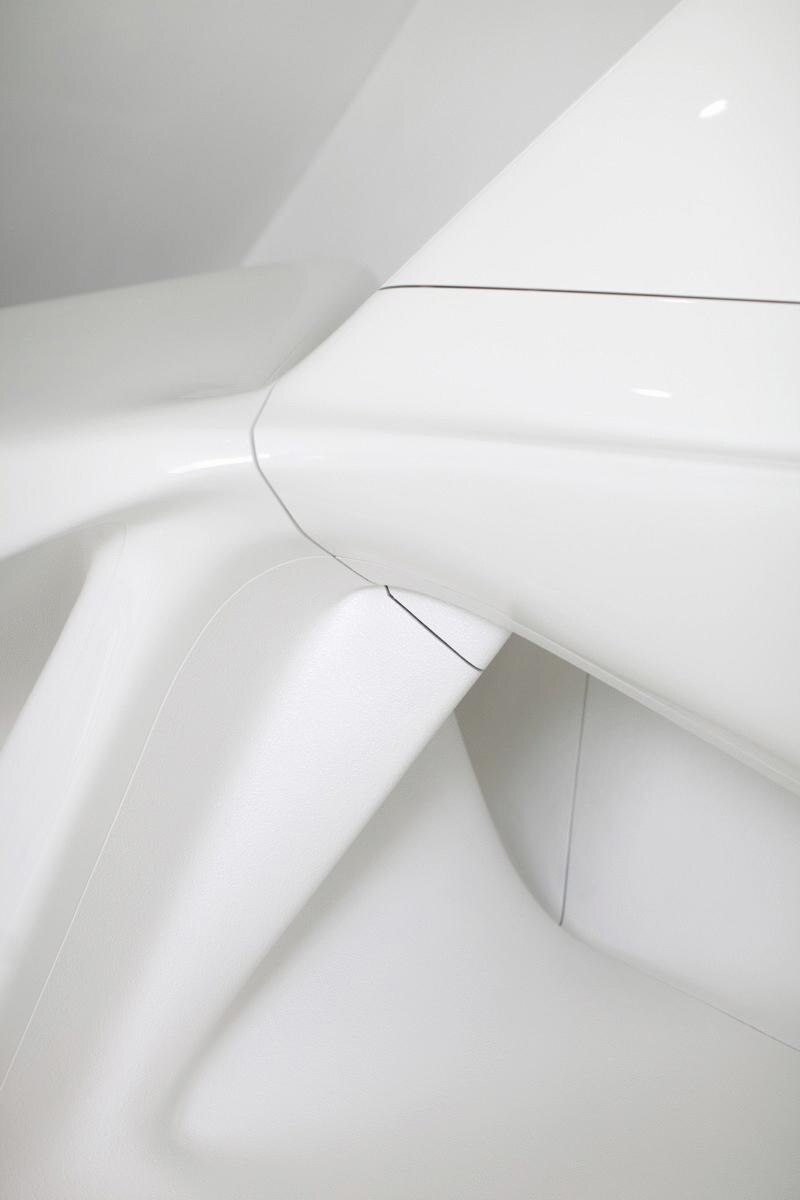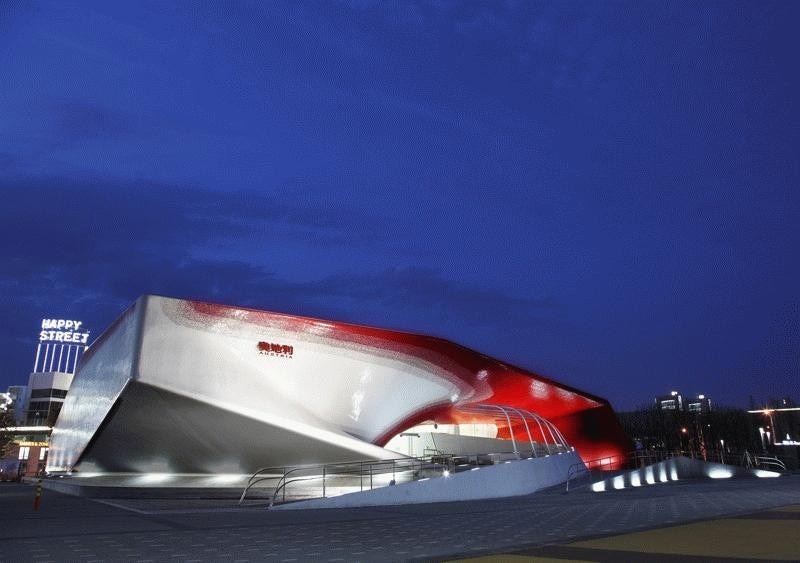
More than ten million tiles cover the pavilion’s facade, a porcelain skin gradually changing from red to white. The cladding of the complex curved surface wrapping the entire building and the roof was made possible by the selection of very small hexagonal modules. The result is what appears to be a smooth, seamless surface, regardless of its opposite nature: 60 million joints result in a regular distribution of the building hull’s tension forces. The design also alludes to the tradition of Chinese porcelain exports to Europe. Austria — Feel the Harmony: this was the motto behind the pavilion's conception as a gesamtkunstwerk consisting of space, sound and images, enriched by tactile experiential worlds. For example, snow and ice are integrated as real elements.
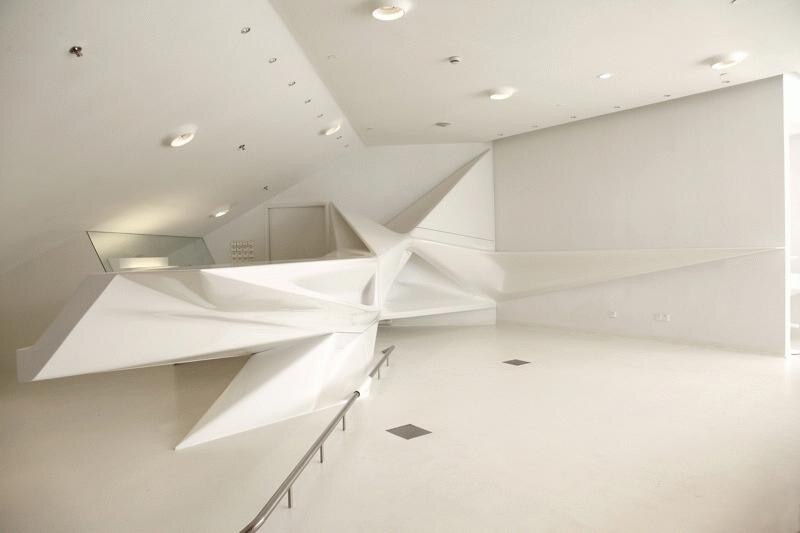
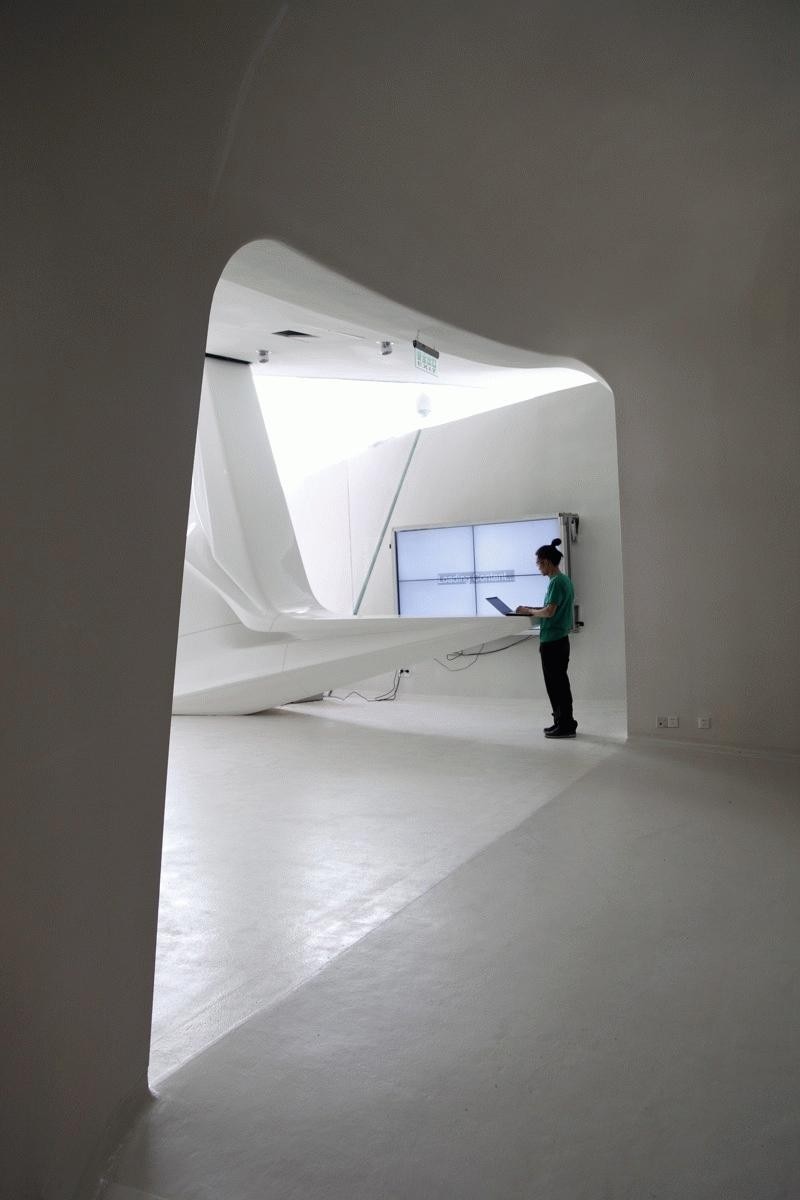
"The spatial relationships of the pavilion playfully adopt the balance, division and symbiosis between the town and the countryside", explains Arkan Zeytinoglu. "Abstract landscapes as sensual experiential spaces generate a rhythmical movement from the natural space to the cultural acoustically condensed urban space." The central room unfolds from the inside outwards. The curvilinear sequence of interior spaces supports the flow of visitors from the entrance area through the exhibition grounds to the exit. Thanks to the seamless transitions the visuals can unfold freely and unhindered in the space. Panoramas and imagery are projected onto the walls, floor and ceiling to fill the interior.
What looks organic is the result of mathematical structures calculated in minute detail. Only apparently a paradox, the mathematics are understood as "the universal language, capable of describing everything, from the structure of a piece of music to the geometry of an oyster shell", says Sandra Manninger of the architects SPAN. "Geometric and mathematical systems present in natural phenomena are embedded directly into the design to increase the efficiency of the form."
The Architects
Matias del Campo, born in 1970 in Santiago, Chile, studied architecture at the University of Applied Arts Vienna. Editor of the Vienna-based newspaper Falter from 1995 to 1998, correspondent for the ORF from 1998 to 2001. Since 2003, numerous projects, exhibitions and publications in collaboration with Sandra Manninger under the label SPAN. Several awards and prizes for the architecture designs of SPAN. Since 2008, visiting professor of architecture design at the Dessau Institute of Architecture.
Sandra Manninger, born in 1970 in Graz, studied architecture at Vienna University of Technology. Numerous projects, exhibitions and publications in collaboration with Matias del Campo under the label SPAN. Several awards and prizes for the architecture designs of SPAN. Since 2008, visiting professor of architecture design at the Genetic Architecture Studio, ESARQ, Barcelona.
Arkan Zeytinoglu, born in 1968 in Klagenfurt, studied architecture at Graz University of Technology, followed by 5th Year Design Studio at the Cooper Union in New York. General planner for private and state clients in the field of architecture and interior design, concept and realisation of innovative hotel and resort projects in Austria and other countries. Since 1995, offices in Vienna and other countries.
Photos © Maria Ziegelböck