

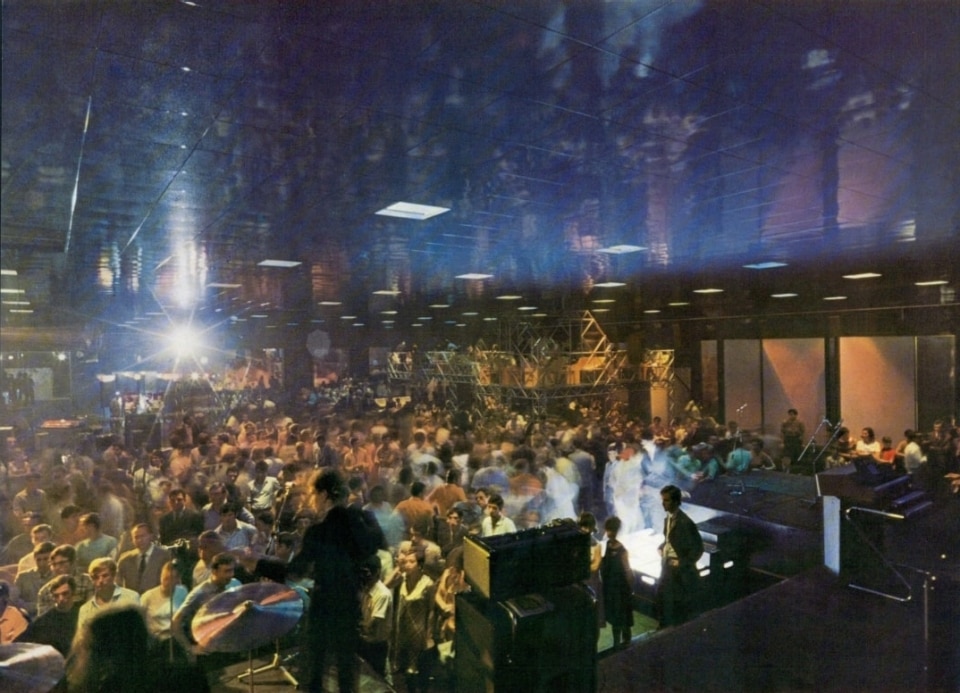
The story of Pietro Derossi certainly belongs to Turin, but it’s more accurate to say it belonged to the world, to that international scene of experiments and provocation in the ’60s and ’70s that upended the rules, blurred disciplinary boundaries, and deliberately broke conventions: art, design and architecture communicating in a single flow. Italian radical design. The Pratone, for instance, the seating/sculpture Derossi created for Gufram with Ceretti and Rosso, was a game-changer. It landed not only in the MoMA exhibition Italy: A New Domestic Landscape, but also on the precious cover of the exhibition catalogue. Over the decades Derossi continued his experiments and teaching across institutions: Politecnico di Milano, Pratt and Columbia in New York, and the Architectural Association in London. Then there were the projects: the housing for the 2006 Olympic village in Turin (with his sons, as Derossi Associati), and way earlier the club spaces born from the energy of Rome’s Piper: its Turin twin and L’Altro Mondo in Rimini, created with Ceretti, Rosso and Clino Trini Castelli. Nightclubs became clubs where cultures intersected; movements arose alongside works by Gilardi and Pistoletto. Domus visited these entertainment machines in January 1968 and told their story in issue 458.
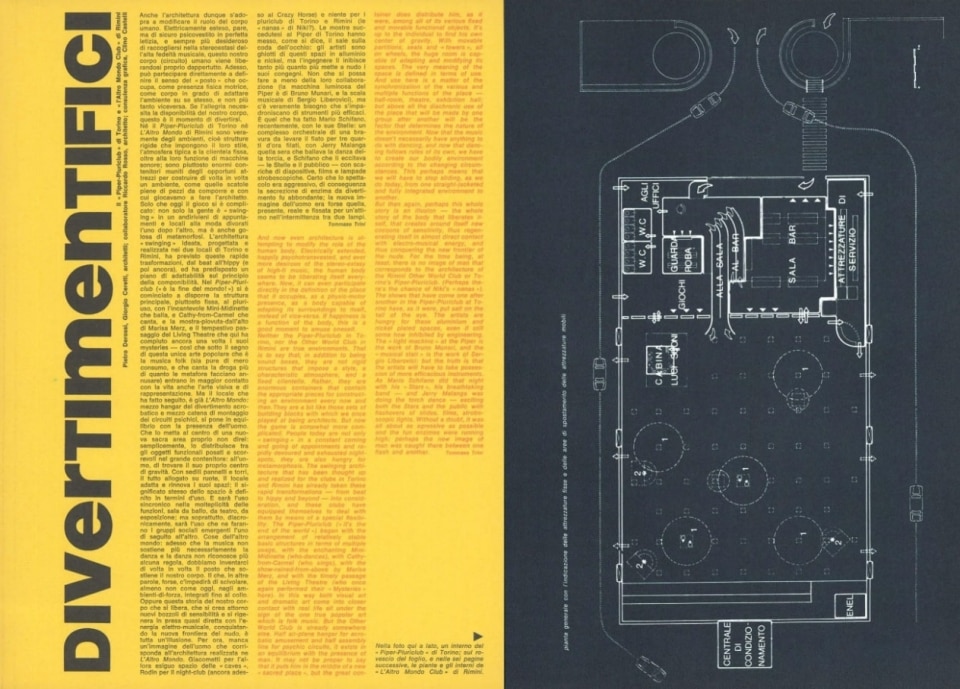
Divertimentifici
Piper-Piuriclub of Turin and the Altro Mondo Club of Rimini Pietro Derossi, Giorgio Ceretti, architects; collaborator Riccardo Rosso, architect; graphic consultancy, Clino Castelli
And now even architecture is attempting to modify the role of the human body. Electrically extended, happily psychotransvested, and ever more desirous of the stereo-extasy of high-fi music, the human body seems to be liberating itself everywhere. Now, it can even participate directly in the definition of the place that it occupies, as a physic-motor presence, as a body capable of adapting its surroundings to itself, instead of vice-versa. If happiness is a function of the body, this is a good moment to amuse oneself.
Neither the Piper-Pluriclub in Torino, nor the Other World Club in Rimini are true environments. That is to say that, in addition to being sound boxes, they are not rigid structures that impose a style, a characteristic atmosphere, and a fixed clientelle. Bather, they are enormous containers that contain the appropriate pieces for constructing an environment every now and then. They are a bit like those sets of building blocks with which we once played at being architects. But now the game is somewhat more complicated. People today are not only « swinging » in a constant coming and going of appointments and rapidly devoured and exhausted nightspots, they are also hungry tor metamorphosis. The swinging architecture that has been thought up and realized for the clubs in Torino and Rimini has already taken these rapid transformations — from beat to hippy and beyond — Into consideration, and these clubs have equipped themselves to deal with them by means of a special flexibility.
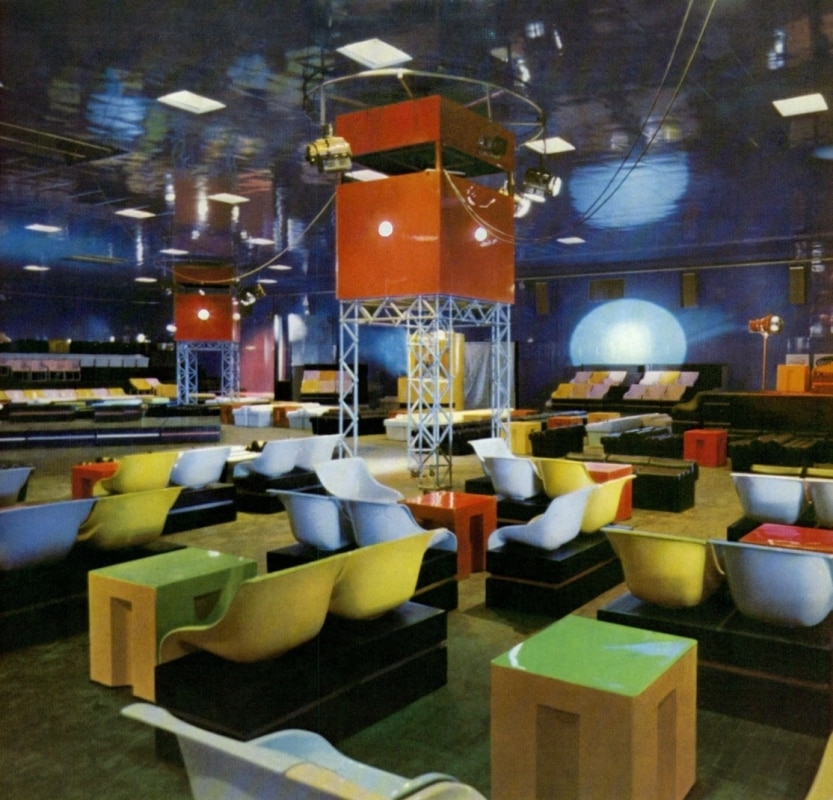
The Piper-Pluriclub («it's the end of the world ») began with the arrangement of relatively stable basic structures in terms of multiple usage, with the enchanting Mini-Midinette (who-dances), with Cathyfrom - Carmel (who sings), with the show-rained-from-above by Marisa Merz, and with the timely passage of the Living Theatre (who once again performed their « Mysteries » here). In this way both visual art and dramatic art come into closer contact with real life all under the sign of the one true popular art which is folk music.
But the Other World Club is already somewhere else. Half air-plane hangar for acrobatic amusement and half assembly line for psychic circuits.
Tommaso Trini
But the Other World Club is already somewhere else. Half air-plane hangar for acrobatic amusement and half assembly line for psychic circuits, it exists in an equilibrium with the presence of man. It may not be proper to say that it puts him in the middle of a new « sacred place », but the great con tainer does distribute him, as it were, among all of its various fixed and movable functional objects. It's up to the individual to find his own center of gravity. With movable partitions, seats and « towers », all on wheels, the huge room is capable of adapting and modifying its spaces. The very meaning of the space is defined in terms of use. And use here is a matter of the synchronization of the various and multiple functions of the place — ball-room, theatre, exhibition hall; but above all the diachronic use of the place that will be made by one group after another will be the factor that determines the nature of the environment.
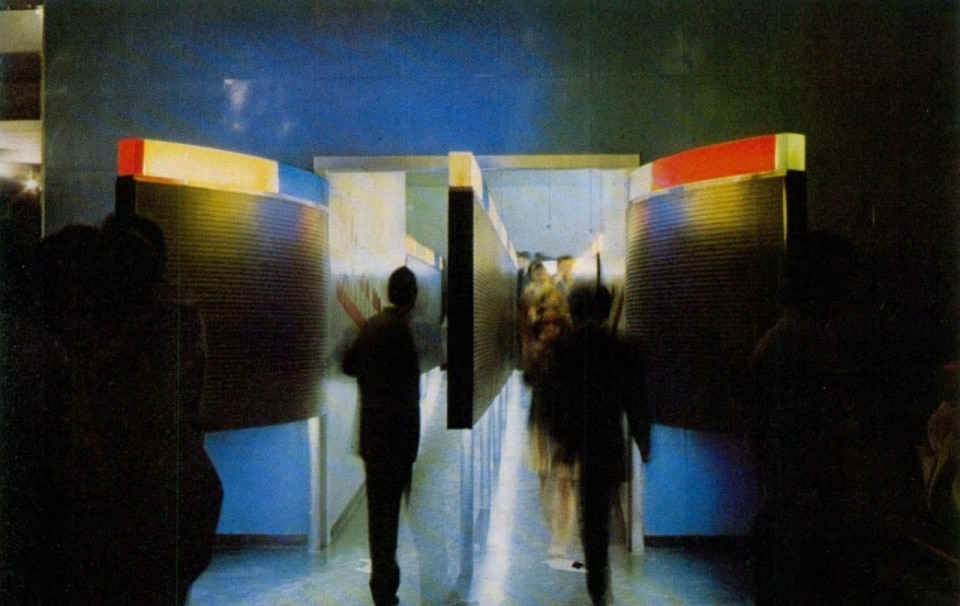
Now that the music doesn't necessarily have anything to do with dancing, and now that dancing follows rules of its own, we have to create our bodily environment according to the changing circumstances. This perhaps means that we will have to stop sliding, as we do today, from one straight-jacketed and fully integrated environment to another. But then again, perhaps this whole story is an illusion — the whole story of the body that liberates -itelf, that creates around Itself new cocoons of sensitivity, thus regenerating itself in almost direct contact with electro-musical energy, and thus conquering the new frontier of the nude.
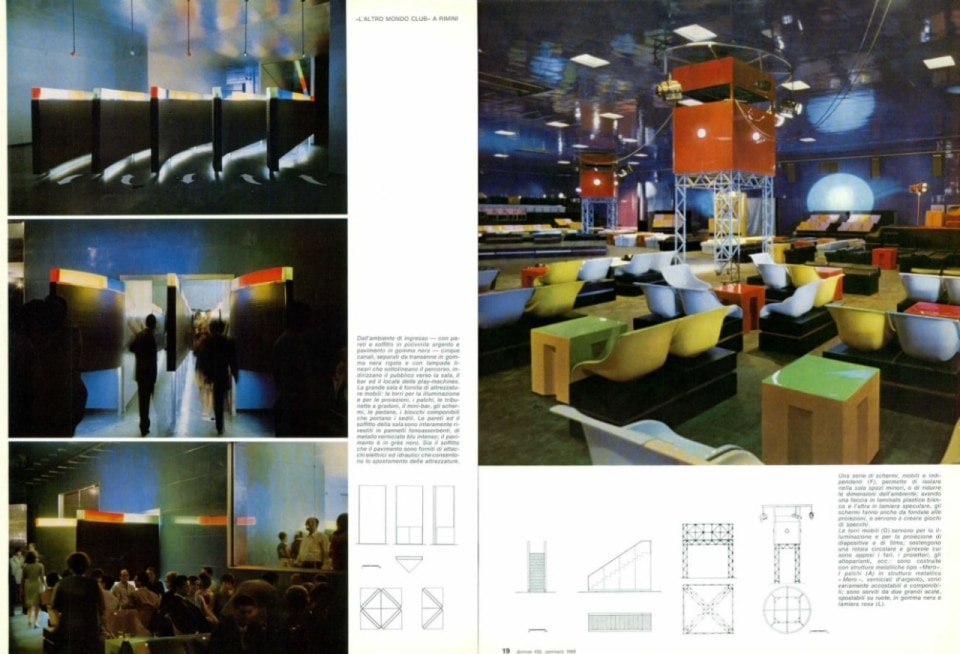
For the time being, at least, there is no image of man that corresponds to the architecture of the Rimini Other World Club or Torino's Piper-Pluriclub. (Perhaps there's the chance of Niki's « nanas »). The shows that have come one after another in the Piper-Pluriclub at Torino have, as it were, put salt on the tail ot the eye. The artists are hungry for these aluminium and nickel plated spaces, even it still some how inhibited by engineering. The « light machine » at the Piper is the work of Bruno Munari, and the « musical stair » is the work of Sergio Liberovici: but the truth is that the artists will have to take possession of more efficacious instruments.
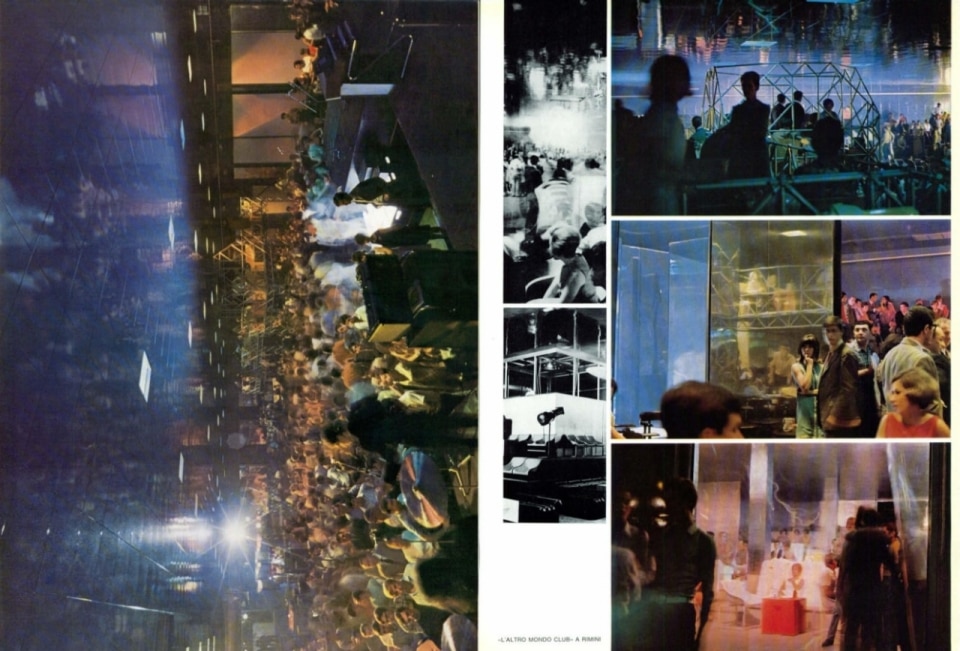
As Mario Schifano did that night with his « Stars », his breathtaking band — and Jerry Malanga was doing the torch dance — exciting both the Stars and the public with flashovers of slides, films, strobos c o p i c lights. Without a doubt, it was all about as agressive as possible and the fun enzimes were running high; perhaps the new image of man was caught there between one flash and another.
Opening image: Domus 458, January 1968