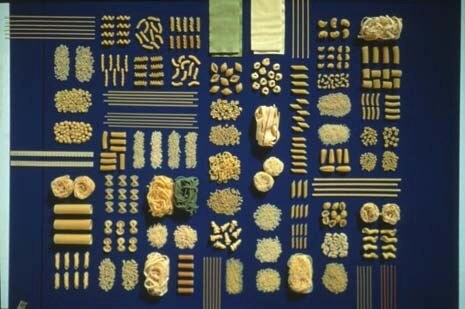
It covers not so much just gastronomy but design and advertising, the culture itself of a country which has undergone profound industrial and social development over the last hundred years. This is the vision of Stephen Bayley, curator of the exhibition as well as founder of the Design Museum in London, who takes it further “Pasta expresses a sense of style, a tendency towards sculpture and art, a love of pleasure which is the unique characteristic of Italy”.
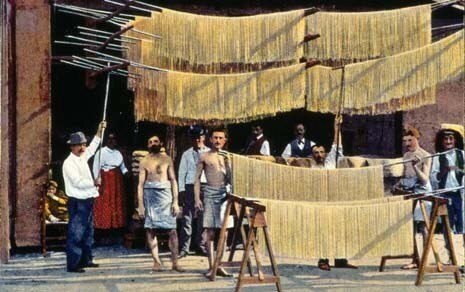
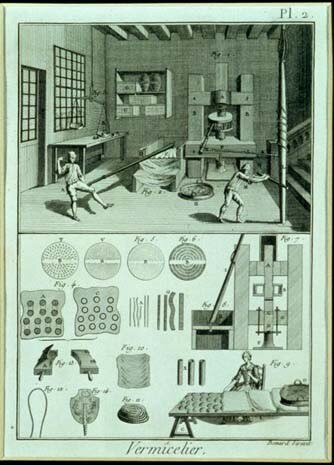
The idea of dedicating an exhibition to the history of pasta was born out of the necessity to show something which goes beyond mainstream arts such as sculpture and painting and which incorporates photography, advertising and graphics. Much of the material on display comes from the Archivio Barilla in Parma. Beginning with images of Naples from the early 1900s of unending threads of spaghetti placed to dry in the sun, on to the innovative technology of the fifties and sixties up to when pasta became in the industrial boom years, along with the Vespa dn Cinquecento, one of the most famous Italian products around the world.
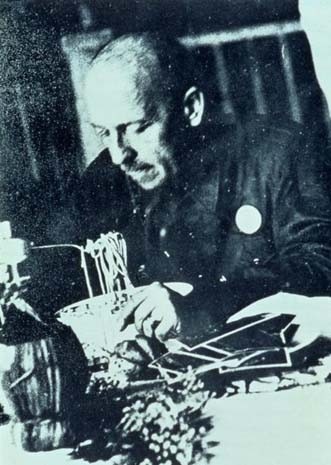
The exhibition contains many curiosities and interesting anecdotes, such as the attack of the Italian futurists on this culinary delight (according to Marinetti pasta was heavy, voluminous, synonymous with slowness, indolence and with its infinite regional variations, formed a perfect gastronomic parallel to provincialism and social immobility), then contradicted with a photograph from 1930 in which the same artist is portrayed heartily tucking into a forkful of spaghetti. Then, following the publication of the Manifesto Futurista, it was Barilla who launched a counter attack making fun of the movement: futurist iconography was magisterially subverted in a calendar from 1931 which showed a young boy in the saddle of an aerodynamic horse made from pasta.
Food and its “extra-gastronomic” relationships are also at the centre of the book “Food by Design” (publisher Booth-Clibborn) presented in London last week at the annual architecture week, on sale internationally from 2 July and also available in Italy. Written by architect and design from Brescia, Antonio Gardoni, it observes the affinities between the two professions of chef and architect, with the intention of surpassing than breaking down the barrier which divides them.
until 15.9.2002
Pasta: Italian Culture on a Plate
Estorick Collection of Modern Italian Art
39a Canonbury Square, London
T +44-020-77049522
F +44-020-77049531
E-mail: curator@estorickcollection.com
http://www.estorickcollection.com