


As in the most beautiful fairy tales, this story begins with a threshold to be crossed. At the corner of Via Montenapoleone and Corso Matteotti, a 1930s Rationalist building rises like a silent guardian in the heart of Milan. This is the new Palazzo FENDI: as discreet on the outside as it is full of stories to tell within, where every detail seems to hold a secret.
Crossing the threshold, it is artist Edoardo Piermattei who leads the way — the latest in a long tradition of collaborations between Fendi and the art world. “In my painting, the project is central,” he begins, “and it’s also the aspect that takes the most time. Perhaps that’s why my work has always had a special relationship with space and architecture”.
Once upon a time, the Palace
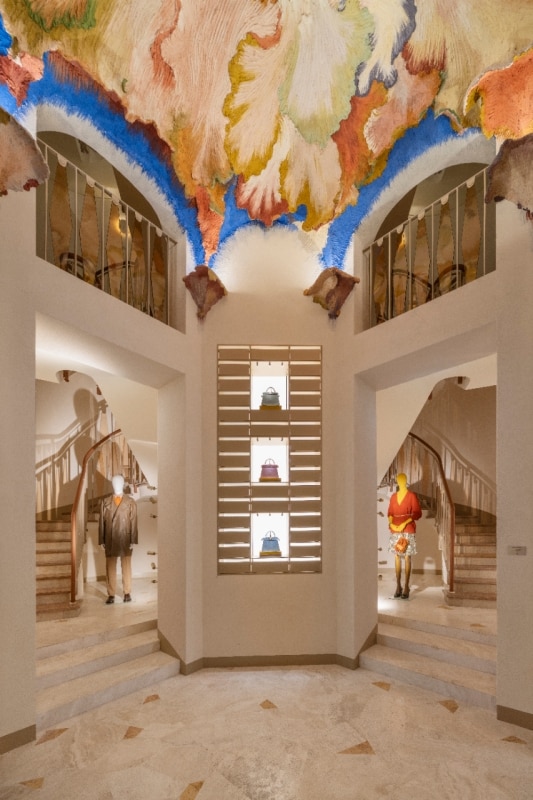
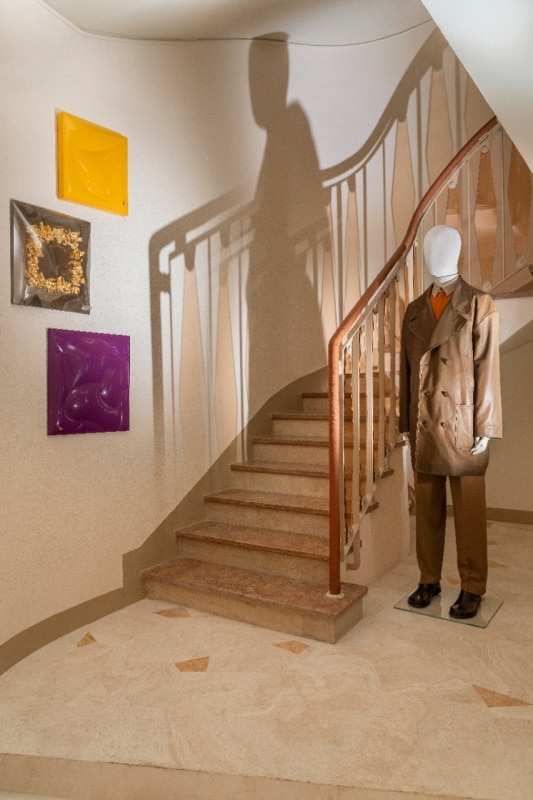
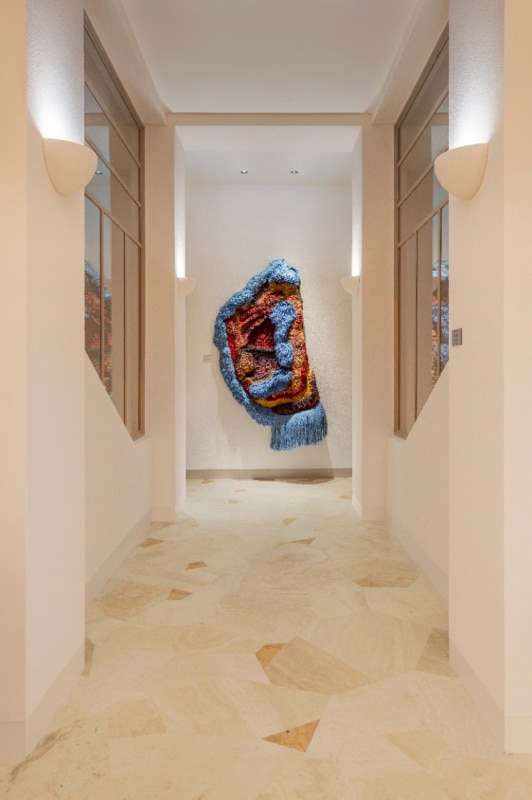
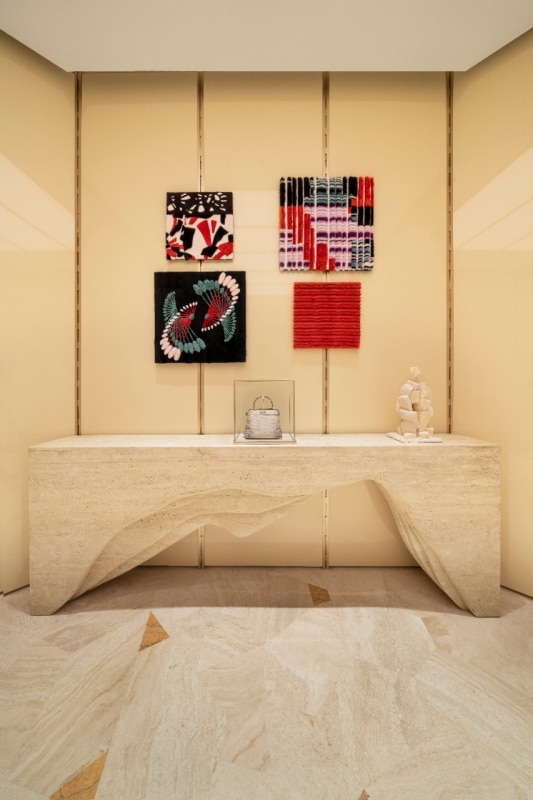
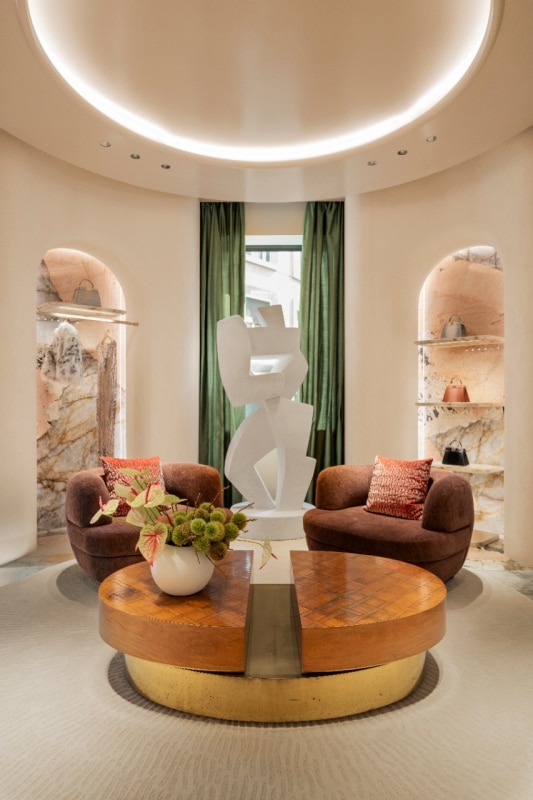
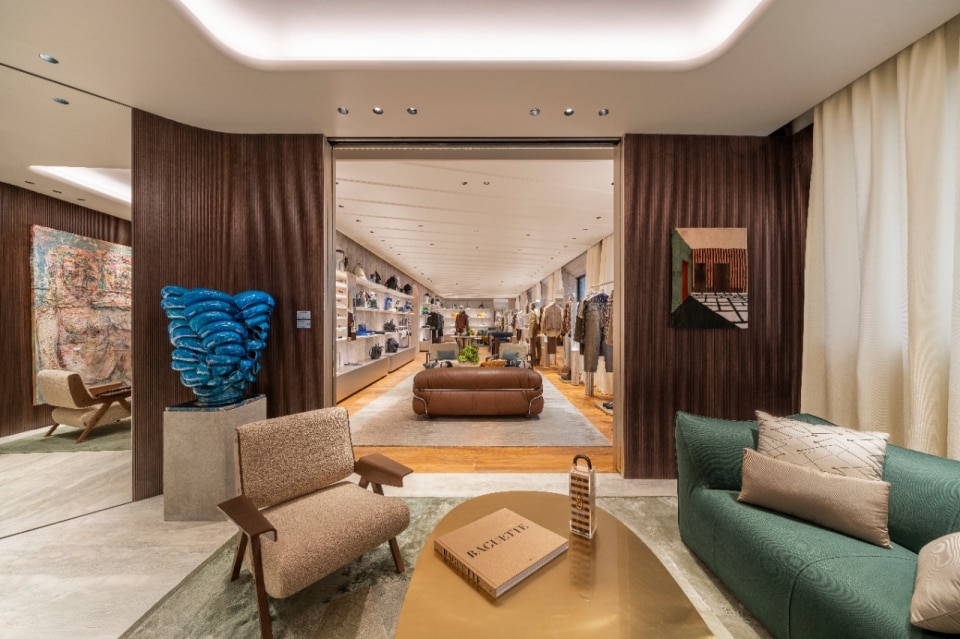
Designed by Emilio Lancia between 1933 and 1936, the building preserves its Rationalist façade intact: arches, square windows, and a central tower that rises over the intersection like an urban beacon. Yet as soon as one crosses the threshold, time seems to split. Its four floors and 910 square meters unfold like the chapters of a story, where the concept developed by the Fendi Architecture Department enters into dialogue with the building’s original soul. Travertine and Roman lime, dark woods, boiserie, and geometric floors inspired by opus sectile intertwine the Milan of the 1930s with the Roman heritage of the maison.
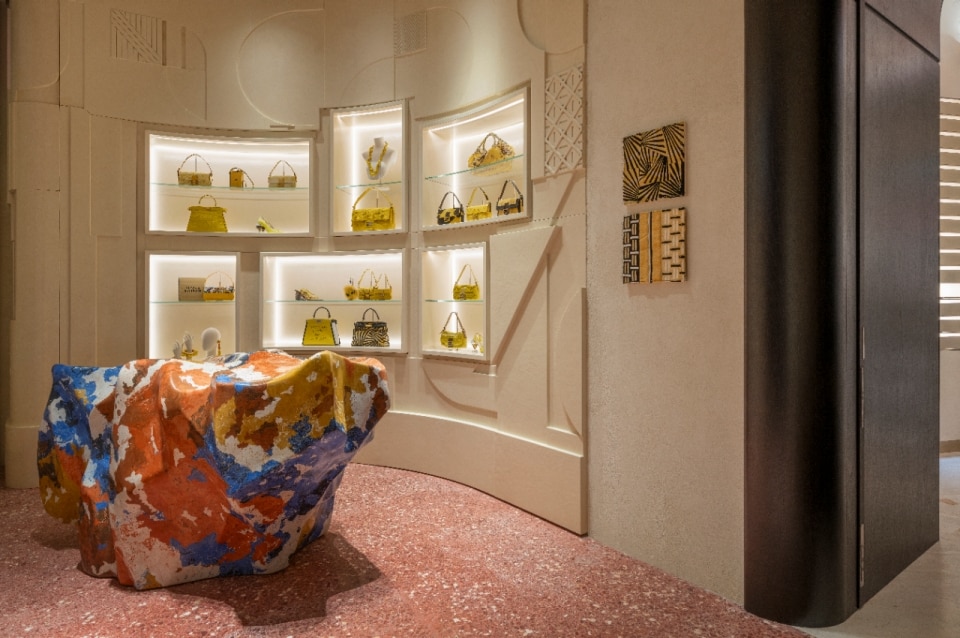
Each floor is a world of its own, an episode in this “total house” of Fendi: the ground floor hosts accessories, baguettes, and scarves that shine like gems scattered across a marble table; the first floor leads into the men’s and kids’ universe; the second opens to haute couture and jewelry; while the third — home to the Atelier and the Appartamento Fendi — contains the beating heart of the maison’s savoir-faire.
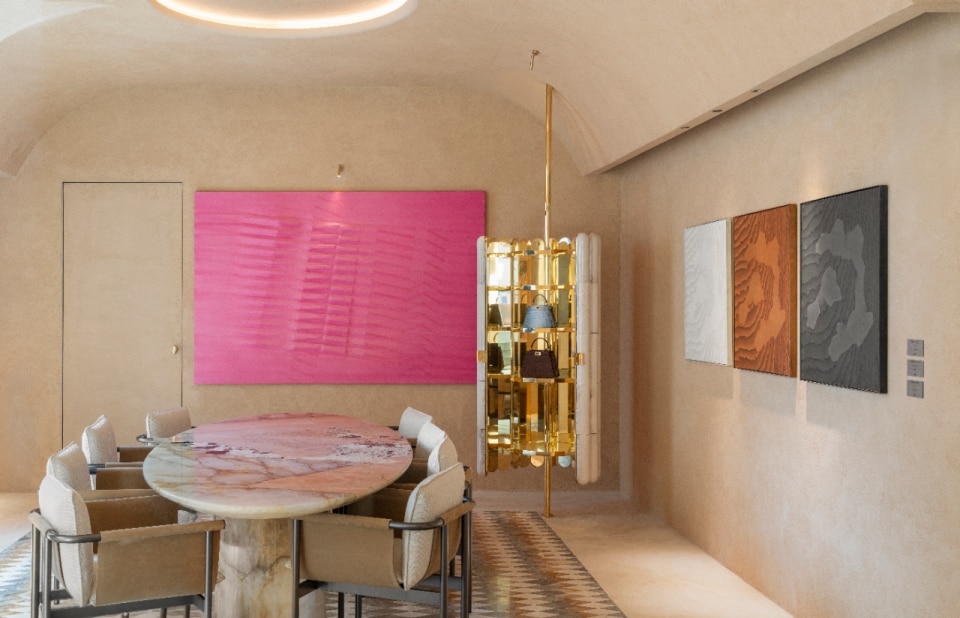
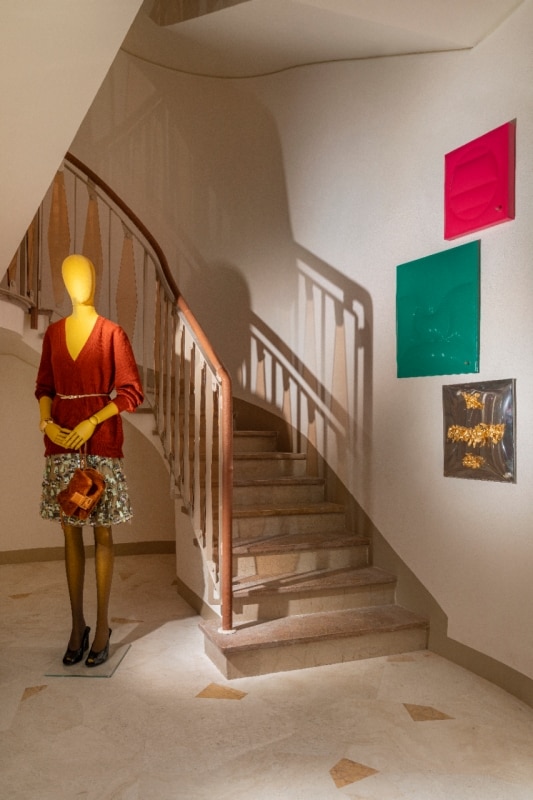
The path is defined by a linear architecture, distinguished by the severity of its materials that nevertheless softens in the face of pastel palettes and velvety surfaces, furs that look like clouds. Staircases coil around rhomboid inserts in pink glass, while handrails in Cuoio Romano with Selleria stitching tell stories of skilled craftsmanship. It is the maison’s unmistakable signature: a historic brand capable of transforming its artisanal heritage into an elegant play of contrasts — mixing rigor and lightness, roots and experimentation.
Treating concrete like whipped cream means something really important
Edoardo Piermattei
The alliance between Fendi and art
Sculptures, ceramics, and installations punctuate every floor, transforming the spaces into a diffuse gallery where the maison’s creations engage in a continuous dialogue with modern and contemporary art. The new Palazzo thus becomes a true cultural device, in conversation with some of the most dynamic institutions on the Italian scene — from the Officine Saffi Foundation to the Mazzoleni and Secci galleries, up to the Arnaldo Pomodoro Foundation, linked to the maison through a long-standing collaboration.
The manifesto work of this fusion between fashion, art, and architecture greets visitors right at the entrance: a travertine wall sculpture that opens like a stone embrace, its folds evoking the drapery of Roman robes. It marks the first intervention commissioned by the new CEO, Ramón Ros, appointed last July while the project was already underway. Yet the interweaving of fashion and art is nothing new for Fendi. During his years as Creative Director, Karl Lagerfeld was already experimenting with the boundaries between disciplines, weaving together unused scraps of fur and transforming them into decorative panels that blurred the lines between fashion, design, and painting. Some of those works are still here today — silent witnesses to a tradition that never ceases to renew itself.
Edoardo Piermattei: painting with concrete.
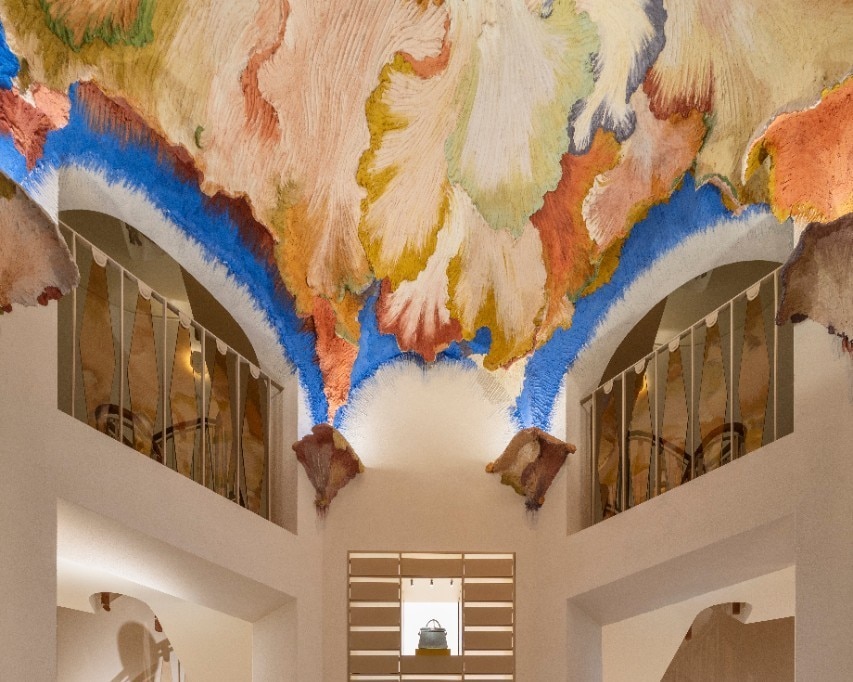
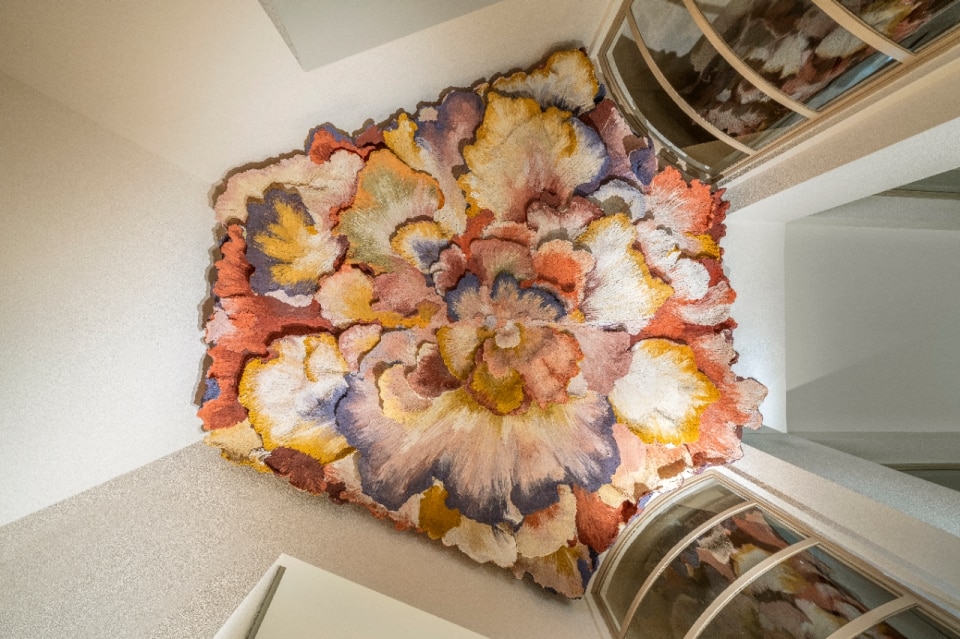
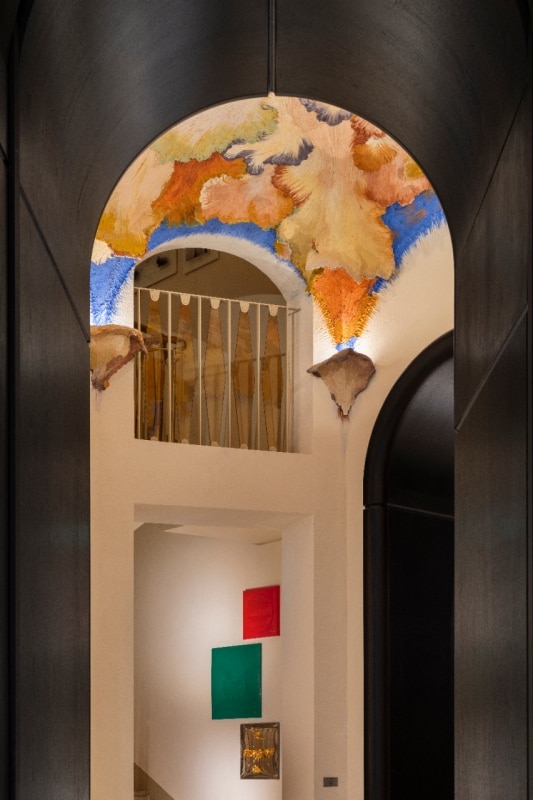
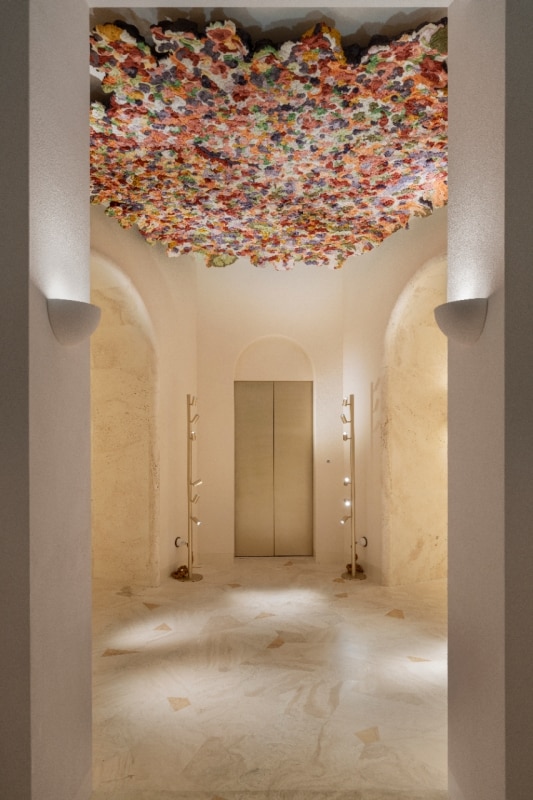
And it is within this legacy of intertwining disciplines that the work of Edoardo Piermattei takes shape. Invited to create a series of site-specific interventions — which he describes as “a single project” — the artist conceived works designed to inhabit the building’s vaults, transforming architecture into both structure and narrative surface. “It took seven months of studies, endless sketches, and fifty-four versions before arriving at the final realization,” he says of a process so meticulous “that, at that point, the execution becomes almost automatic.”
His works unfold across the building’s three floors: on the first, a hand-sculpted vault of concrete petals opens above the visitor’s head, tinted in shades of color like a blooming rose; on the second, another vault is decorated using a pastry chef’s sac à poche; while on the third, yet another finish appears, once again entirely handmade. “I tried to imagine four different ways of treating the same material,” he explains — “which, not by chance, is concrete.”
As I use it, concrete is emptied of that part of political and symbolic investment-it can finally be light, a little bit 'cretinous'.
Edoardo Piermattei
A material that carries with it a well-established imagery, and that — as if by enchantment — transforms under his hands. “Concrete is invested with a strong political and social symbolism: it is the Soviet Union, it is the postwar period, reconstruction, but it is also the material of the memorial, if you think of Libeskind’s,” he reflects.
Born in Turin, in the cradle of Arte Povera, which turned concrete into a conceptual and historically codified medium, Piermattei deliberately chooses to strip it of any ideological weight. “People keep thinking it’s stucco,” he says, “and I keep insisting that it’s actually concrete. Just because we’re used to imagining it as a casting material doesn’t mean it can’t take on other forms.”
In his practice, the humble substance becomes unexpectedly poetic. “Treating concrete as if it were whipped cream means something really important to me,” he explains. “Something light can be serious without necessarily becoming solemn.”
“I like to take materials to their semantic limits,” he adds — a principle that resonates with many of the works featured in the palace’s permanent collection, which already includes pieces by Anton Alvarez, Roberto Sironi, Roger Cal, Daniel Crews-Chubbs, Luke Edward Hall, Florian Tomballe, Nick Cave, Arnaldo Pomodoro, and Agostino Bonalumi.
The future of luxury: experience and culture
On the top floor, the path opens onto the Fendi Atelier — a true laboratory of savoir-faire, where visitors can witness the making of the maison’s lines amid tables covered with samples, machines in motion, and artisans at work. All around, aluminum displays inspired by Franco Albini’s designs showcase some of Fendi’s most iconic pieces, arranged like a continuous, silent fashion show.
The Atelier is also the beating heart of “Rock the Craft,” a project conceived to celebrate Fendi’s artisanal dimension and open a contemporary space for reflection on the value of craftsmanship. Within this program, Edoardo Piermattei, in close collaboration with the maison’s artisans, has translated his interventions for the palace into a new Peekaboo bag, presented as part of the Peekaboo Artists series. A second bag designed by the artist will be unveiled at the Palace on October 25, 2025, ahead of the opening of a new concept restaurant by Langosteria.