


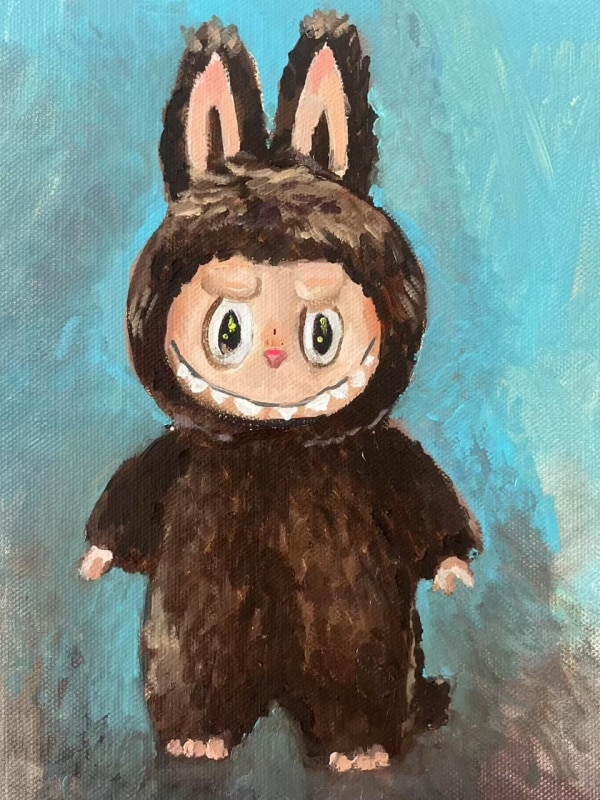
The Louvre-Lens is putting on an exhibition about kittens. Or rather: it will be staging a major exhibition on the aesthetics of the adorable, drawing in part on one of the most ubiquitous images in contemporary digital culture—that of cats on the internet. Why can’t we resist a puppy, a stuffed animal with huge eyes, or a pink, soft, seemingly harmless object? And why has an aesthetic long considered minor, childish, sentimental, or bordering on kitsch become one of the most recognizable forces in contemporary visual culture—from social media to kawaii, all the way to the Labubu phenomenon?
The Musée du Louvre-Lens attempts to answer this question with the exhibition “So Cute! The Art of Happiness,” on view from September 23, 2026, to January 18, 2027, co-produced with the Museums of the City of Strasbourg and curated by Annabelle Ténèze and Émilie Girard. The exhibition is structured as a genealogical exploration that spans the history of art from antiquity to the present day, examining the emotional, formal, and political impact of a concept – that of adorability, or “cute” – which proves to be far more ambiguous than its soft surfaces might suggest.
The Grammar of Tenderness
The visual experience of what is cute or adorable has its roots in specific evolutionary mechanisms linked to the survival of mammals and, in particular, the human species. John Morreall, in his 1991 essay “On Cuteness”—republished in 2022 as part of the collection “The Cute,” which is part of the Documents of Contemporary Art series published by Whitechapel and MIT Press —draws precisely on the studies of ethologist Konrad Lorenz, who identified specific infantile morphological characteristics, such as a head disproportionate to the body, a protruding forehead with low-set eyes, round cheeks, a plump body, and short limbs—all elements that act in adults as “release stimuli,” triggering behaviors of care and protection toward the most defenseless subjects. Throughout the modern era, this “grammar of tenderness” has extended beyond the biological bodies of infants and young animals, applying to everyday objects, automobiles, and even architecture, establishing a direct link between a non-threatening visual form and a spontaneous linguistic response that, according to Morreall, tends to eliminate the critical distance between subject and object.
In art theory, the “adorable” stands in contrast to the historical and elevated categories of the Beautiful and the Sublime. Lacking a rigid academic codification or a fixed historical framework like the Baroque or Art Deco, the “cute” possesses a vernacular and catchy nature that has allowed it to permeate complex movements, from Pop Art to Conceptual Art. Artists are drawn to the aesthetic of the adorable because it blurs the boundaries of our social reality. Fields as diverse as robot design and animal domestication reveal an unexpected connection when it becomes clear that they follow the same relational logic.
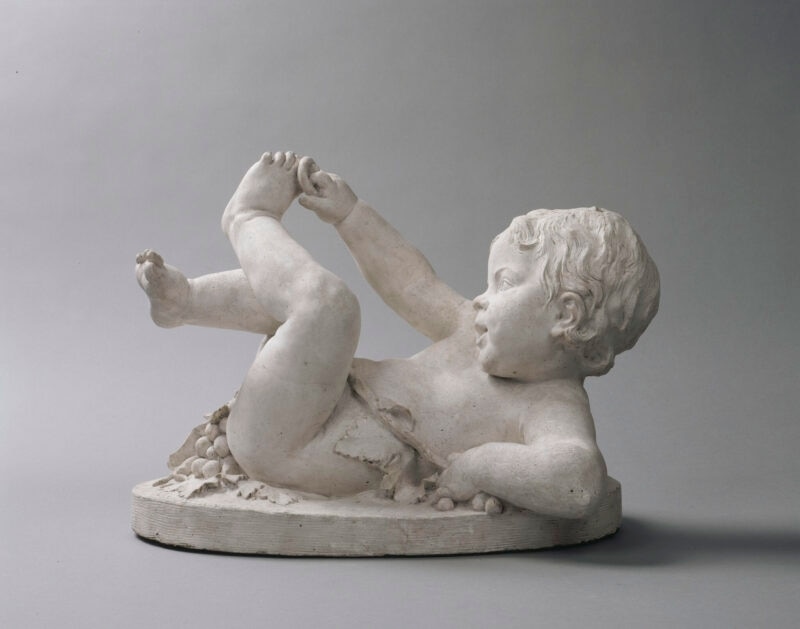
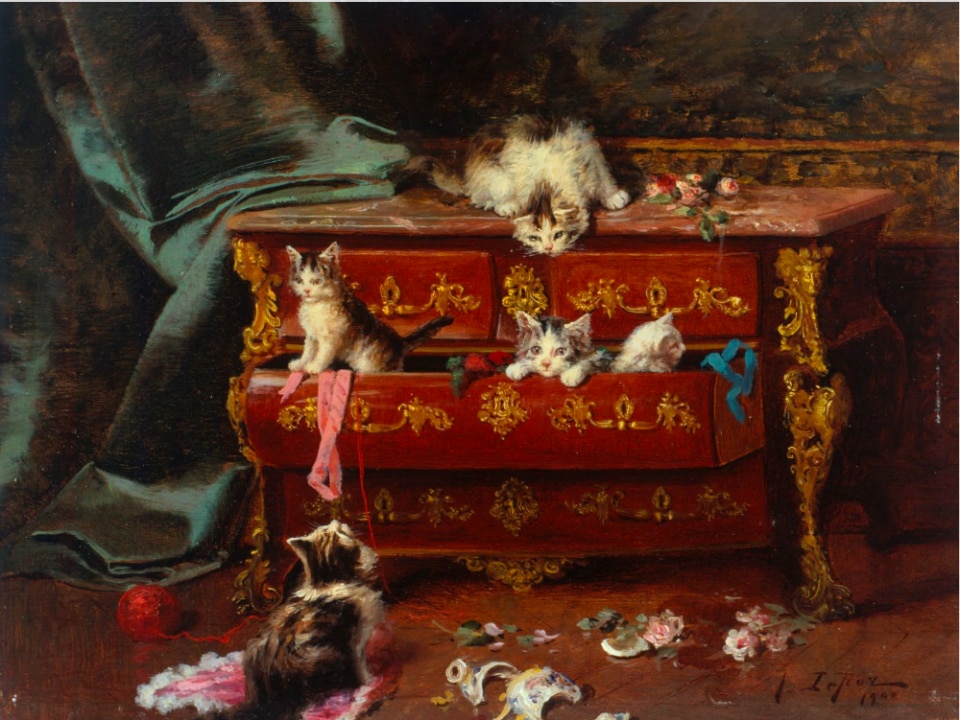
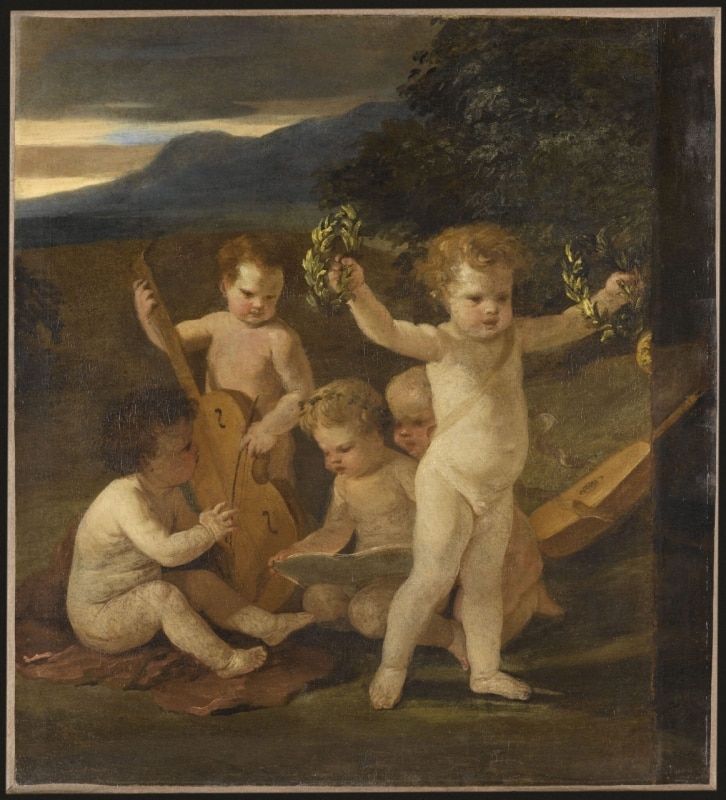
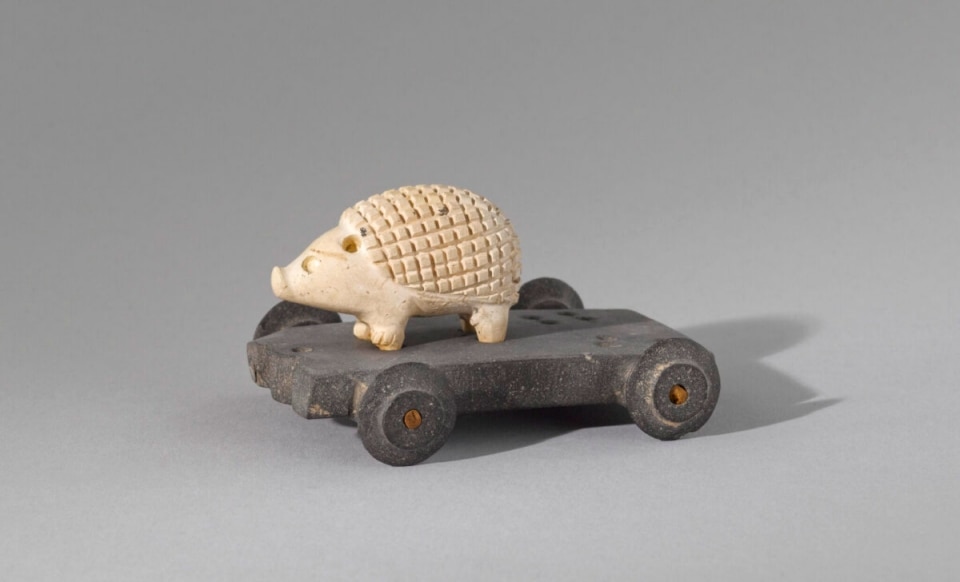
Through an exhibition featuring over three hundred works—including paintings, sculptures, installations, videos, and archaeological artifacts—set within a display designed by Mathis Boucher, the exhibition at the Louvre-Lens fosters a dialogue between ancient artifacts and contemporary works. The evolution of this iconography is traced from the stone toys of Mesopotamia and the cupids of Nicolas Poussin, through the childhood portraits of Auguste Renoir and the paintings of Tamara de Lempicka, all the way to the hues and features of “kawaii” culture and the colorful creatures of Jeff Koons and Takashi Murakami. A historical example of this transition toward domestication and visual delight can be found in Jules Le Roy’s painting “Chats dans une commode” (1900), which anticipates contemporary sensibilities toward the animal world and themes of domestic comfort. It is no coincidence that the curatorial narrative of the exhibition project begins with Tim Berners-Lee’s response to the question of what surprised him most about the development of the internet: the success of cat videos.
The dark side of the cute
Behind the apparent innocence of its soft shapes and pastel hues, the exhibition at the Louvre-Lens also explores how the “cute” aesthetic implies political and commercial dimensions that can quickly veer toward disgust, alienation, or propaganda. In her “Fifteen Theses on the Cute” (2001), Frances Richard maps the richness of this category and explains its structural complexity through a precise geometric arrangement: “Draw a circle and radiate from it the abject, the melancholic, the evil, and the childlike. Now, in the intermediate zones, add the erotic, the ironic, the narcotic, and the kitsch. Intersect the Romantic/Victorian, the Disney-esque/consumerist, and the biologically deterministic. At the center of this multi-spoked wheel lies an empty space of connection. Label it ‘cute.’”
It is precisely within this complex web of tensions that many contemporary artists work in a subversive manner, using vulnerability as a critical tool to examine social violence, the asymmetries of global production systems, and gender issues. Through Annette Messager’s altered puppets, Mike Kelley’s stuffed animal assemblages, or Philippe Katerine’s anthropomorphic sculptures, the reassuring surface of what is adorable is cracked, transforming our need to relate to what is comforting and cute into an indicator of the fragility of our present.
Opening image: Jules LE ROY, Cats in a Chest of Drawers, 1900, oil on canvas, Roubaix, La Piscine – André Diligent Museum of Art and Industry © La Piscine Museum (Roubaix), Dist. GrandPalaisRmn / Arnaud Loubry