


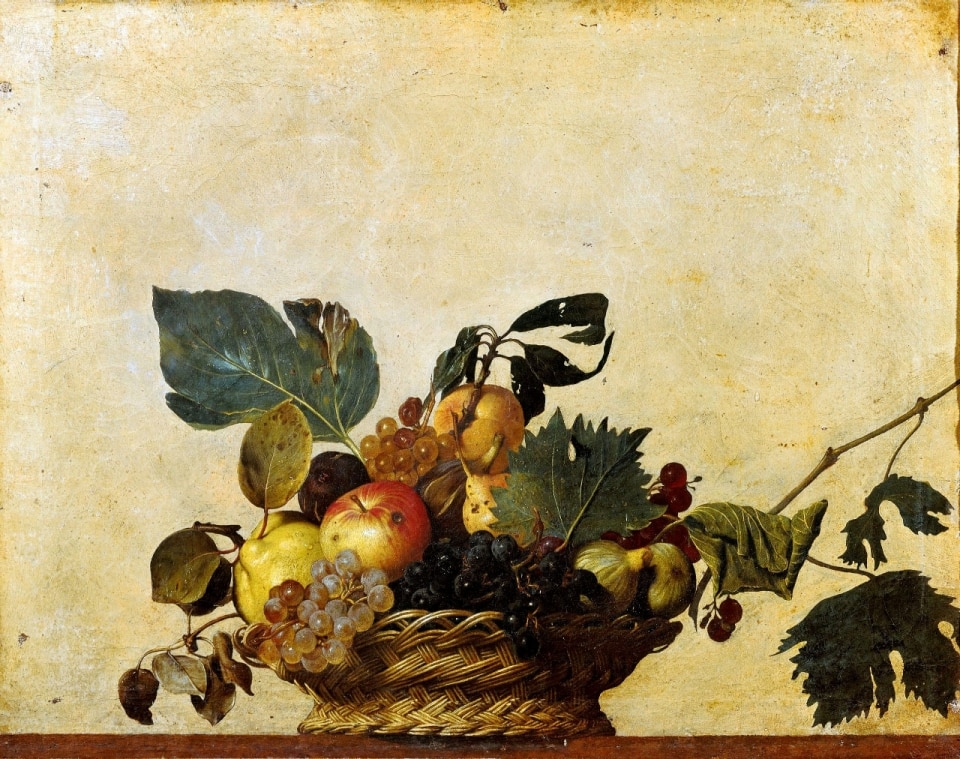
Take any object. A piece of fruit, for instance. Hold it in front of you long enough, and at some point, it stops being an apple or a cluster of grapes. It becomes something prior to language. That is where the question begins: what is a thing when we truly look at it? Not its name, function, or use, but the irreducible presence that makes it this thing, here, now, before our eyes. Every great painter has asked this question through fruit. Before it became a symbol, fruit in art was always an answer disguised as an object.
The ancients understood this well. In the frescoed houses of Pompeii and Herculaneum, grapes and baskets of figs fill the walls with a natural ease that is never entirely innocent: the desire to possess, if only with the eyes, what is abundant. But with the rise of Christian thought, fruit ceased to be decoration and became language. A dense, ambiguous language capable of carrying multiple meanings at once.
Consider the apple. No fruit bears such extraordinary theological weight. It is the fruit of Eden, the forbidden fruit through which Eve — and with her, all humanity — chose knowledge over obedience. The apple is where the desire to know collides with the Fall, a paradox painters have both loved and feared.
Everything begins with an outstretched hand in Tintoretto’s The Temptation of Adam and Eve.
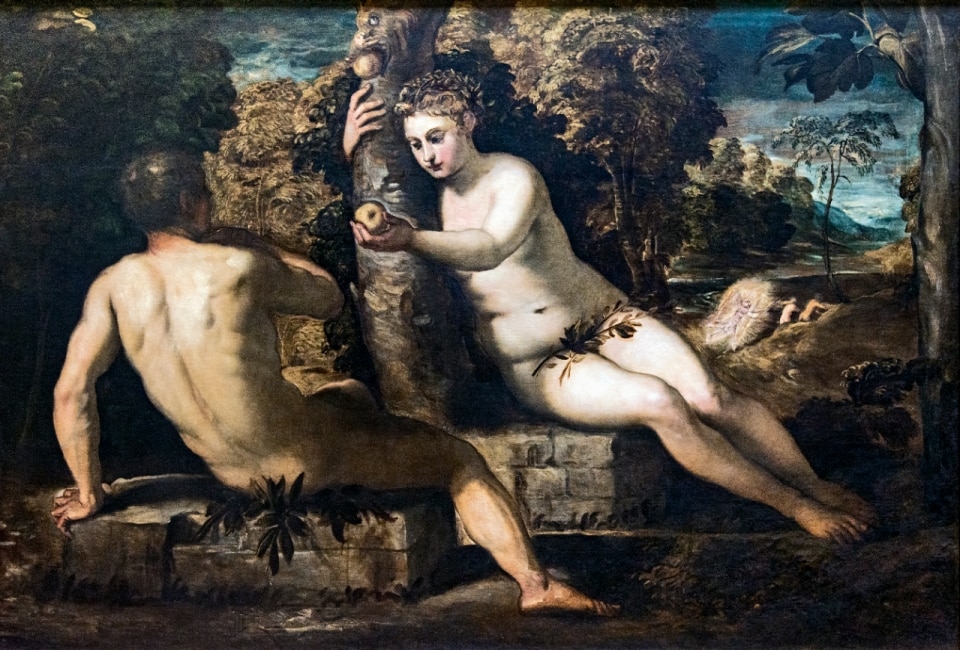
Eve extends her arm toward Adam, an apple in her hand. She leans against the tree. Her body tilted toward him as she offers the fruit. Adam recoils, though not completely. Tintoretto is not painting sin. He is painting desire.
The Book of Genesis never actually mentions an apple. It speaks only of “fruit.” Early Jewish and Christian commentators proposed figs, grapes, even pomegranates. The apple emerged through language itself, from the Latin pomum, which evolved into the French pomme.
What gives the painting its tension is not technique, but posture. Eve does not merely offer the apple — she presents it the way she presents herself, her torso bending forward, her gesture opening outward. The fruit becomes an extension of the body, an extension of invitation.
The apple is where the desire to know collides with the Fall, a paradox painters have both loved and feared.
And the apple in her hand — round, smooth, warm with light — is the precise point where theology becomes eros. There is nothing abstract about it. It has weight, scent, the texture of something meant to be bitten into. In Latin, malum means both “apple” and “evil”: one sound for two ideas history chose to bind together. Tintoretto paints the apple not as a symbol, but as a real object — desirable, dangerously beautiful. The apple is still there, in Eve’s hand. Still reaching toward Adam. Still warm.
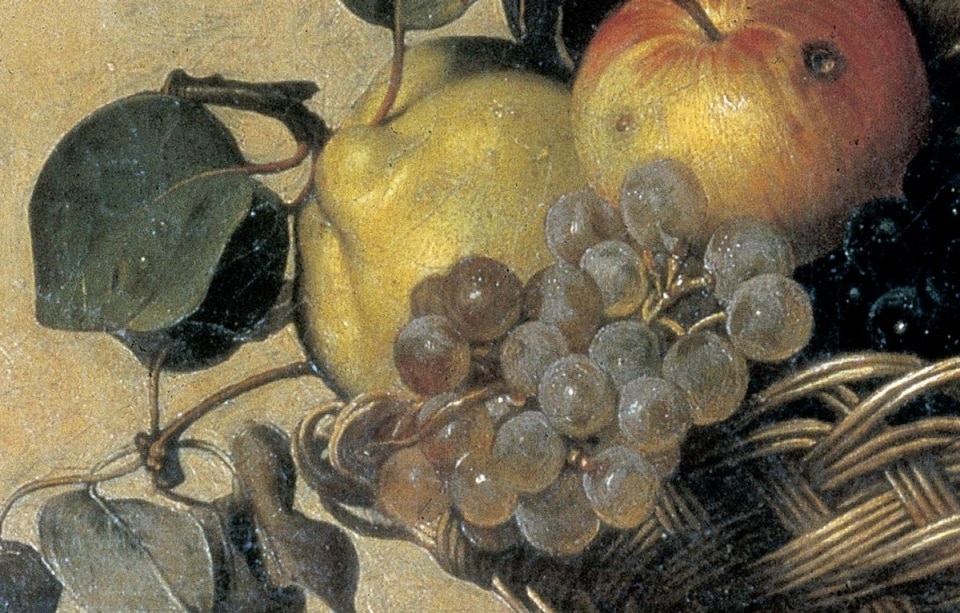
At the Pinacoteca Ambrosiana hangs Caravaggio’s Basket of Fruit, painted around 1599, a work that overturns every convention of ornament and beauty. Caravaggio strips reality bare, free of embellishment or correction. The fruit and withered leaves become symbols of both the fleeting nature of youth and life, and, in religious terms, the Passion of Christ.
There is no nostalgia in that basket, no aesthetic indulgence. Something far more radical is at play: the certainty that beauty and decay are not opposites, but the same condition seen from different angles.
Then comes the pomegranate, one of the most compelling fruits in Western painting. In the Middle Ages, it became a symbol of Resurrection, appearing throughout sacred and Renaissance art.
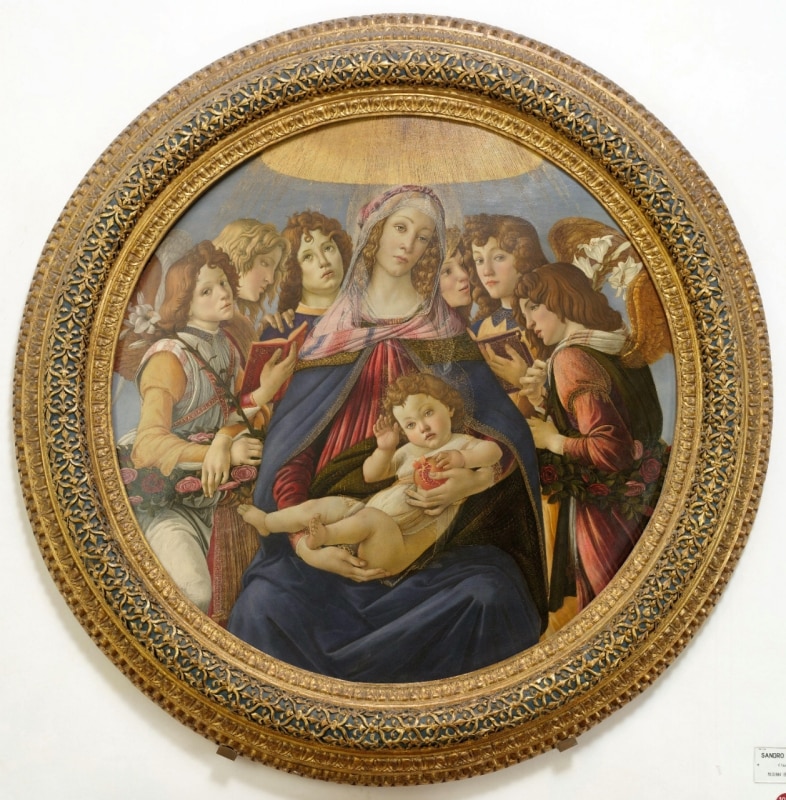
In Botticelli’s Madonna of the Pomegranate (1487), the Christ Child does not hold a symbol so much as a destiny. His small fingers close around the pomegranate alongside the Virgin’s, condensing into a single gesture everything theology had spent centuries trying to explain: motherhood and sacrifice, blood and unity, the individual and the multitude. The tightly packed red seeds evoke drops of blood not yet shed but already foreknown. To contain the entire economy of Redemption, there was no need for a theological summa. Fruit was enough.
Art has always used fruit to think through larger truths. Painters captured it to preserve it. And in preserving it, they granted fruit the only form of eternity it can possess: the eternity of the gaze.
Among all fruits, grapes hold the closest relationship to Christian symbolism, because wine becomes the blood of Christ in the Eucharist. In early Christian art, grapes stand for Christ himself, or for his blood. Yet with Dionysus, the grape also becomes intoxication, sacred delirium, the dissolution of boundaries between the self and the whole. The cult of Dionysus was tied to the mysteries of the afterlife, making vines and grapes enduring symbols of life beyond life — imagery later absorbed by both Jewish and Christian traditions.
In Baroque painting, these two dimensions — sacred and profane, Eucharistic and Dionysian — coexist with remarkable elegance.
However, it is in seventeenth-century Dutch painting that fruit finds its most rigorous philosophical form: the vanitas. A vanitas still life relies on symbolic objects to evoke the transience of life. The term comes from the biblical phrase vanitas vanitatum et omnia vanitas — “vanity of vanities, all is vanity” — and, like the memento mori, serves as a warning about the fragility of existence.
Fruit in these paintings is always suspended at the edge of change: perfectly ripe, fully desirable, yet already beginning to spoil. It is such an exact image of human life that it feels almost cruel.
Jan Davidsz de Heem, one of the great masters of the form, arranged every element with precision. Grapes and pomegranates suggest abundance and eternal life, while lemons symbolize deceptive beauty — brilliant on the outside, bitter at its core — as well as temptation, wealth, and the hidden bitterness of life itself. In de Heem’s work, fruit is never merely beautiful. It is eloquent.
Art has always used fruit to think through larger truths. Painters captured it to preserve it. And in preserving it, they granted fruit the only form of eternity it can possess: the eternity of the gaze.
Opening image: Caravaggio, Basket of Fruit, 1597-1600