

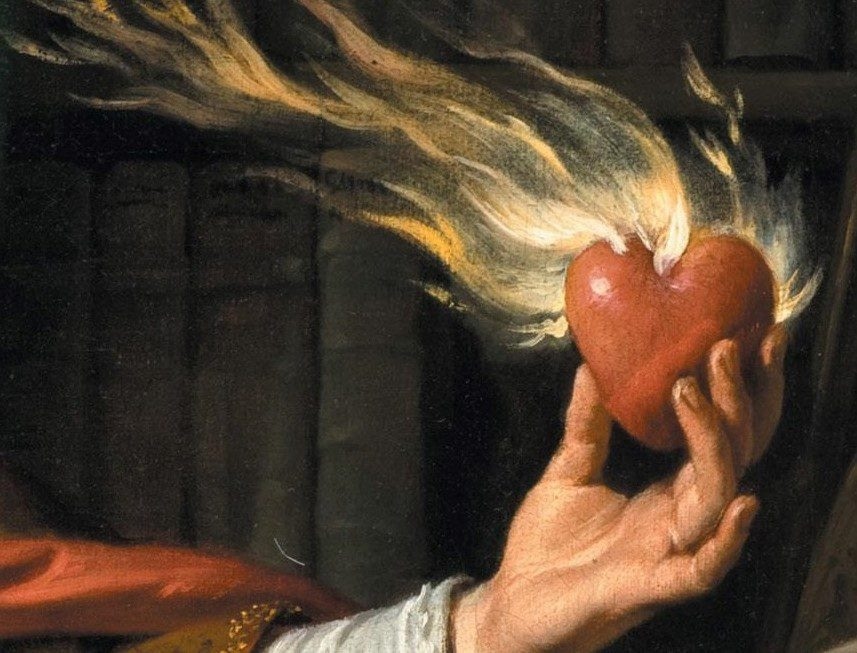
Three are the principal points along the vertical axis of the human body: the brain, the heart, and sex. This is not anatomy; it is cosmology. The human being is a map of the world, and the heart occupies its exact center, the junction between reason and instinct, between what is thought and what is desired. The alchemists understood this. They understood it before physicians, before philosophers, certainly before us.
In medieval and Renaissance hermetic thought, the heart is associated with the Sun. It is the igneous principle, the anima mundi pulsing at the center of the body as the star pulses at the center of the planetary system. The correspondence is not metaphorical; it is structural. The sun warms and illuminates; the heart warms and distributes. Gold, the solar metal par excellence, and blood share the same symbolic dignity: both precious, both in motion, both life-giving forces for what they contain. The Latin cor is already, etymologically, the root of cordis, of courage — a force that comes from within rather than from outside.
For the alchemists, the heart was the lapis cordis, the stone of the heart: not the philosopher’s stone in any material sense, but the point where spirit and matter converge, where solve et coagula, dissolution and formation, meet. To disturb the heart was to unsettle the individual’s cosmic order. Art translated this cosmology into images of extraordinary power. And it is here that the symbol ceases to be a concept and becomes tangible.
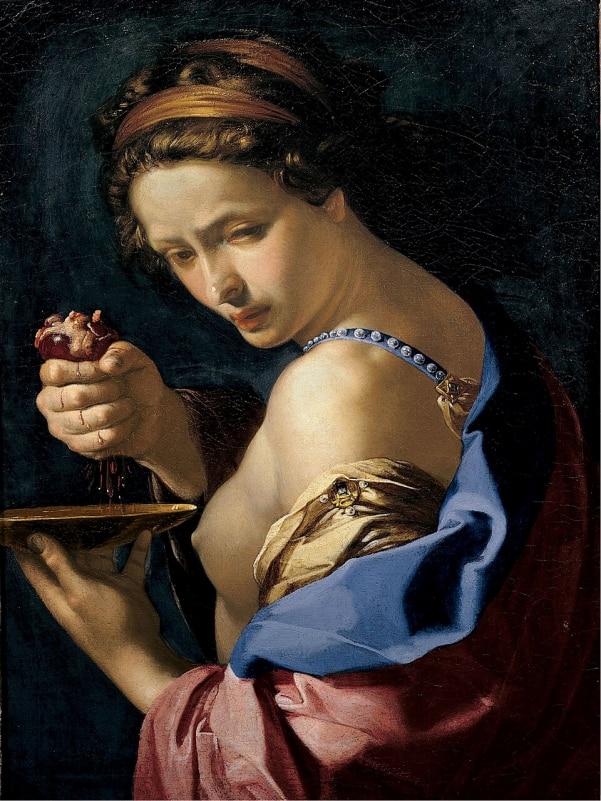
Bernardino Mei, the seventeenth-century Sienese painter, created one of the most visceral and literarily complex representations of the “idea” of the heart in the history of Western art. His Ghismunda, a small-format oil on canvas painted around 1650 and now housed at the Pinacoteca Nazionale di Siena, draws not from Scripture but from literature.
Boccaccio. The first novella of the fourth day of the Decameron: Tancredi, Prince of Salerno, murders his daughter Ghismunda’s lover and sends her the young man’s heart in a golden cup. In a final act of defiance against her father, Ghismunda drinks poison mixed with Guiscardo’s blood.
Art painted the heart as map, wound, flame, and gift long before physiology explained how it functioned.
Ghismunda’s hand grips Guiscardo’s heart with a dramatic, almost terminal force — a physical tension that becomes a moral position. Mei constructs the composition around a polarized structure: the lapis-lazuli blue of the dress set against the pallor of exposed flesh, not in pursuit of chromatic harmony but semantic contradiction. The formal beauty of color becomes the vehicle through which the violence of the subject turns unbearable. The blue-pink pairing does not decorate; it declares. It declares that sensuality and fragility are not opposing attributes of womanhood, but the same condition seen from different angles.
Iconographically, Mei’s choice of a Boccaccian subject is itself a statement. Mei abandons hagiography. He abandons the system of symbols that tradition had developed to render the vision of the torn, pierced, or offered heart acceptable: the martyr’s palm, the crown, the celestial light that justifies suffering. None of that is present here. Guiscardo’s heart is not transfigured; it is anatomical. A perfect human heart. The dense, material brushwork refuses all sublimation. What we see is exactly what it is: an organ removed from a once-living body, now dead, now held in a woman’s hand like evidence presented at trial.
The painting neither consoles nor elevates, neither mediates between the real and the divine: it records. And in recording — with that technical brutality that is also a form of intellectual honesty — it accuses. Not Ghismunda. Not Guiscardo. But Tancredi: the father, the sovereign power that disposes of another’s life and sends back the remains as warning. The heart in the cup is the language of power; the heart in Ghismunda’s hand is the reply — not supplication, but defiance.
Yet the heart in art was not articulated only in the Baroque era.
In the thirteenth century, the illuminated manuscripts of courtly love introduced the heart as a love token: the knight literally offers his heart to the lady, and the lady accepts it, destroys it, or locks it in a casket. In the Roman de la Poire, the celebrated allegorical romance in French verse, the heart appears as a tangible object, passed from hand to hand like a jewel or a legal document. The metaphor had already taken on flesh.
“You pierced my heart with your love,” wrote Augustine of Hippo in addressing God. A recurring image in seventeenth-century painting, the “cardiophore” saint is one who holds in his hand a flaming heart or a heart pierced by an arrow, the sign of deep love for the divine.
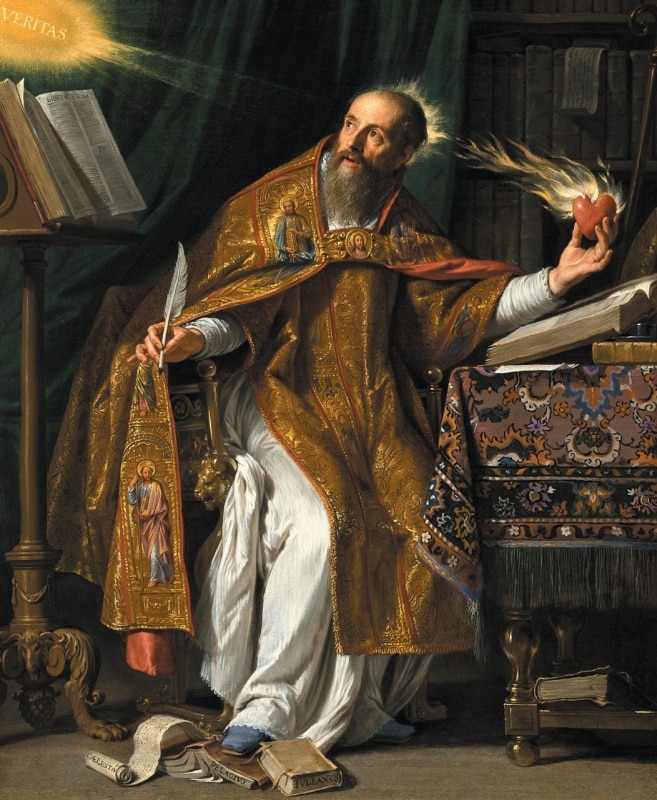
Philippe de Champaigne, the seventeenth-century French painter, portrayed the saint holding a blazing heart. Emblem, convention, devotional ornament. An attribute like any other — a symbol placed in the saint’s hand so that the faithful might recognize him and move on.
And yet, in the painting preserved at the Los Angeles County Museum of Art, Saint Augustine, the saint does not display the heart; he withholds it. The difference is immense, and entirely pictorial. Display addresses the viewer; custody looks elsewhere. Augustine looks elsewhere. The heart rests in his hand like a secret shared with someone who is not us.
Champaigne was a Jansenist. This is not a marginal biographical detail; it is the key to everything. For Port-Royal — the intellectual and spiritual community he frequented and deeply admired — grace could neither be earned, exhibited, nor negotiated. It arrived, or it did not. Augustine’s flaming heart is not an achievement, but a wound received. The arrow does not travel from the saint toward God; it travels from God toward the saint. The direction changes everything.
The heart in the cup is the language of power; the heart in Ghismunda’s hand is the reply: not supplication, but defiance.
Champaigne’s painting is structured around emotional tensions traced through the oblique lines that organize the composition. Light falls across Augustine with the dry, almost austere quality that defines the painter’s mature work: not the warm, enveloping light of the Italian Caravaggisti, nor the theatrical radiance of the Roman Baroque, but something closer to evidence itself — light that reveals things exactly as they are, without embellishment. The heart burns, yet Champaigne paints it with the same precision he would devote to a book or a hand. The fire is convincing because it is described, not amplified. Augustine holds a burning heart. He does not show it. He does not offer it. He knows it.
Art painted the heart as map, wound, flame, and gift long before physiology explained how it functioned. Because what interested artists — and alchemists — was never the muscle itself. It was what the muscle contained: the first principle, the beginning of all things, the exact center of everything human.
Along the vertical axis of the body, the heart occupies the middle ground. Neither above, like the contemplative brain, nor below, like the desiring sex. At the center, where everything that truly matters ought to be.
Overview image: Philippe de Champaigne, Saint Augustine, 1645-1650, Los Angeles County Museum of Art. via Wikimedia Commons