

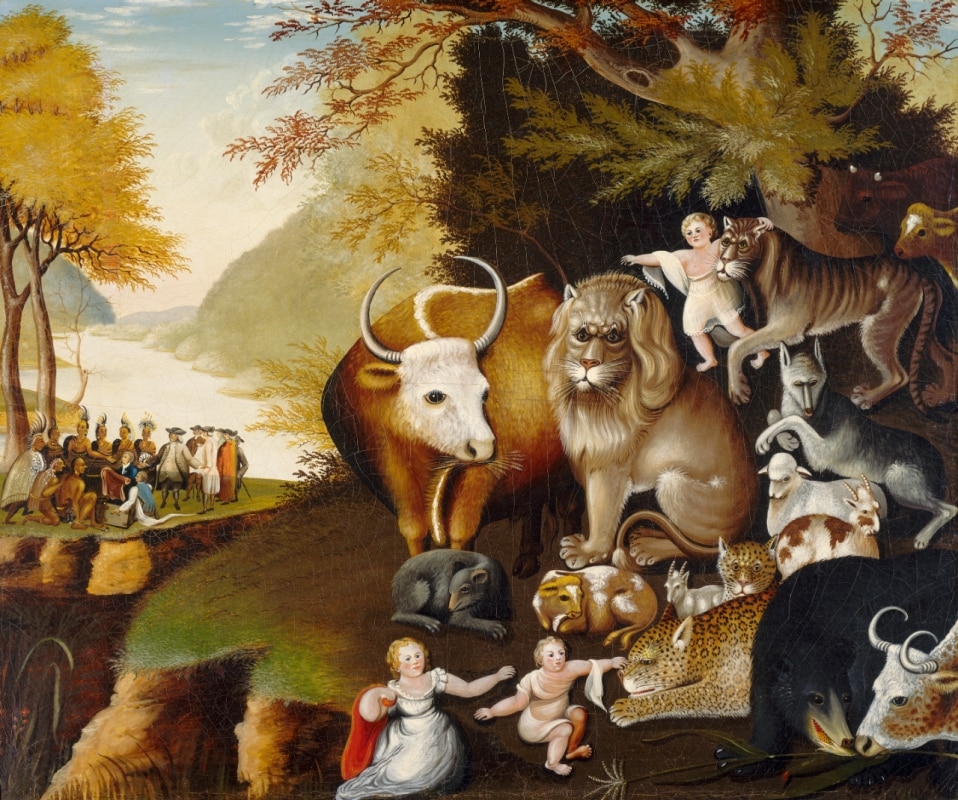
There is a painting every American knows even without ever seeing it. They carry it inside them, like a recurring dream—one they cannot explain but recognize the moment it appears. It is called The Peaceable Kingdom. Edward Hicks painted it between 1820 and 1849, more than sixty versions of the same scene: the lion beside the lamb, a child stroking a wild beast, and in the background, William Penn shaking hands with the Lenape. An America that never existed, painted by a man who desperately wanted to believe in it. The nation’s first great comforting lie.
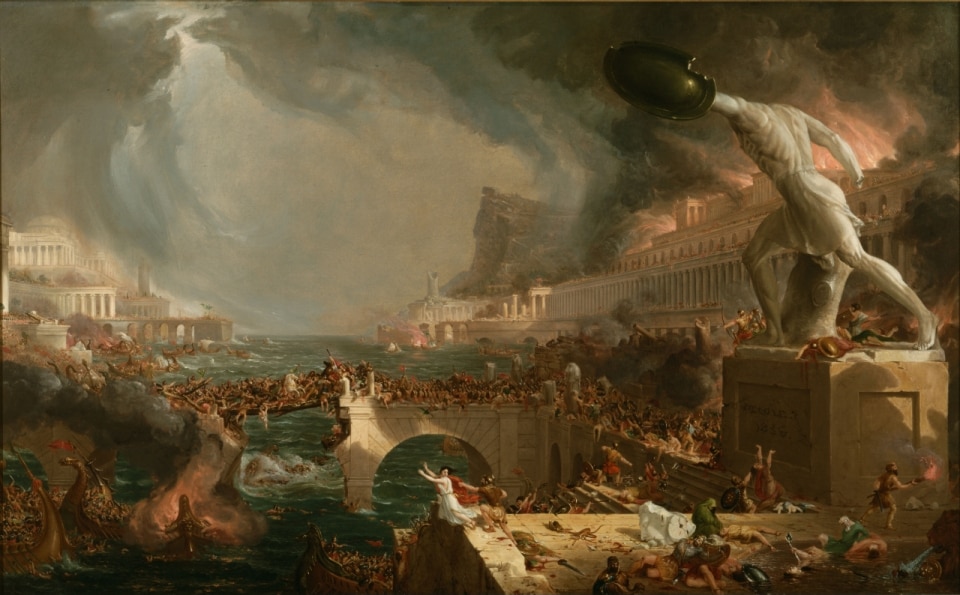
The entire American imagination lives inside that tension: the longing for innocence and the dark awareness of guilt. Even before Hicks, it was already there in the landscapes of Thomas Cole, founder of the Hudson River School. In the 1840s he painted virgin forests like Gothic cathedrals, rivers like paths to redemption, mountains like God’s promises. But Cole knew that nature was already doomed. His cycle The Course of Empire remains the clearest prophecy ever made about a country that was not yet fully born—and was already imagining its own end.
America has always told its story in images before words. Not by accident. It was a country without a long enough past to turn into poetry, so it invented its mythology in color. Winslow Homer painted sailors and newly freed slaves with the same austere dignity—no rhetoric, no sentimentality. Albert Bierstadt turned the Rocky Mountains into mural-scale visions, not to document them but to make them unreachable: beautiful as Paradise, uninhabitable as a dream.
America has always told its story in pictures before words.
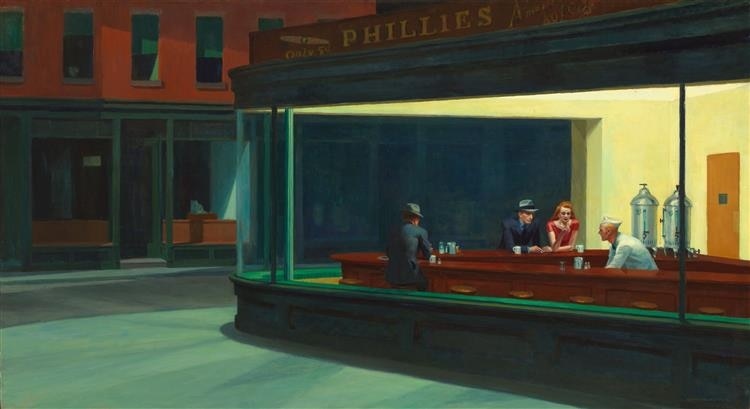
Then came the twentieth century—and with it, the crack. Edward Hopper understood before anyone else what was happening: America was not a country moving toward something. It was a country slowly emptying out. His Nighthawks from 1942 shows four figures in a brightly lit diner at night. No one looks at anyone else. No exit is visible. Loneliness not as tragedy, but as architecture. Hopper painted motels, highways, Sundays when time refuses to move. He painted the future of a country that had won the war and did not know what to do with victory.
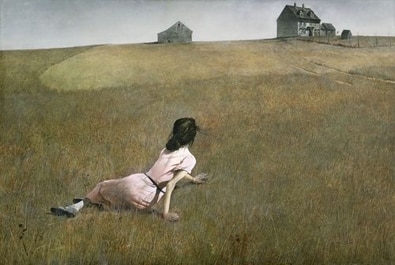
At the same time, Andrew Wyeth painted Christina's World: a woman crawling through a field toward a distant farmhouse. It looks American. Simple. Almost pastoral. But Christina Olson was disabled, unable to walk. That house in the distance might have been forever out of reach. The American Dream reduced to effort, strain, distance. Few noticed at first. The painting was beloved. It was beautiful, rural, reassuring. America has always loved its symbols of defeat as long as they appear as victories.
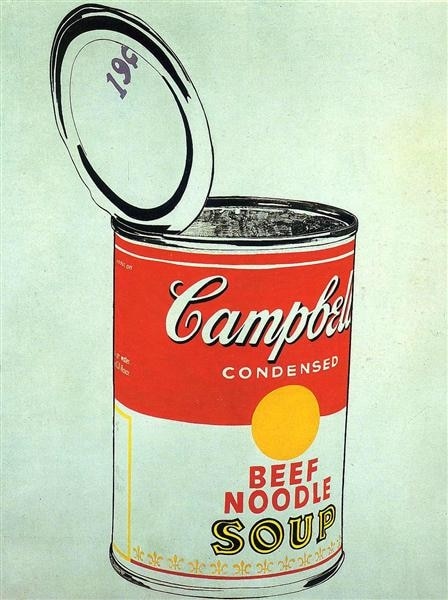
Then came Andy Warhol, and the circle closed in an unexpected way. Warhol did not depict the country—he reproduced it. Marilyn Monroe. The electric chair. Campbell’s soup cans. Dollars. Mao Zedong. Everything is on the same level. The same serial technique. The same absence of emotional hierarchy. He was the fiercest critic the country could have—and the most invisible—because he seemed to celebrate what he was dismantling. Had consumerism devoured art? No, it hadn’t. Art had devoured consumerism and taken its shape to survive inside it.
Then came Jean-Michel Basquiat, straight from the street, with spray paint. His canvases are skulls, crowns, crossed-out words, Black bodies demanding a name. Copyright as protest. Anatomy as resistance. Basquiat did not ask to enter the American imagination. He broke through it. He died at twenty-seven, in 1988. America quickly turned him into an icon to sell.
In the 1990s, Kara Walker cut black paper silhouettes and pasted them on museum walls: plantation scenes, slavery, violence. Elegant in form, like the shadows of a puppet theater. Beauty as bait. Horror as content. Meanwhile Jeff Koons built enormous, hyper-polished objects—the balloon dog, the steel rabbit—and called them sculpture. They were mirrors. You looked at them and saw yourself distorted, enlarged, ridiculous in your desire to own beautiful things or to understand something that was never meant to be understood.
And now? Now America has returned to painting itself with a thick, confident brushstroke, free of doubt: Make America Great Again. A slogan that is, above all, an aesthetic act—the return to an imaginary past that never existed, just like The Peaceable Kingdom. The same nostalgia for innocence that never was. The same desire to believe in something simple enough to fit on a red cap. A prayer that anticipates war. The American oxymoron.
Contemporary art responds with the tools it has, including installation, photography, performance, and artificial intelligence. However, the question remains the same as ever: who belongs to this story? Who has the right to depict—and who is merely depicted? Titus Kaphar repaints old portraits, erasing the white figures and bringing forward the Black ones who had always been there, hidden in the background.
Contemporary art responds with the tools it has. However, the question remains the same as ever: who belongs to this story?
Institutions like the Museum of Arts and Design, the Whitney Museum of American Art, and the Museum of Modern Art—along with dozens of private collections—are rewriting their holdings with an urgency that feels almost like panic. It may already be late.
The American imagination was born from contradiction and still lives by it. A country founded on freedom while holding slaves. A nation that proclaims equality while excluding women, Black people, the poor, Indigenous peoples, immigrants. A nation that painted paradise on lands it had seized by force. That tension never resolves. It can only be represented. And in that endless, obsessive, violent, moving act of representation lies perhaps the only form of truth American art has ever produced. Thomas Cole understood this two hundred years ago. Every dream has a final act. It is called ruin. But look closely—even in the ruins, there is still light. Not enough to save anyone, yet perhaps enough to paint the next chapter.
Opening image: Edward Hicks, The Peaceable Kingdom (1826)