As I am writing this piece, it has become official that Orhan Pamuk has left Istanbul. I had just arrived in the elegant neighbourhood of Nisantasi to play homage to Hrant Dink in the place now covered in flowers where he was shot from behind in front of the window of a watch shop alongside the entrance to his newspaper office.
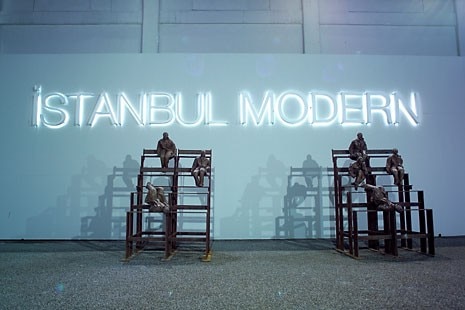
It’s difficult to ignore the current state of affairs, whilst Turkey and in particular Istanbul - fallen capital of an empire whose dismemberment we still read as at the roots of the principal conflicts in the modern world – are at the centre of the debate on Europe. ‘Modern’, ‘modernisation’, westernisation’, ‘identity’ are central words, that reoccur in conversations, books, writings, discussions about this beautiful city, at the point where Europe and Asia meet but according to geographic conventions on the borders of both. At Istanbul, the Museum of Modern and Contemporary Art has been up and running for just over two years, with its mission already indicated in its name: Istambul Modern.
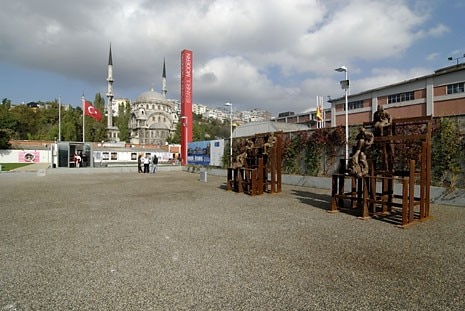
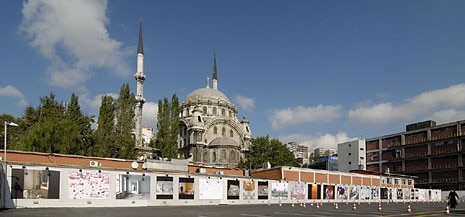
Housed in an ex warehouse building by the Bosforo, on the quayside between Tophane and Karaköy where passenger and goods ships still dock, the museum opened in December 2004. As well as bringing together an initial nucleus of Turkish modern art– which it aims to expand – it intends to present itself as a fixed point of reference for the artistic community; during the few years since its opening it has been visited by over two million people and become also one of the obligatory tourist attractions for outsiders coming to the city.
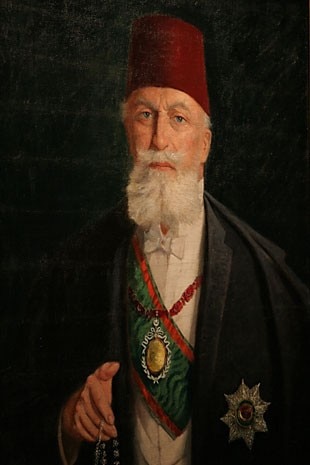
Bearing in mind the initial caution of artists towards the figurative in the light of a tradition that is basically iconoclastic, the origin of modern Turkish painting could be said to go back to the mid 19th century with the work of refined intellectuals linked to important figures within the Empire such as Osman Hamdi Bey (also an archaeology enthusiast and responsible for the fine archaeological museum) or - Abdülmecid Efendi, son of Sultan Abdülamid II, last descendent of the family to live in the palace after the dethronement of his father, apart from anything else an enthusiastic painter who is known for his delicate intimist portraits.
In Turkey, the tension of modernity, also in a dialectic manner, is interwoven with the Republic’s political events and the forced process of westernisation already present, begun during the years before the fall of the Ottoman Empire; an open debate not without its contradictions. Pahmuk’s words come to mind “Westernisation has given me and millions of my fellow citizens a taste for finding our history ‘exotic’”.
Istanbul Modern is an institution backed by the government but has basically private roots, sponsored by a Turkish Telecom fresh from privatisation and very much wanted by the Eczacibaci family – also patron of the Istanbul Biennale that in the next edition curated by Chinese Hu Hanru will be examining the difficult theme of modernity in its relation with the east and alternative models for westernisation.
Director David Elliott came to Istanbul from Stockholm, passing via Tokyo (he was director of the Moderna Museet and the Mori Art Museum) after training at Oxford. Like the geography of his experience as a director, Elliott states a desire to orientate his programme not only on the various expressions of Turkish art but – established in the heart of the city that has always been considered the bridge between east and west and a cultural crossroads – to be open to receiving various signals that come from a larger region that goes as far as understanding the Balkans, the Caucasus, the middle east and North Africa as well as central Asia: an area, for centuries crossed by populations that share a common belonging.
From this privileged observatory, Elliott proposes to focus on the creative vitality expressed in visual arts in an area that is increasingly central to the sociopolitical future of both Europe and Asia according to a vision of art placed within a global dimension (in the sense of a phenomenon that embraces the entire globe) alongside a new system of multipolar relationships.
http://www.istanbulmodern.org