What is a monument? Is it a work, a sculpture, a representation of death, or even architecture that serves to remember? Brother Egidio, who produced an explanation of the Gospels in Italian, affirms that burial grounds are called “monuments” because it is their duty to urge men to ponder the inevitability of death. For several centuries in Europe monuments have performed a similar purpose: to remind us of the fallen in war.
As the historian Reinhart Koselleck explains, until World War I memorial monuments were for kings and erected according to classical iconography, such as St George on horseback slaying the dragon, the earliest model of which was erected in Prague in 1373. But from the 1910s, at Marylebone in England and Regen in Germany, a democratisation of death memorials afforded the humble soldier this sovereign place. Koselleck maintains that the memory of the names of soldiers who died in war, inscribed on countless monuments in European towns and villages, stems from the creation of popular armies after the French Revolution.
These armies called upon their citizens to defend the ideals of 1789 and export them at bayonet-point throughout Europe. Monuments are solidly associated with war, although in their iconography, writes Koselleck, they retain their monarchical origins. In his opinion one of the greatest early 20th-century events was the democratisation of death as seen in the monument to the Unknown Soldier. Here is the symbolisation of “anonymous mass death”, the tangible sign of a “structural, or even anthropological community”. Until the 1930s the idea of the monument remained tied to the image of a glorious, meaningful death, of men who had laid down their lives for their country. But after the conflict waged in Europe by Nazism and Fascism, the idea of a just war, which had already been questioned after the great massacre of 1914-18, began to fade.
No war appeared worthy of a monument, perhaps not even the Allies’ victories that left millions of dead on battlefields and in cities razed to the ground during World War II. As a result, what sort of monument should be erected in remembrance of the millions exterminated by the Nazis in the concentration camps? Peter Eisenman accepted the challenge to create a monument to the European Jews killed in gas chambers and buried in common graves, slain by the murderous fury of men and women who had organised a senseless massacre with the instruments of modern industry. The architect’s brief was to build a monument without names or dedication in the centre of Berlin.
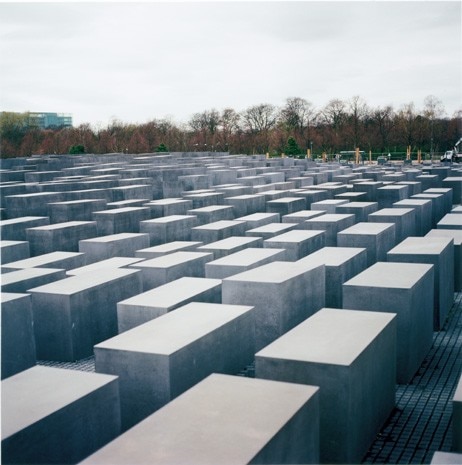
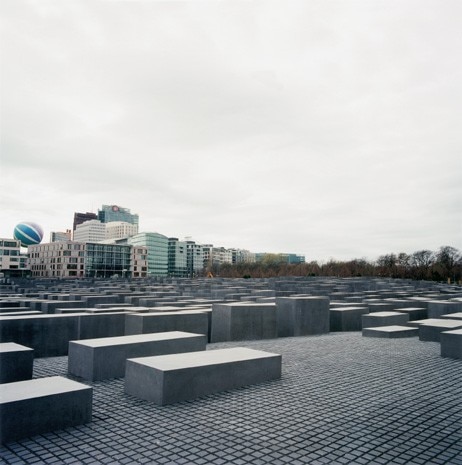
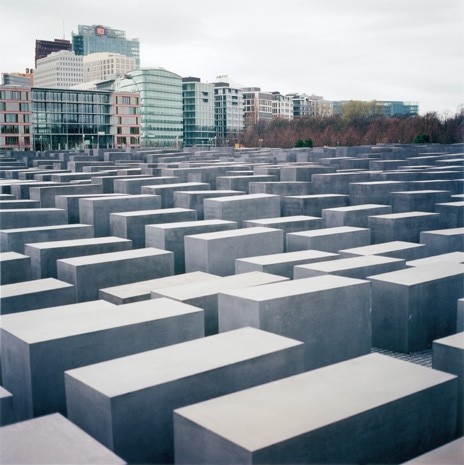
It would stand near the Brandenburg Gate, not far from Adolf Hitler’s Chancellery bunker, along the line where the Wall once stood and close to the hyper-modern headquarters of the new Germany’s governing institutions. I visited the monument, composed of 2,511 stone pillars, in March. It had not yet been completed in all its detail and heavy snowfall had partly covered it, making it even more evocative. The vast war cemeteries built after World War II are all alike in shape, size and colour, with their anonymous and homogeneous stone markings and white crosses as symbols of everlasting rest. But here the monument is transformed into something different and paradoxically disquieting. No bodies are buried here. As you approach the area you realise the tombs are not all alike, that they possess a lower as well as an upper dimension.
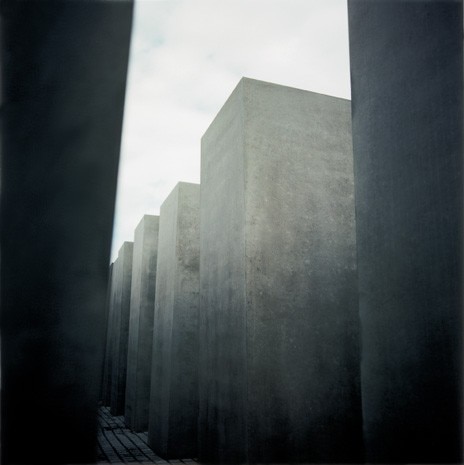
Towards the centre of this postmodern necropolis, the lower part of these concrete forms sinks into the ground to reveal a subterranean quality that is at first glance inaccessible. The urns, a few centimetres high along the edges of the field, tend to get taller as you walk towards the centre of the monument, which is geometrically and symbolically unreachable. There the shrines, similar to tombs in certain Renaissance frescoes, are transformed into monoliths reminiscent of the mysterious “object” in 2001: A Space Odyssey. The headstones are all the same size, the top measuring 95 by 238 centimetres and made of a blackish-grey concrete sharpened at the corners. At the centre they are 4 metres high, transformed into fossilised trees like a forest of stone.
They are all perfectly square, though they generate crooked perspectives depending on where you stand. From the outside you can’t see the “inside”, and you can’t see the “outside” from the inside either because the headstones are not perfectly perpendicular: their upper and lateral surfaces are slightly tilted, suggesting a misalignment. Their irregularity and instability are true to another architectural hinge element of Peter Eisenman’s monument: the idea of a gap, an “interstice”. The space described by the monoliths is a space “between”, something produced by absence, as if this place were accessible only by subtraction.
This is time inhabited by the victims, their own time but also ours: a suspended, interrupted, virtual but nevertheless present time. The anonymous appearance of the whole structure, with no names or words, acquires significance in the central corridors. Sinking and rising, the grey arches evoke a permanence in time and space; time as a corridor and, more abstractly, as a “nervous system of space”. One of the questions Koselleck asks in his essay Monuments: A Subject for Collective Memory? concerns memory itself. In our culture we often speak of “collective memory”, as if a collective being capable of remembering really does exist.
In truth, as each of us can testify, memory is strictly personal: the experiences of individuals are not interchangeable. Even when they concern a shared traumatic event, memories remain personal. Each person has the right to their own memory, without which it is not possible to live. Monuments on the other hand seek to transform the memories of individuals into a shared memory and they are not always successful. At times they force individuals’ memories in an ideological direction. Eisenman seems to have given himself the task of turning the monument into an individual experience. But no matter how uninhabitable this space is, it is navigable: there are neither barriers nor gates.
In Maya Lin’s monument for the 60,000 Americans killed in the Vietnam War, the Vietnam Memorial in Washington is a slab of polished black granite with all the names of the fallen inscribed on it and in which visitors are reflected. Likewise in Berlin, the structure designed by Eisenman produces a spatial experience, reversing its outward sepulchral nature. It is a remembrance of the dead but also a meditation on our vital space. For this reason the underground construction of the Ort der Information, containing an archive of names, photographs, display cases and other services, appears debased. It feels like a sham and a belated concession to the necessity to inform and comment on what clearly obsesses its German clients.
This is the exact opposite of Eisenman’s proposition. In the Ort der Information, collective memory prevails over the personal - or at the least obscures its difficult dialectic. But should didactics come first? Is this an unforgivable weakness? Perhaps it once again shows the need to create a politically correct “political memory”.