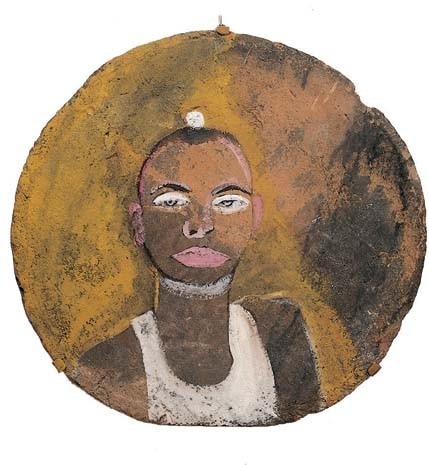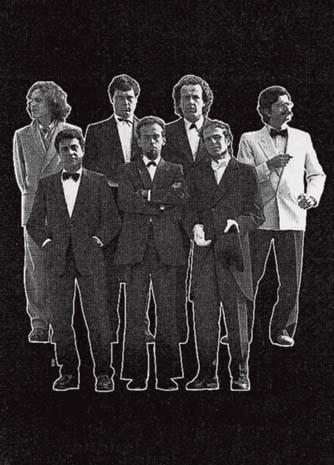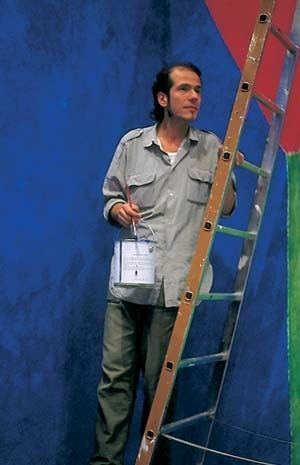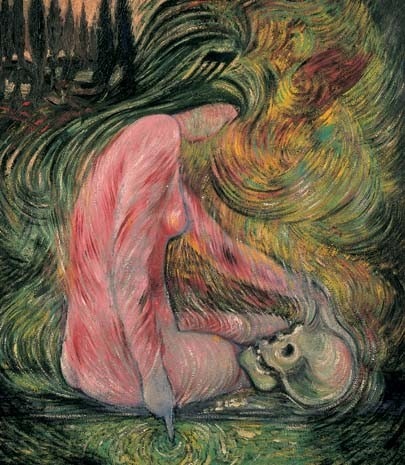
The inevitable gap created between the observer and a work of art from the past, even the recent past, leaves little room for the feelings and emotions of those who may have personally experienced that period. Although crowded with live faces, voices and emotions, the critic's memories are compulsorily subjected to revision by the intellect. He must reconcile the pleasure of nostalgia with the necessity for retrospective consideration, the illusion of youth with the reality of maturity. In short, with the need to question even his own ideas, even his own memory.
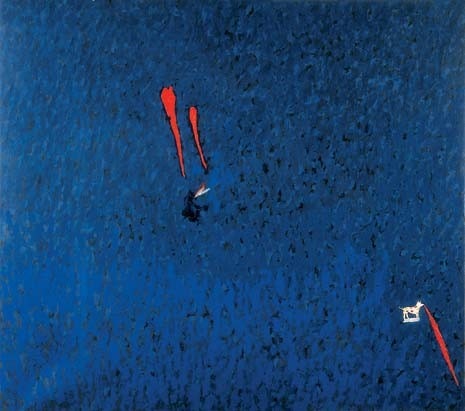
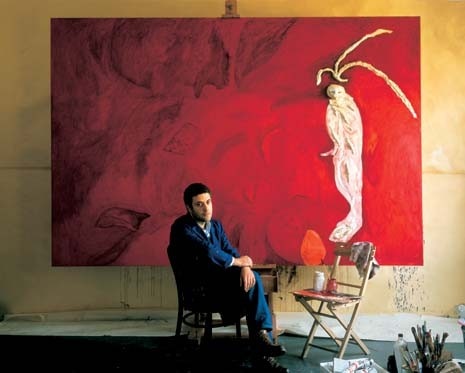
For example, in a perspective cynically adjusted to the times, it may perhaps be a socio-psychological consolation to have known the personal nature of artists like Mimmo Paladino, Enzo Cucchi, Nicola De Maria, Sandro Chia and Mimmo Germanà, back in the roaring Eighties. But the fact remains that the artistic tendencies and phenomena that flourished in that decade – under the generic label of postmodern (architecture), neomodernism (design) and, for Italian art, Transavanguardia – marked for the work and role of artists in Italy a metamorphosis, and with it the joys and suffering of an irreversible transformation.
For a long time a gilded provincial circle had prospered, in which dealings were confined almost exclusively to those between the client (the gallery) and the artist, with a simple and final consecration by the “public”, the collector or the user (in the cases of design and architecture). But the implosion of Pop culture witnessed, in Italy too, the onslaught of art as a fully-fledged business. And with it came such entirely new figures as the trend-setter, the marketing expert, and the powers governing the international system of museums (which had begun to expand in a big way). Plus, of course, the communication pundits.
These combined forces, which also tended to act as the undemocratically elected representatives of the public itself, subjected artists to an unprecedented psychological and cultural pressure. Artists were called upon no longer simply to perform the privileged role of craftspeople producing a work. Instead they were expected to act as mediums, capable of transferring into the object all the – only apparently superficial – complexity of heavy cultural and market conditions.
The haunting exhibition, dedicated in recent months by the Castello di Rivoli to the Italian Transavanguardia, comes moreover as a final corollary to the theorem in its time demonstrated by the critic Achille Bonito Oliva. He had gathered together a number of artists who were united certainly by their age group, but divided by visions no less certainly remote in time and thought. Supporting them with a barrage of exhibitions, writings, essays, books and interviews, Bonito Oliva carried through a unique operation: he established an “artificial” art movement. Not that the artists concerned are not animated by a natural talent.
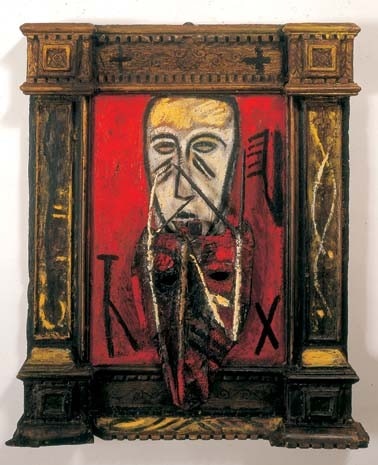
On the contrary, hidden among them are some of the best exponents of Italian art of all time. Take Mimmo Paladino and Enzo Cucchi, who alone represent the ideal link between the grand tradition of classical painting and the innumerable suggestions offered by the recent decadence of Italian society, as a result of its contact with other unexpected and mysterious cultural situations, religions and mystiques old and new, from consumerism to miscellaneous exoticisms.
Transavanguardia, and in consequence the artists that built its myth, are artificial because they are in fact the fruit of what is primarily a linguistic device, for which we are indebted to Bonito Oliva: that of a fascinating idea. Encapsulated in a neologism the idea was that the original concept of avant-gardes having run its course, it could be reinstated, really or virtually, as a pseudo-avant-garde joining them all together, or running simultaneously through them all.
Though disarmingly simple, it is a concept flavoured in the course of time by infinite shades of meaning of which again Bonito Oliva has been the most impassioned but disenchanted citharist (“Depth of Surface” for Chia, “Curved glance” for Cucchi, “Painting of Cupola” for De Maria, “Forms of Paradise” for Paladino, “Frontier of Images” for Clemente in the catalogue of the Rivoli exhibition). But precisely because it is so simple, it had an explosive effect on the art market, as did for that matter the name “Arte Povera” coined by Germano Celant ten years earlier in connection with other artists.
Curators and critics eager to catch up, but above all museum directors, saw Transavanguardia as a means of reconciling themselves – throughout the Eighties and part of the Nineties – with the public and collectors, by offering them a cocktail of symbols, figures and colour which only a short while before would have been indigestible to many but became instead agreeable to all. Who would dare suggest that Paladino is not a great painter? Who could find anything superficial about the works of Enzo Cucchi, the one who endeavoured most to mingle genres and techniques, becoming a poet, writer, architect and even designer of books, works and objects?
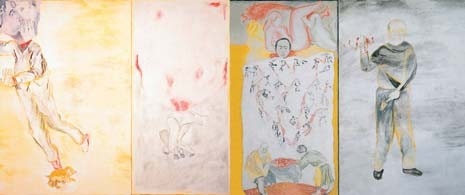
Nor can anybody ever state that Chia’s works do not recount dreams or think that De Maria’s colour does not in itself contain the essence of poetry, or deny that Clemente’s visions have not a germ of healthy folly, of a kind that has always been shared by the mentally ill and artists. For they both want the world to believe in their visions, even if the world has no intention of doing so.
The real novelty of the Transavanguardia, however, lies in its being the first (and perhaps last) episode in the outright marketing of Italian art. For no such marketing operation has been devoted, and probably never will be, to many of the artists, especially painters, who preceded Transavanguardia – from Capogrossi to Carla Accardi, Piero Manzoni to Pino Pascali: namely the pursuit by galleries, museums and the art trade, of a speculative strategy along American lines. A strategy focused on varyingly heroic or ordinary artists living or dead, backed by heavy investments of energy and money (right up to the apogee of apologetic shows staged by the MoMA, Guggenheim, MoCA, etc) designed to make them the blue chips of the art market.
Otherwise there would be no explanation to the feat of Jeff Koons’s giantisms, to the albeit fluctuating enthusiasm for the monstrosities of Dinos and Jake Chapman, but it also explains the outstanding opportunity given by this system to the very young Matthew Barney. Against a plethora of “bright ideas” and television-inspired epigones of Dada and New Dada, the sentiment of experience lived gains the upper hand over the reason of research, and kindles the illusion of a small, successful resistance to the fate of decadence. Also, it heightens the paraesthesis of the Italian Transavanguardia as a generous season of youth in Italian art, though brief and already over.