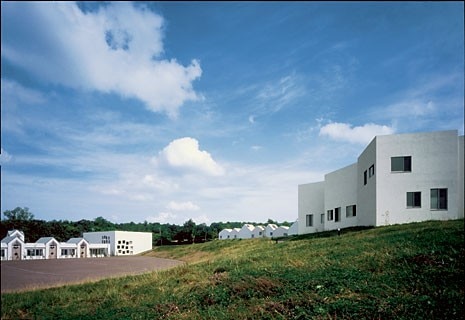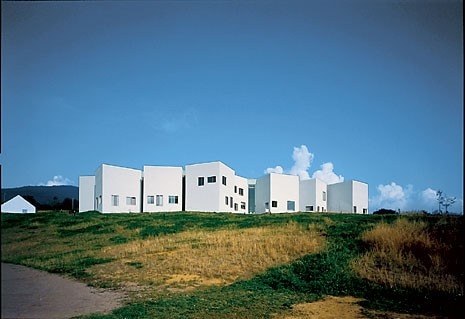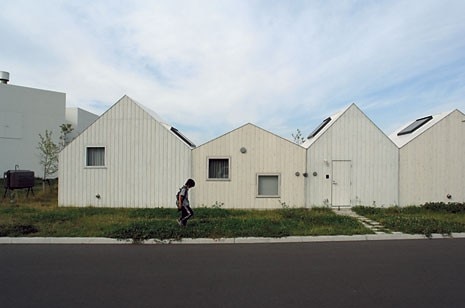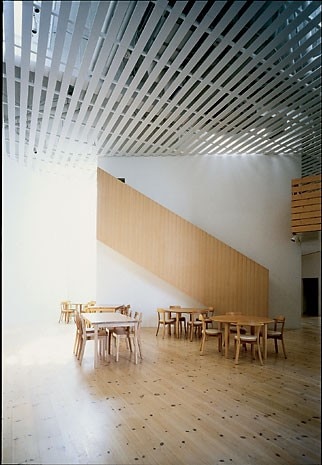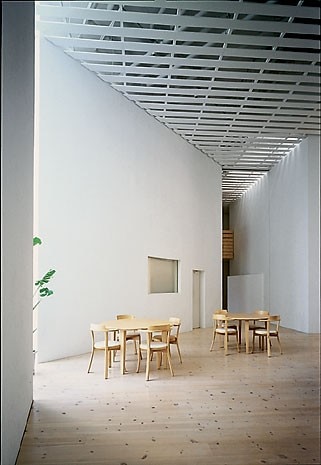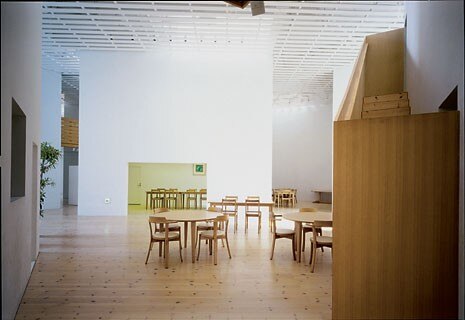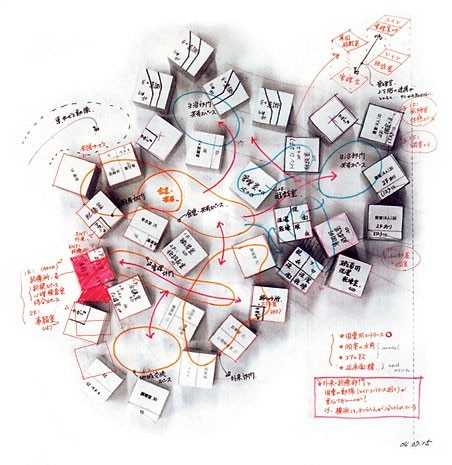
The Children’s Centre is in Fujimoto’s native Hokkaido. A residential facility where psychologically damaged young people live and heal together under medical guidance, the facility has a complex programme requiring insight and sensitivity. The architectural responses are disarmingly simple yet possess an inner complexity. The smaller element, the “7/2 House”, accommodating two families, is a child’s drawing of a house, overlapping seven times. Interior and exterior diverge, creating “various spatial landscapes between articulation and continuation”. The larger element is a residential care facility for up to 30 children. It is a collection of 24, 2-storey white cubes of nearly identical size that appear to have been scattered at random, as if a bowl of dice had been upset over the site model, hitting instantly on the final scheme. Functions requiring privacy, quietness or concealment, such as sleeping, bathing and ablution, consultation and meeting rooms, and storage are accommodated in the cubes. Other activities, through which the social life of the community is constituted and its therapeutic effects mobilised, occur in the spaces between the cubes, occasionally interpenetrating them.
These are buildings filled with what Fujimoto calls “useful ambiguity”. The spatial composition eschews hierarchy and diagrammatic legibility in favour of overlapping local centres. Although unconventional, the client (a doctor) saw the potential of such spatial qualities as an asset to the children’s healing process. The abundance of irregular alcove-like spaces in the residential block, with various degrees of connection to and separation from the public realm, enable children to tune their “sense of distance” intuitively – the balance between privacy and social connection, the need to be embraced and the desire to explore. Fujimoto has long been interested in the architectural potential of a “precise randomness”. The idea of using this approach in the project occurred while watching children play with boxes during a visit to a similar facility in the early design research for this building. In making assemblies in response to situations or materials immediately at hand rather than according to an overarching or predefined plan, children seemed intuitively to capture the qualities of complexity and ambiguity, ingredients that Fujimoto sees as underlying the appeal of traditional urban spaces. “I think that this kind of method of making, in which elements respond mutually to each other but without reference to a larger organisational pattern, results in a ‘soft order’ that is very interesting, and very powerful.”