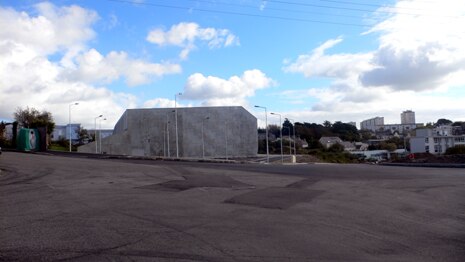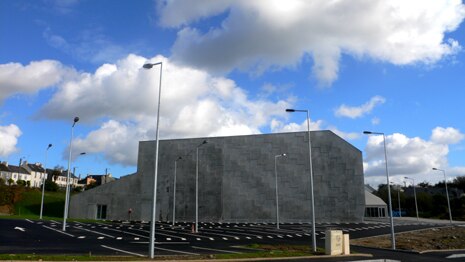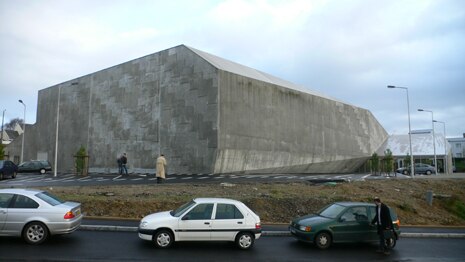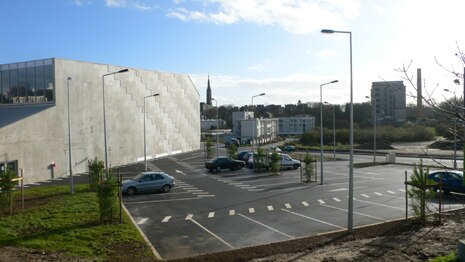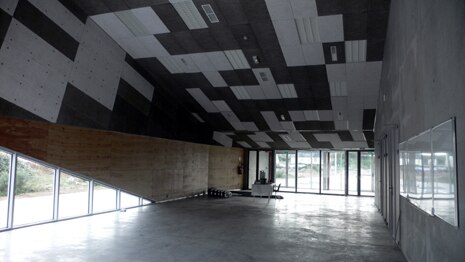
French architecture practice Block has recently completed a sports complex at Brest, a port in Brittany on the western coast of France. The architects’ idea seems to have arisen from a simple analysis of the brief with the composition of the entire building generated by the arrangement of a series of functional volumes. The sports complex, destined to host regional competitions and the city’s various sporting associations, consists of a main sports hall extending over 1,000 square metres, a second one of 650 square metres and a multi-functional hall covering 170 square metres, surrounded by a green area and parking for 40 cars. These volumes, regulated by sporting standards, are adapted to the topography of the original site and seem to be packaged in a skin of printed concrete; a large shoe box textured with the famous diagonal Adidas stripes. The design appears as a hybrid form that lies somewhere between an industrial hangar, the generic image of sports graphics and a bunker.
A work of architecture that is also an easily identifiable sign, a conceptual work that through processes of cross breeding, contamination and sampling seeks to develop a derivative product to reread and rewrite the urban and natural scenario, where the architecture tends to disappear to fuse with both real and virtual elements of the context The external area has been remodelled to hide a number of functional volumes, while a simple asphalt surface for the car park is inhabited by tall pylons of light. Once inside, crossing the hall, one reaches a central circulation axis that is used to articulate the flow of the public and allows access to the various sports areas. Panels of grey and white fibreglass, used to regulate the acoustics, provide the interiors with a pixel pattern. A large north facing window equipped with blinds provides natural light while controlling solar gains. Block è uno studio di Nantes che si è formato, come agenzia di architettura nel 2000, ma la sua storia risale ad alcuni anni prima.
Block is a practice in Nantes that was established as an architectural firm in 2000 but whose story began some years earlier. At present, the practice is made up of Denis Brillet, Benoit Fillon and Pascal Riffaud, all of whom qualified in 1997 from Ecole d’Architecture in Nantes, but the first significant move, that indicates something of the spirit of the practice, dates back to 1996 with the illegal occupation of a World War II bunker and the creation of an active and experimental project for the city, Blockhaus Dy.10. A bunker made entirely from concrete with no windows became a space for interaction and experimentation. “We needed a place to work in and carry out our research but this simple action generated a network of questions as much about the extraordinary nature of the refuge as on the concept of property or possession”. This gave rise to their early collaborations and the creation of experimental entities. A new attitude to formulating scenarios for architectural research was immediately perceived, as this closed and dark place was transformed into a workshop for installing events, a place in which to set up initial processes and verify possible strategies.
“This place has become our workshop, a testing ground for our experiments in the real world. It is this interest in the real world and the presence itself of reality, intended as a starting point from which to produce meaning, that truly orientates the creative approach to our designs”. This way of working, this intensity in the creation of connections, also emerges in the way the designs are developed. Like DJs they create ‘compilations’ using ordinary elements of the city, in a computerised process that is not the simple production of images and drawings but a place for fusing virtual elements with real ones, architecture and territory.