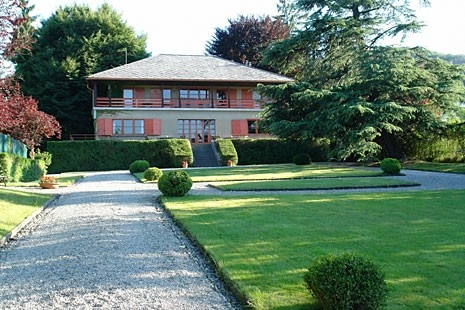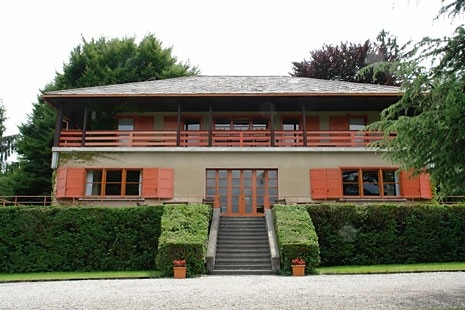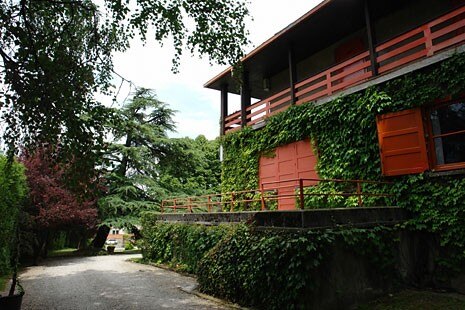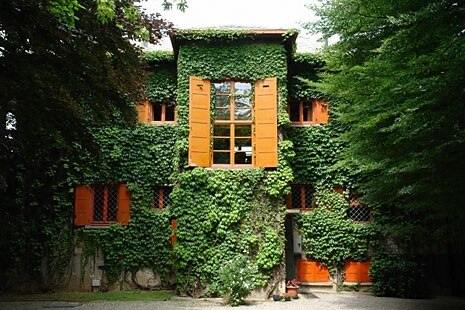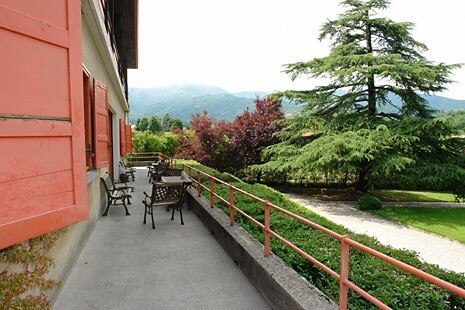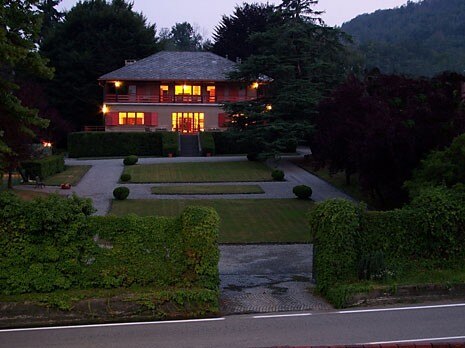
The Colli House, designed in 1928 by Giuseppe Pagano Pogatschnig and Gino Levi Montalcini, was conceived as a holiday home for the Colli family of Turin.
Domus, June 1930 wrote “This building is a very interesting sign: conceived with all the attributes of modernity, it overcomes cliches (...) It does not renounce any modern need but sums up all the pleasures of Italian living (...) And above all, it is a house that is a home, not a machine, and yet perfectly functional, a house that you confidently fall in love with immediately and the value of which will therefore for those who live in it be a lasting one. This lasting effect, like a friendship between walls and inhabitants, is a practice to not be forgotten.”
The house interpreted the wishes of the client: airiness, space, light, representation. Light seen as an element of joy and well being ensured by a study of artificial lighting that still exists in its original elements today, combined with rays of natural light that enter large windows that offer views of the surrounding landscape.
This villa that has survived time, the war, enforced use as a military garrison and a shelter for livestock as well as an outpost for Nazi soldiers, is at the centre of a paradoxical and, unfortunately in Italy, not unusual situation; the owners and managers of the study centre that they have founded and where they live, are forced to contend with one of the many inconguities (to use a euphemism!) of politics today. Paradoxical because the villa of well being now finds itself having to fight as a territorial entity with the worst side of modernity.
Over the years the Comune has granted permission for the construction of various factories including the one nearest the villa, a company pressing metal whose production methods produce noise and vibrations that place the building in danger.
After the owners sent a letter to the Provincia di Torino, the Comune placed the villa and gardens in “class III”, a class that still does not reflect the historical and architectural importance of the house and what it stands for. The owners, the Chiono family, have made a further appeal, still pending at TAR, to have the villa placed in Class I.
For now what little news these is unfortunately is all negative for the villa: in the summer of 2005 the nearby industry received another permit from the Comune to build a new factory, that now sits on the edge of the estate that villa Colli lies in. A number of appeals have been made for the building’s protection; the association receives support from many, including the Association Alberto Sartoris of Lausanne, the FAI, Rita Levi-Montalcini, honorary president of the association, the Presidente degli Industriali Luca Cordero of Montezemolo, Giorgio Armani, Leonardo Mosso, Laura Castagno and former President Carlo Azeglio Ciampi. An international committee has been formed for protecting the house that has gathered a list of signatures.
The matter was taken to court at the Ivrea Tribunale that unfortunately pronounced a sentence that took account of the expert witness’s report for the owners of the factory and not that of the Chiono family. The condemnation of the villa Colli to succumb to the dictates of a situation that is as absurd as it is taken for granted in this country, seems not far off. What is more, no evidence was given regarding the fact that the new planning permit for the construction of the new factory is practically next to the villa’s gardens, one of the few gardens from Rationalist architecture in a perfect state of conservation.
We suggest readers relive the entire episode, translated briefly here in its various phases, in order to be able to take part in a story that in any other European country would be resolved with just a few telephone calls. Let’s ask ourselves, ask yourselves, is architecture still of any interest.