The National Diet Library was established by the Japanese government in 1948 as a repository for every new domestic publication and selected foreign volumes. At the beginning of the 1980s, the librarians calculated that the entire storage space of their facility in Tokyo would be full by the year 2002, due to accelerating book production and the appearance of new media formats. With no adjacent land available in Tokyo, the government decided to build an annex 500 kilometres away, in the countryside between Kyoto, Osaka and Nara. Designated the ‘Kansai Kan’, it was intended as a focal point for every library in Japan and throughout Asia.
A design competition announced in 1995 was guaranteed to attract radical proposals, and equally guaranteed to be won by a work of competent, assured modernism. Fumio Toki had a track record that made him particularly well qualified for the project. Before opening his own office in 1988, Toki was a member of Daiichi Kobo Associates, where he was project architect for a number of major works, including the Tokyo Metropolitan Central Library.
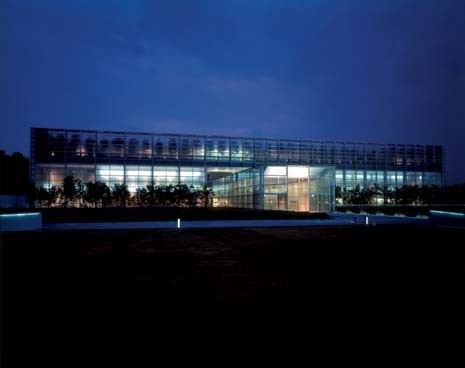
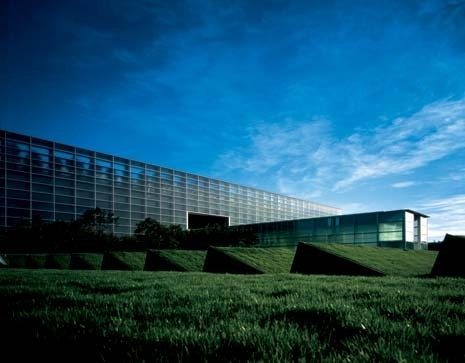
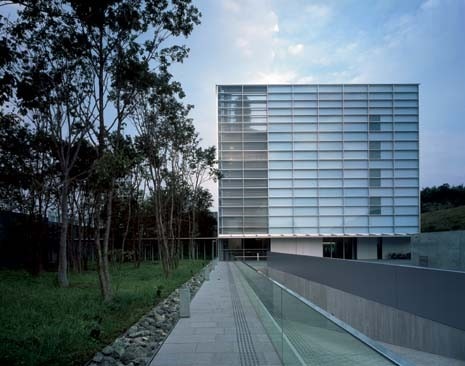
As a modern symbol of transparency and freedom of information, the expression of Kansai Kan was almost inevitably going to be a glass box; as a cumulative time capsule of irreplaceable knowledge, it is necessarily the sturdiest glass box possible. The site was not actually open pasture, but located within Kansai Science City. Initiated 15 years ago, this research and development zone in rural Japan comprises mainly private foundations. Kansai Kan is its symbolic and literal heart, manifested as a glass box raised on an artificial plateau.
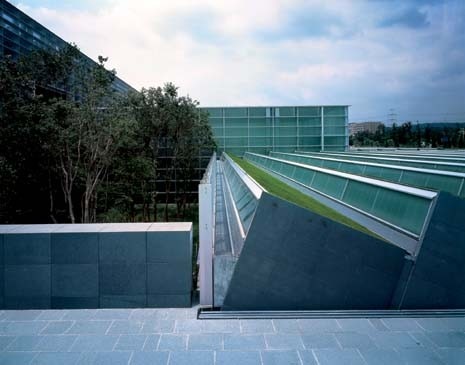
This exposed, transparent volume contains administration and research spaces, while the plateau is actually the roof of the public reading room. Its street edge is a gentle waterfall flowing down a granite wall, and the upper surface is an array of grass-covered skylights. This enormous plinth is traversed by an entrance hall in the form of a smaller glass box. The three primary volumes each relate to a distinct garden condition: the entrance hall is set within the green field above the buried reading room, which itself looks out onto a sunken courtyard of trees and shrubs, while the exterior terrace of the rooftop café features a row of trees that are visible through the translucent glass walls. With a storage capacity of six million volumes, the library stacks are hidden deep underground, where light, temperature and humidity may be strictly controlled.
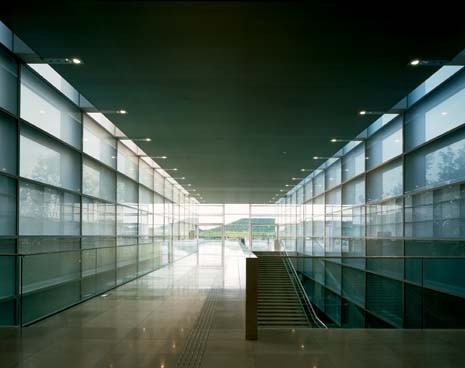
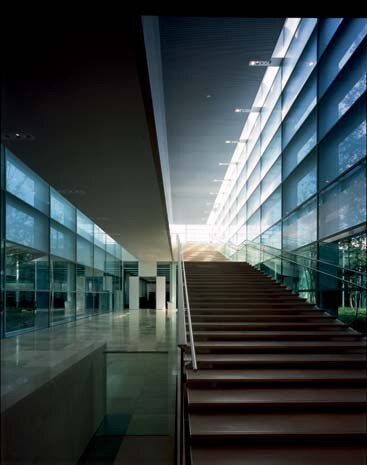
The simplicity of the exterior composition is complemented by the clarity and calm of the internal spaces, and a central full-height atrium gives instant orientation from almost anywhere in the building. The combination of tranquillity and monumentality induces an almost religious atmosphere, which seems entirely appropriate: in the predominantly secular, knowledge-based society of modern Japan, perhaps the only remaining ‘sacred’ space is the library. Kansai Kan not only resonates with the grandiosity and serenity of a traditional Japanese temple, but it also shares the extended axial sequences and orthogonal volumes displaced into slight asymmetry. In comparison with a temple, the obvious difference is the quantity of natural light that floods the building. Even so, there is an unexpected sense of density, if not opacity. The glass facades are double-skin curtain walls; subtle patterns on their surfaces create an ambiguous moiré effect, and the large air-handling pipes contained within the walls are also made of glass. Rather than an enclosure of transparent screens intended to unify inside and outside, the multiple layers and textures make the building appear to be composed of solid, translucent volumes. Within, the floors are of natural wood and stone, and the majority of walls are finished with authentic stucco – evident in the acoustics as much as in their texture. Throughout the entire design, in both the surfaces and their connections, there is an overt sense of depth and strength.
Among the delicate, ephemeral work that characterizes contemporary Japanese architecture, this is a work of distinctive presence and permanence. This is not to suggest that there is any lack of refinement or elegance in Kansai Kan. Hidden notches allow the various planes to meet without frames, and the sophistication of the various connection details makes them appear unusually simple for their size.
Certainly for a project of this scale and importance, any sense of fragility or impermanence would have been inappropriate, yet the Kansai Kan is not so much opposed to the tradition of transience in Japanese architecture as it is part of an alternative lineage. While the insubstantiality of the traditional teahouse and the ritual rebuilding of Ise Shrine are constantly invoked in discussions of Japanese architectural culture, there is an equally important heritage of extreme longevity. In pre-modern Japan, the roles of architect, engineer and carpenter were combined in the daiku, a profession divided into hereditary guilds that specialized in particular building types. The prestigious sukiya daiku, for example, were responsible for the teahouses – small-scale, delicate, intuitive and artistic work.
Regarded with even greater reverence by Japanese society were the miya daiku, the builders of large temples, of necessity far more concerned with structural and constructional rigour. While the teahouse seems to float or recede, the temple has an overt physical presence and weight. If the sukiya style is the historical source of ephemerality in contemporary Japanese architecture, the substantiality and scale of Kansai Kan is clearly a descendant of the miya tradition. It is not difficult to see a parallel between Kansai Kan and nearby Horyu-ji Temple, built of timber felled 1,300 years ago and the oldest extant wooden structure in the world.