There are examples of utopian industrial settlements all over Europe, from Robert Owen’s New Lanark in Scotland, built at the end of the 18th century, to the Czech communities designed for the Bata shoe enterprise between the two world wars. But it is the French-speaking world that gave them their most remarkable architectural expression, in particular Nicolas Ledoux’s awe-inspiring salt works at Senan. Grand-Hornu was a coalmining complex in what is now French-speaking Belgium.
Its origins go back to 1783, but Pierre Cadorna and Bruno Renard designed much of it in 1825. With its formal symmetry and robust neoclassical detail, the site shows a clear debt to Ledoux (in fact, Renard was one of his pupils). The formality of the complex, with its symmetries and axes combining pits, housing for miners and managers, schools, hospitals and social facilities, is all the more remarkable given that coalmining is so dependent on the random patterns that emerge from accidents of geology.
No coal has been dug at Grand-Hornu since 1954, when it was shut down as part of the European Steel and Coal Agreement to rationalize uneconomic pits. Almost 50 years later, after a long period of dereliction followed by series of aesthetically indifferent attempts to conserve the structures as tourist attractions, a large slice of the complex has now reopened as French-speaking Belgium’s Museum of Contemporary Art, ironically once more thanks to the intervention of a European institution. The European Union regional development fund made a substantial contribution to the cost of refurbishment, and the former mines now are host to a permanent collection of contemporary art, temporary exhibitions and performance spaces.
Restoring the complex to the way that it looked when it was a working mining community was, of course, impossible. The centrepiece is the oval courtyard, which may look as if it has the formal dignity of an industrial palace. But this was never the grassed estate of a country house or a paved urban square. When it was in use it was a grimy mess, full of coal trolleys and conveyor belts, the brick walls riddled with passageways and doors. In this context our neurotic contemporary obsession with a static idea of heritage makes no sense at all.
Restoring Grand-Hornu to the way it was would have meant putting back the grime, which would be no more authentic an expression of reality than tidying away all traces of the past. And it would also have had the effect of freezing the complex as a useless ruin.
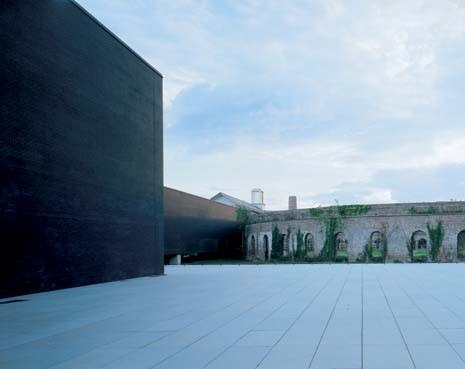
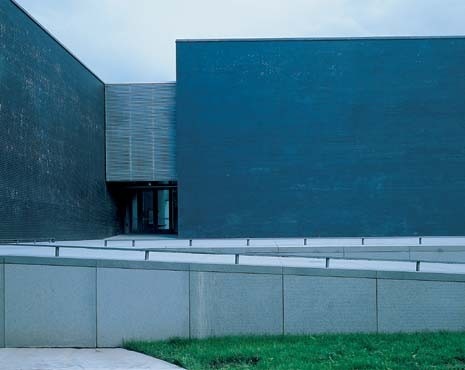
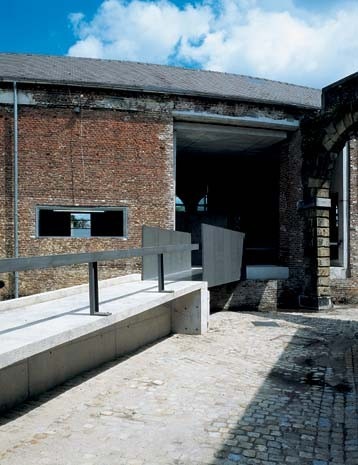
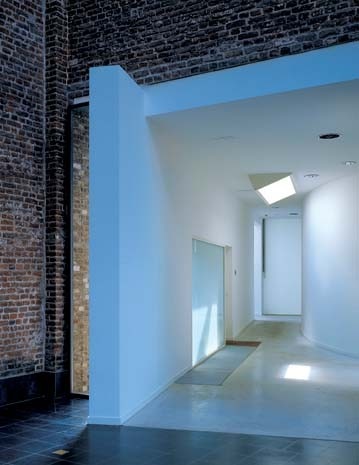
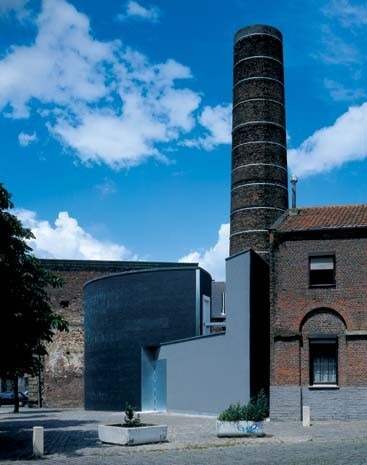
Pierre Hebbelinck, the project’s architect, was against the idea of an overly deferential approach, and he doesn’t treat the site as a static and monumental architectural relic. He uses it instead as a territory for new building with a fresh land use strategy. He has not been afraid to introduce structures and has deftly created a counterpoint between the worn and buckled red brick of the original complex and the black brick and white plaster of the additions. These new elements are taut and rendered immaterial. His precise contemporary abstractions reveal the forgiving ways of traditional building, when apparently decorative detailing was often used to mask the everyday mistakes of construction.
The conventional wisdom about building here would be to make the new disappear into the existing, to remain ‘discreet’ and not disturb the morgue-like quietness of a building reduced to its own cemetery, a postcard image of reassuring forms. Hebbelinck has refused to do this without being crudely exhibitionistic. He has inventively and sensitively brought a new life and distinctive architectural language to the site. His search for precision and bold detail is reflected in the sloping walls, buttressed by metal structures that resemble the arms of a young person propping up his shaky elder.
The architect’s gestures are unambiguous and precise, leaving little room for constructional error. Every defect and imprecision is visible and speaks to the old wall. The impact of this project lies in this boldness of expression, in its potent gestures and delicate balances. There is in Hebbelinck’s work a kind of echo of the specially commissioned installation made for the museum’s permanent collection by the artist Christian Boltanski. It movingly evokes memories of the miners who once worked here. It’s not actual history; it’s an interpretation and mediation on history. Hebbelinck has gently undermined the 19th-century authority of the neoclassical buildings with their neatly planned and reassuring symmetries, the paternalistic scenery created to represent labour and also to control it, in order to highlight new orders of spatial organization and patterns of behaviour. We move through the new extensions and maintain a variable distance from the old ones, heedless of being on this side of representation. Still, it is striking that you can’t clearly see where the mine actually was, its machines, railways and hoppers: to visit a workplace without being able to read its mechanisms suggests a vague sense of indecision.
The museum may in time create a new meaning for the whole site, provided the roots of the cultural and social operation do not with time betray the energy transmitted in its realization. This is no longer a place that is about monumentality or paternalism. The architecture should not inspire awe or fear. The rooms and the outdoor spaces are explored with the curiosity of an ever-renewed, continually distorted sense of discovery. Relations between the existing and the new, like the unfolding of a story or the nuances of language, ennoble each part of the place.
The principal quality of Hebbelinck’s architectural insertion is its permanent search for experience, comparison and dialogue. The architect has explored the constraint to translate in an even more sensitive and affirmative way the principle of spatial correspondences and emotional journeys. The original site and the new architecture are woven together, sometimes revealing openings through outsize frames, moving closer and further away from the existing material like a dialogue between two people telling each other about their past and future lives. Every movement describes a fresh light, a new possibility, a strategy of the possible, made almost autonomous by the successive rhythm of spaces.
Augmenting the interest in differences and questions, irresolutely poised and waiting to be redefined, are propositions appropriate to institutions attempting to generate culture and regenerate a sense of things. The comparison with contemporary business is telling. As long as Grand-Hornu was a workplace, its capacity to create roots and organize was implicit. Today it is a place that must grow to survive as an archaeological site, a landscape and an exhibition centre, contemporary in its attitudes but nevertheless a museum