



The first Italian exhibition devoted to the French master Georges de La Tour (Vic-sur-Seille 1593 - Lunéville 1652) continues after the long break caused by the pandemic. This time the unsurpassed French master is presented by an outstanding scholarly committee, from the curator Francesca Cappelletti to Pierre Rosenberg (former director of the Louvre), Gail Feigenbaum (director of the Getty Research Institute), Annick Lemoine (director of the Musée Cognacq-Jay), and Andrés Ubeda (deputy director of the Museo del Prado). The choice was perhaps inevitable. Together with paintings by equally well-known masters - Gerrit van Honthorst, Paulus Bor, Trophime Bigot and Frans Hals - the exhibition presents numerous striking genre paintings and candlelit scenes. Light is the unifying motif of de La Tour’s compositions, whose art has always been compared, in critical historiography and in the perception of the general public, with the work of Caravaggio, with whom he shared a love not only for light and shade but also humble subjects and imperfect bodies.
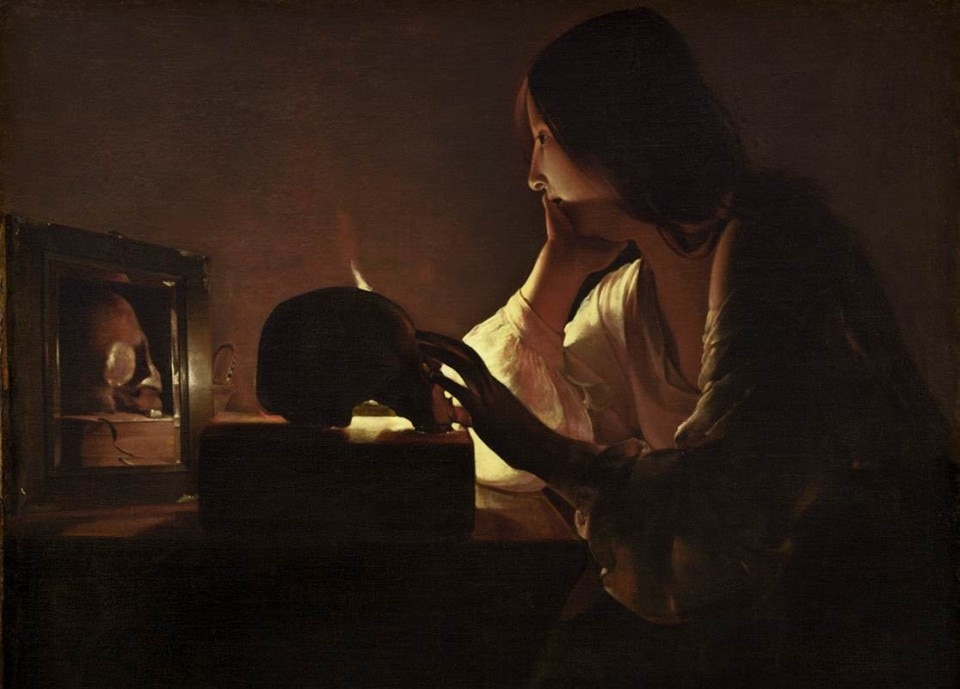
A highly refined observer of nature and everyday life, starting from his youthful works, de La Tour was always set beside the leading figures of the Baroque and more precisely seventeenth-century naturalism. The exhibition poster is his Penitent Magdalene, depicted precisely by the soft yet vivid light of a single candle that gives the woman's body volume and strength. Everything is perfectly studied. The light radiates out from the centre of the scene, enabling the viewer to observe and understand he numerous details that the painter depicts or interprets through the figure’s seductive facial expression: the lips slightly parted, the hand touching them and supporting her thoughts, and her dishevelled hair, in keeping with tradition, depicted loose and flowing, being brought out just above her forehead by that light that seems to be the creator of everything. And finally the skull, Mary Magdalene’s iconographic attribute, also evokes the effects of time and is represented twice, being reflected in the mirror. Here it is not the young woman that attracts our gaze but the candle flame, which picks out both sides of the skull, illuminating and shadowing it, and compelling us to reflect on time’s inexorable passing, on life and death.
The exhibition will end on 27 September and has apparently been an outstanding success, both because of the extraordinary nature of the works on display and the numerous visitors delighted by them.
Opening image: Georges de La Tour, Penitent Magdalene, 1635 - 1640, Oil on canvas, 113 x 92.7 cm, National Gallery of Art, Washington D.C., United States