


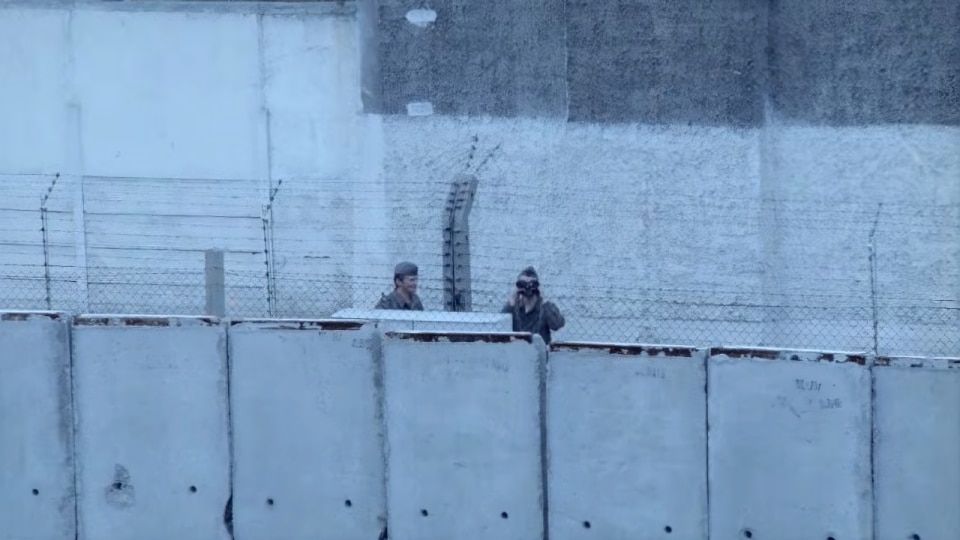
Hollywood seems to have lost all restraint. After decades of sequels, reboots and expanded universes, Andrzej Żuławski's 1981 film Possession has even been added to the list of works to be remade. This seems an inevitable move only if the film is considered strictly as a story: an imploding marriage, a monster, possession, and the female body as a battlefield. But Possession is not just a story. It is also a place and a moment in history that no longer exist.
The announcement of the remake sparked a curious reaction, especially online. Among cinephiles, critics, and horror enthusiasts on Instagram, a small but vocal opposition movement formed, rallying around images and posts that assert the unrepeatable nature of Żuławski’s work. This is not the usual distrust directed towards remakes, but rather the firm conviction that 'Possession' belongs to a specific historical, political and urban context that cannot be recreated.
Paradoxically, this stance coexists with the openness shown by Isabelle Adjani herself, who expressed appreciation for Margaret Qualley being chosen as the lead. However, the point does not concern the actress. Even an exceptional performer could not restore what the film absorbed from its city. Remaking Possession today would inevitably result in a completely different film. One that we feel no need for.
Sam Neill's death on 13 July at the age of 78 also draws attention to one of the most extreme and uncompromising performances of his career. While Adjani delivered one of the most radical and disturbing performances in cinema history, Neill countered with an opposite yet complementary intensity: his portrayal of Mark is that of a man who is helplessly watching his world dissolve, consumed by a restrained paranoia that renders even the most absurd gesture believable.
People often talk about these performances and about Żuławski’s personal life, particularly his separation. Much less is said about the city. Yet Berlin is not just a backdrop; it generates every single scene. The film was shot at a time when West Berlin was still a suspended enclave, a political and psychological island surrounded by the Wall. No contemporary set design could recreate that setting because it wasn’t just architecture; it was a perception of space.
The Wall is the film's great, silent protagonist.
The apartment in which Anna undergoes her metamorphosis is not merely dilapidated. It is a place that seems to have been abandoned by history. The peeling walls, endless corridors, deserted stairwells and view of suspended Berlin transform the home into an extension of the city itself.
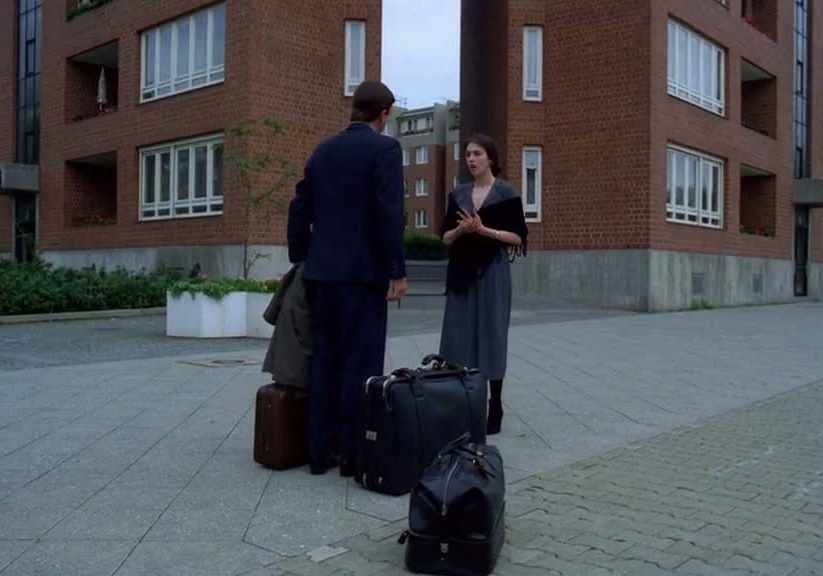
The large residential complexes of West Berlin, the modernist housing now devoid of any promise for the future, the vast asphalt surfaces and empty spaces left vacant by the proximity of the border all contribute to a sense of isolation preceding the horror itself. Even the characters’ movements seem strange; they walk through a city that appears to be constantly interrupted. Open spaces do not liberate; they expose. Interiors do not protect; they compress.
The Wall is the film’s great, silent protagonist. When Żuławski filmed Possession between 1980 and 1981, Berlin was still bisected by the Grenzmauer 75, the latest iteration of the fortification system built by the German Democratic Republic: a barrier of prefabricated reinforced concrete panels, over three meters high and topped by the characteristic cylindrical tube that prevented anyone from climbing over it.
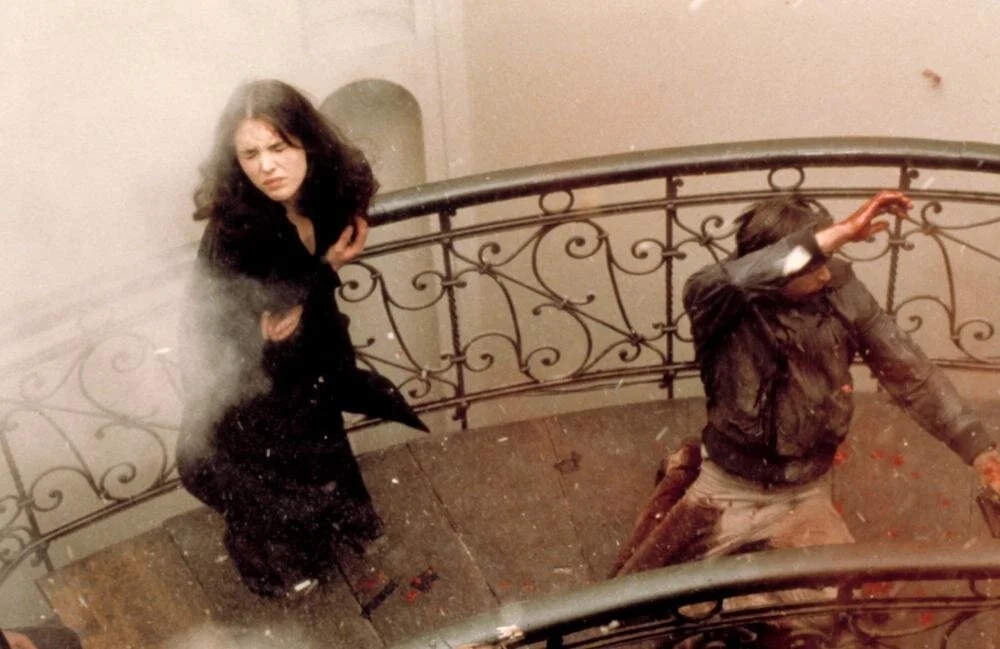
However, reducing it to a physical artefact would mean missing its full scope. The Wall is an urban infrastructure that transforms the city: it creates the “death strip”, forces demolitions, disrupts the continuity of streets, and produces voids, margins, and blank backdrops. It is this fractured geography, rather than its ideological weight, that creeps into Possession. The film’s anguish stems not only from the characters, but also from a Berlin that appears to have lost its spatial unity, making every crossing an experience of separation.
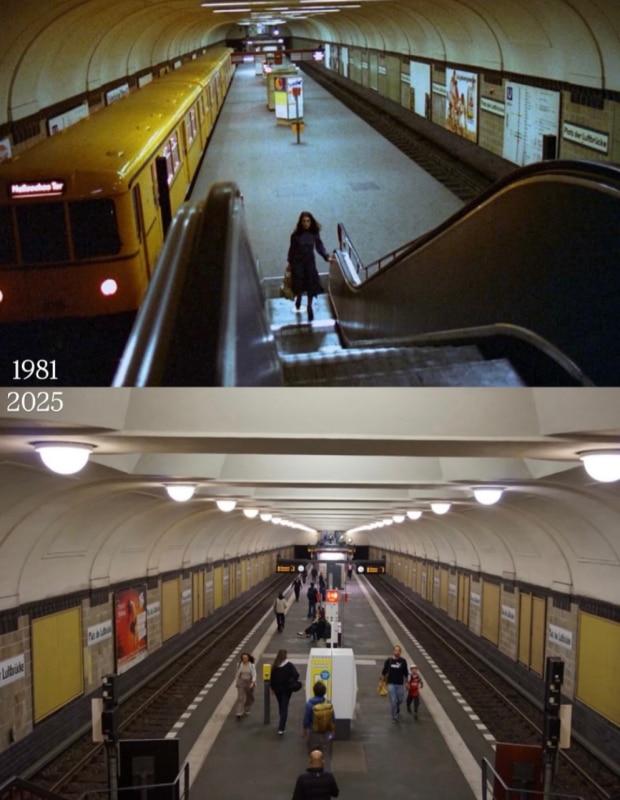
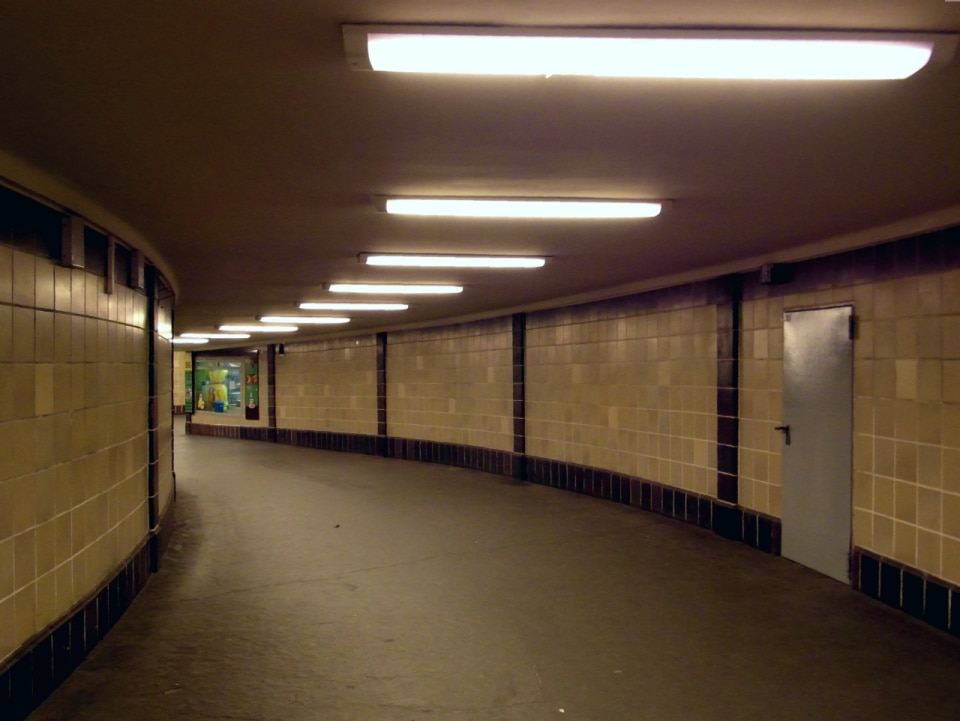
This is why the famous physical breakdown of Isabelle Adjani in the Platz der Luftbrücke U-Bahn station remains one of the most disturbing scenes in cinematic history. It does not simply take place in a subway station, but in infrastructure that Žuławski strips of all daily function, transforming it into a psychological space.
The long, tiled tunnel, the cold lights, the metallic noise, the concrete and the repetitive architectural features all participate in the performance as much as the actress’s body. It is as if the city has stopped being a container for the action and has become the very device that generates it.
Setting it in contemporary Berlin would create an even more radical disconnect: the city no longer has the liminal quality that made the horror seem real.
Andrzej Żuławski understood something that many contemporary directors seem to have forgotten: architecture does not merely host emotions; it produces them. The anguish of Possession stems from the constant friction between bodies and surfaces: gigantic windows isolate, tunnels amplify footsteps, and modernist geometries become psychological devices. It is as if the entire city were already infected.
Today, Berlin is a different city. It has become a European laboratory for creativity, cultural tourism, gentrification, start-ups and galleries. It has even transformed many of its scars into urban heritage. This is not a value judgement, but a historical fact.
Consequently, any potential remake would face an impossible dilemma. Where would you place Possession now? Reconstructing the Berlin of 1981 with absolute historical accuracy would result in nothing more than a museum exercise. On the other hand, setting it in contemporary Berlin would create an even more radical disconnect: the city no longer has the liminal quality that made the horror seem real.
Every horror film needs an emotional geography. The Shining has the Overlook Hotel. Possession has Berlin. Not just any Berlin, but the specific city that was caught between two political systems, where even the urban planning seemed to manifest an identity crisis. The tentacled monster growing in the apartment does not come from another dimension. It is the biological product of a fractured city.
The remake therefore risks misinterpreting precisely what makes Possession one-of-a-kind. Not the monster, not the blood, not the exceptional acting, but the perfect convergence of urban space and psychological collapse. Some films belong to their actors. Others belong to their directors. Possession belongs to a city that no longer exists.
Opening image: Possession, Andrzej Żuławski, France/West Germany, 1981. Photo via Mubi