Interview with Kram/Weisshaar
Stefano Mirti: We know that the relationship between the two of you (who have quite different backgrounds) is the main ingredient in this project. Can you tell us more about it?
Reed Kram: The two of us met in 2001 while working as consultants for Koolhaas/AMO on the Prada projects, in particular the IT project for the New York store. A tight schedule and high ambitions forced us to work in an extremely interdisciplinary approach within the design team. When one designs anything of a certain complexity, it often becomes entirely segmented. The person designing the shell enclosure and the person designing the “soft” interfaces for devices don’t even talk to each other. To us this seemed quite unnatural. We felt there was a huge opening for truly integrated design work, and that it was really time to generate that overlap.
SM: When did you start the Breeding Tables project?
RK: It was two or three years ago. We were in Milan during the Furniture Fair and we took a walk around. We started realising what an enormous untapped potential there was. Very few projects and companies seemed to reflect the rapid development of technologies in any dramatic way. It seemed like a natural place for exploration.
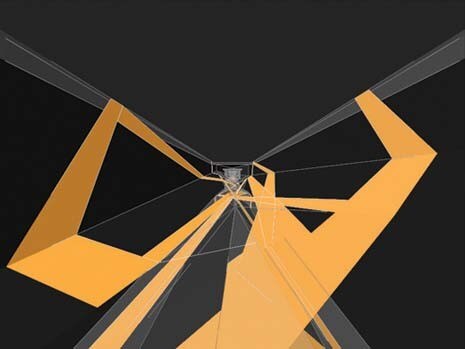
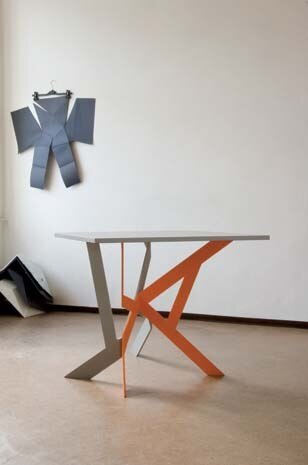
Clemens Weisshaar: The next day we were at a bar in Cadorna station waiting for a train to take us to the airport. We were having a coffee and thinking about how to turn disappointment into productivity. Just as the train was about to depart we had an idea on the napkin: why don’t we grow structures on the computer? We decided that tables were a good playground to begin with.
SM: Can you tell us about the project managing side of this venture? How did you find the money the support?
CW: The project was entirely self-funded. It started out more as a research project in our offices and gradually picked up speed as we went along. The idea of fundamentally involving computing in the design process as well as considering the process itself as an integral part of the design grabbed more and more of our attention.
RK: In its infancy, the project was impossible to communicate to potential sponsors. No one was brave enough to spend money on a venture like this that had an entirely open-ended outcome.
CW: And we were obsessed enough to invest. I generally object to the idea of the designer sitting in his studio dreaming up the next chair and then knocking on doors looking for a company to produce it. I think that is fundamentally the wrong approach. One needs to work with a company, understand what they are about, what they are good at and what they really need. Then one needs to do a project for them that solves problems or is enough of a challenge to take things to the next level. With this project we had to sacrifice a sacred cow and simply do the project ourselves. However, we needed a sparring partner to develop it.
SM: Who was that?
CW: We just talked to people we had worked with before around Munich. They were all people who I had known and who I had worked with previously. The infrastructure is quite incredible. All the companies that come to mind when you think of Munich like Siemens, BMW or DASA (DaimlerChrysler Aerospace) rely on this network of tiny, highly specialised companies. It is a bit like Brianza in Italy. Two long-time collaborators, a father and son who run a little company with super high tech laser cutters and bending machines, became our test laboratory. They got the idea straight away and were fascinated by the project because it is what they do every day: turning a data set into physical matter. We wanted to control that process from beginning to end and eliminate any obstacles (exchanging data, communicating, and so on) from the idea to the physical product stages.
SM: Why did you choose tables to introduce your methods?
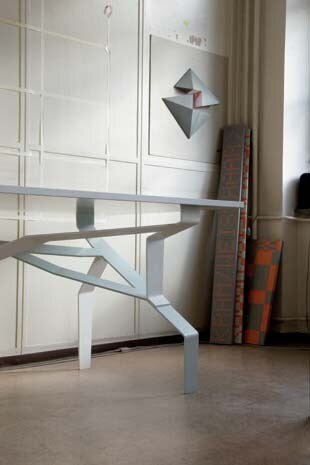
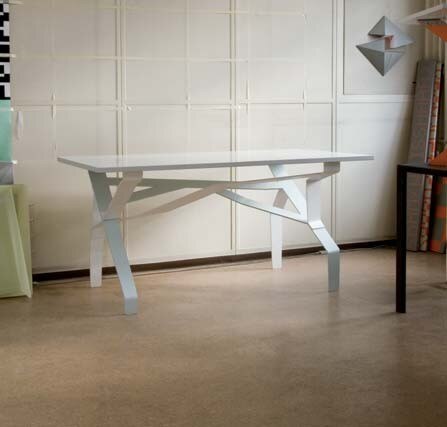
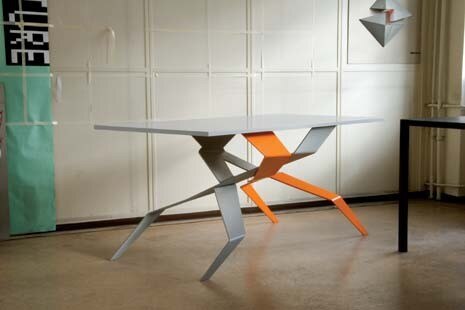
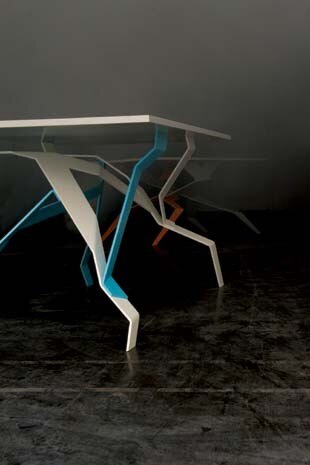
RK: Tables seemed an appropriate place for algorithmic work for a couple reasons. The typologies of common tables are fairly well defined: the desk, the dining table, the large work table, the sideboard, the low table and so on. For each table typology a specific set of rules apply. You have to place a level area of a certain size at a specific height. Also, to insure stability and comfort, the legs have to conform to the rules of the type. For example, with a desk you have to allow for a good bit of space under the front of the table for the person working at the table. Whereas for a low table, we don’t have to worry about leg clearance so the table legs have free reign. In each case the table legs must touch the floor in precise zones so that the table’s balance is steady. In the Build 1.0 of the Breeding Tables software we play within these constraints.
CW: It is beautiful to teach a computer how to design things. As designers we have so many things in the back of our heads that we do automatically without thinking about them. Teaching a machine to help you is both thrilling as well as annoying at times. It forces you to reverse engineer the way you think and extract a logic that has to be crystal clear.
SM: How does the Breeding Tables process work? Is it like fruit on a tree? Do they naturally grow from the flower to the fruit, from green to red until it is time to pick it?
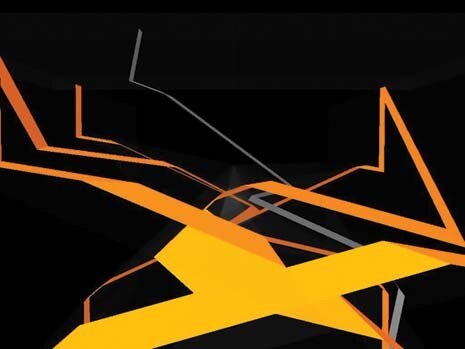
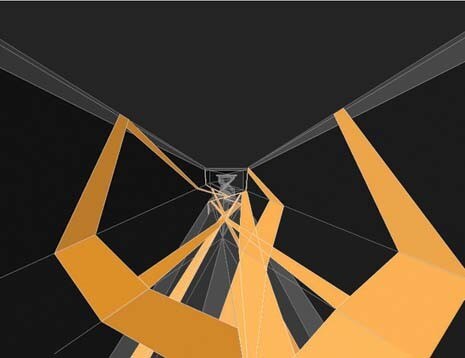
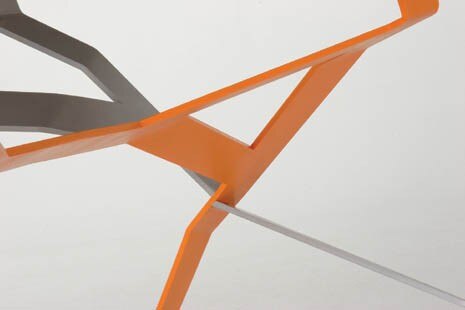
RK: In a way, yes. We made the software behind the Breeding Tables and it grows proposals. This does not mean that the software stands on its own. I really dislike purely automated design. It has no meaning. I used to work on video games. What the video game industry is able to do these days is simply unbelievable. They can conjure up entire parallel worlds. We are now using video game techniques and a kind of appreciation for a video game attitude in a different arena. The Breeding Tables software serves more as a hyper-extension of the designer’s hands. The programme allows us to realise potentials we would not be able to achieve on our own, since designing hundreds of distinct tables would break the back of any designer. The human being becomes the bottleneck. It simply wouldn’t work. The software acts as a kind of digital sweatshop, constantly shooting out proposals from which we choose and refine the most promising. These selected tables are allowed to reproduce further. The software also helps us to construct complex geometries with irregular angles efficiently. The fact that each table is still selected by us is critical.
SM: In the picture you sent us from Cologne, we saw a number of familiar furniture pieces such as the school-like chair…
RK: These are the re-editions of Jean Prouvé’s chairs. Vitra made a special edition in light blue for the exhibition that is just like the tables. It pays homage to Jean Prouvé who was an inspiration to us. It is not only inspiration, there is a real emotional link. Like Prouvé, Clemens was trained as a metalworker.
SM: What are the implications of being trained as a metalworker?
CW: The logic of the industrial manufacturer is best learned from the inside. All of Prouvé is a constant refinement of his early period, learning a craft and working in a very pre-industrial way as a blacksmith. He gradually expanded his reach towards more industrial techniques. Looking at his work, it is an incredible transformation, especially since he had to start from scratch. He had to buy the machines and even build some of them to run the workshop, to invent everything. In a way it is much easier for us now. The technologies are there, we just need to connect loose ends. We live in a different world than Prouvé’s one. Now we are talking about virtual structures built on relations. We should not forget that in most cases the only good source for in -depth information on a specific technology is the person running the machine. Half an hour spent observing and talking is worth more than stacks of white papers.
SM: Are there other lessons to be learned from Prouvé?
RK: The way he related to technology. He had a very “hands-on” attitude. He always struggled in order to find the best way to get involved in the process. His idea of design was a seamless process where the designer is involved from the first to the last.
SM: Although you refer specifically to the design tradition, your attitude seems quite innovative.
CW: Let’s say there is now a potential opening for change. Many of the given conditions around design are under pressure – and this creates space for movement. This is a moment for considering the entire process.
SM: How often do you work together and how often do you work at distance?
RK: Although we are based in different places, we meet a lot. But there is no given schedule. Sometimes we work together for two weeks, then apart for several weeks. You end up in this state of communication that is very peculiar, always on but not necessarily in the same place. Thanks to techniques that are coming out now, a lot of new modes of connection are possible. Take for instance the Skype Internet telephony service. The other day we set up a microphone in each office and connected the sound of the other office to our stereo speaker system using Skype. It is no longer the two of us talking to each other; it is the environment of one studio space linked to the other. I do my things and then I can hear Clemens and his assistants, and the same is true for him. It is like having the other people in the same room, but they are actually in Munich. Five minutes to the local manufacturer. This is much better than video conferencing - to simply connect the sound spaces. Our web servers become the shared desk where we constantly exchange data. This also forces us to maintain a strict discipline and communicate things very precisely, which is good.
SM: The last time we met it was in the summer at the Prada opening in Los Angeles. What you did in that setting and this current project appear to us to be quite different. Still, we can see this as a step forward. What are the things you learned while doing Prada that were translated into this new project?
CW: The technology project for Prada Beverly Hills was very exciting. Compared to New York we reduced the team significantly and worked closely with Fulvio Grignani, (head of Prada’s IT department) and his team. Together with Markus Schäfer we formed the design team and built a network of manufacturers that were able to make what we envisioned. Since ambitions were quite high and the things we wanted to do were pretty complex, this was not easy. We had to find people who could execute very delicate and specific tasks in very little time. This resulted in something like a distributed factory spread across countries and continents. There was the little company in Ivrea, Italy doing printed circuits, the BMW Formula 1 supplier making CNC milled components, the resin expert in Brianza, the mould maker in Munich, computer hardware experts in New Jersey and programmers in New York. Understanding the specific capabilities of all these partners and plugging them together was key. With the tables we did something similar regarding the development of infrastructure yet smaller since the project is significantly less complex.
SM: Technologically, this is a quite advanced way of working.
RK: Nowadays, the technology (to a great degree) is already detached from the companies. This means we can play with it. Take for instance the Italian furniture industry. The furniture companies in a lot of cases outsource the technology. They were “outsourcing” long before it became a buzzword and manager’s darling. This attitude is largely potential-based. They did so because they could, because the infrastructure was there. Again, this could be intended as a model to face the Asian challenges. In China they use a neo-modernist system of manufacturing: mass production, chain-line, costs reduction. Here the strategy has to be different simply because we can’t compete with this. It is based on a network of flexible partners. When needed, you can engage different partners. In our experience, it doesn’t work to simply send drawings to a supplier. You must work with the supplier and build a relationship.
CW: In our mind, apart from its productive features, this is a way to face the Far Eastern challenge. For European industry, this is a possible way to innovate and to compete with other economies. The really scary thing about China is not that they are able to make things cheaply. The thing that's scary about China is how motivated they are. In this respect Breeding Tables is also about optimism.