


The Accademia Carrara in Bergamo sits at the foot of the city’s Città Alta, a nineteenth-century picture gallery that houses one of the most important collections of Old Masters in Italy. The museum was recently expanded in a project that won the 2025 Italian Architecture Prize.
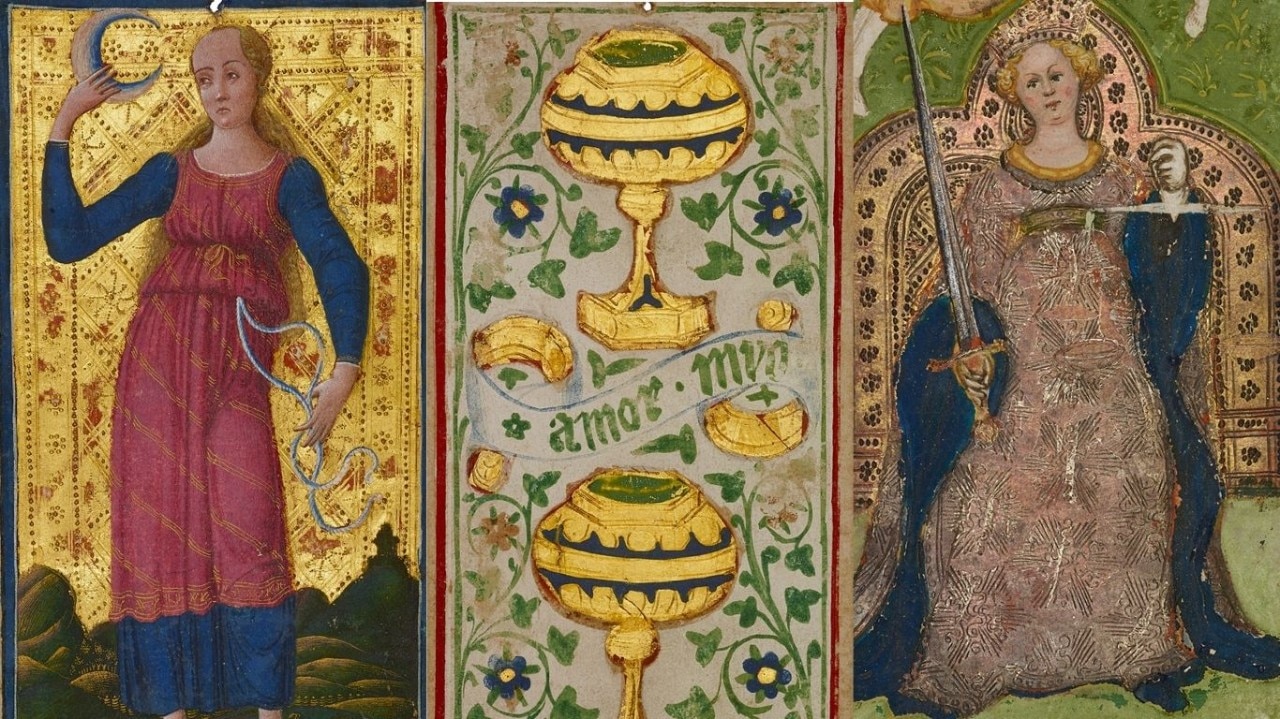
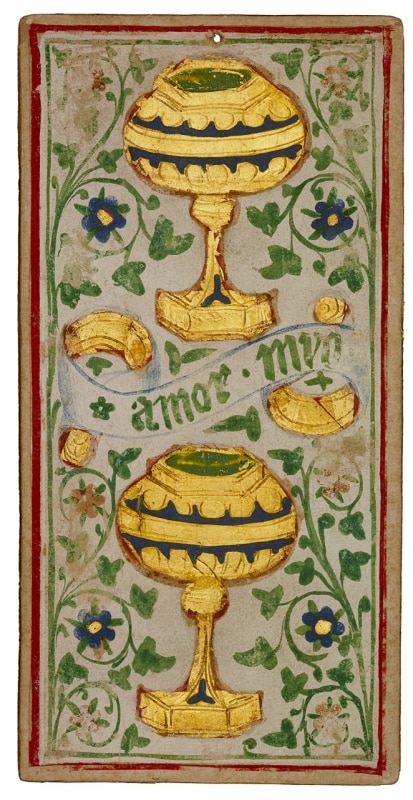
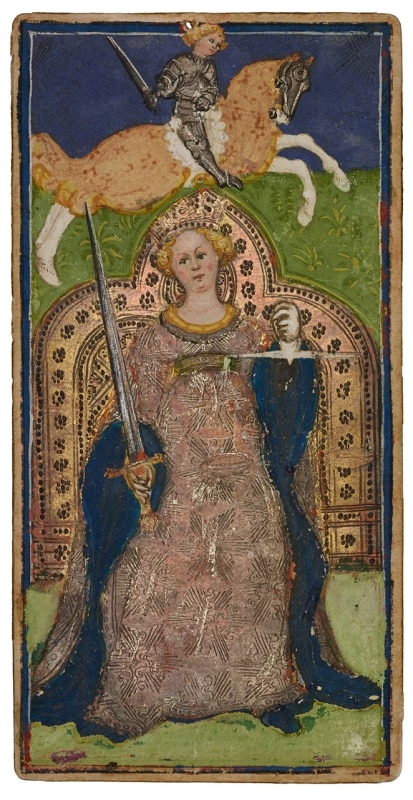
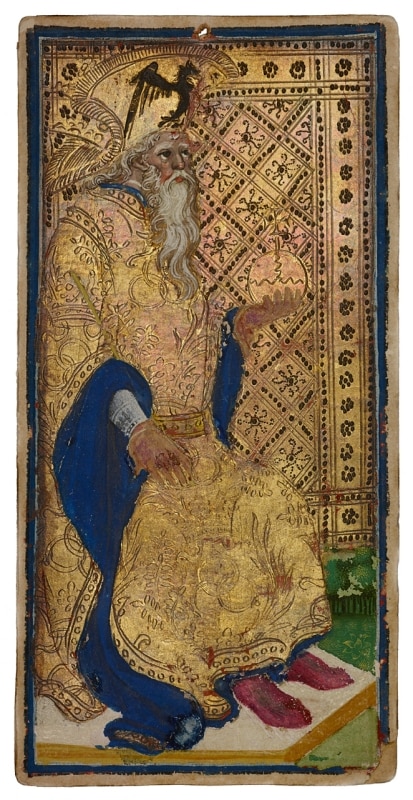
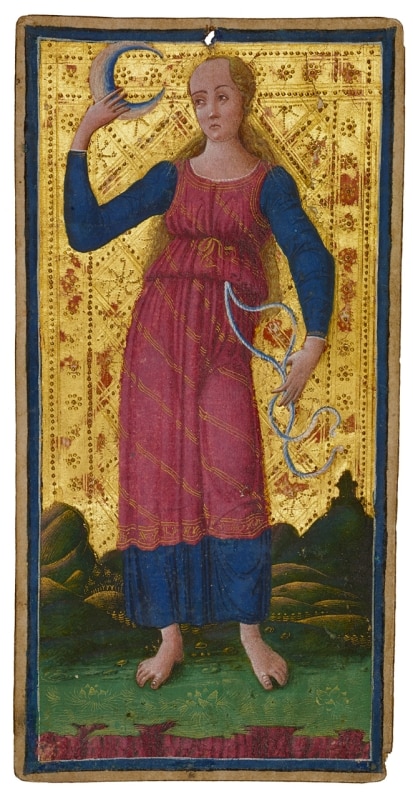
Until a few weeks ago, its storage rooms held for more than a century much of one of the oldest and most complete tarot decks in the world: the Colleoni deck, commissioned in the mid-fifteenth century by Francesco Sforza and Bianca Maria Visconti, the dukes of Milan.
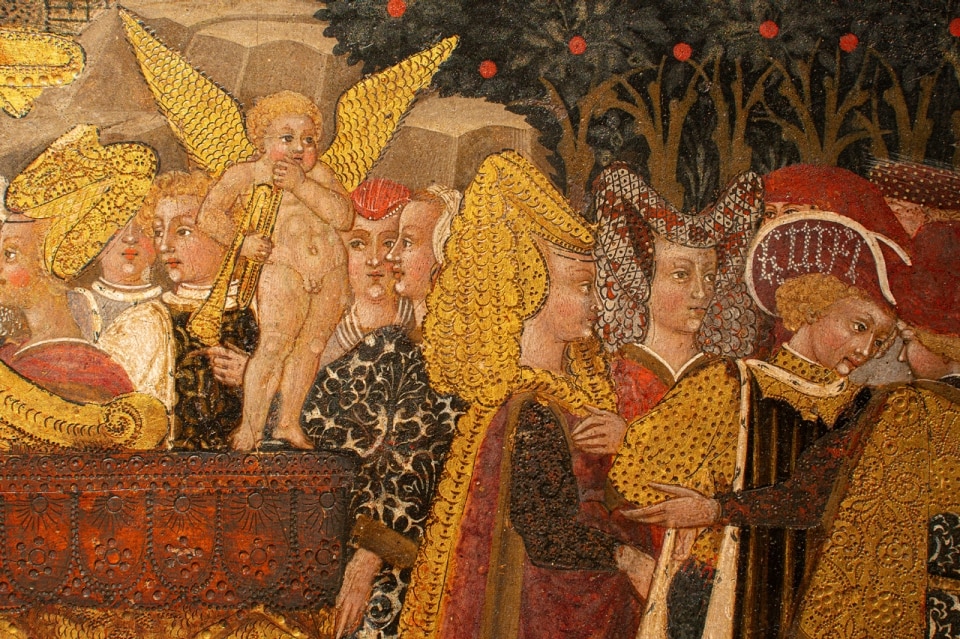
It is around this object that curator Paolo Plebani has built the exhibition “Tarocchi. Le origini. Le carte. La fortuna”: (“Tarot. The Origins. The Cards. Their Fortune”). The show brings together not only tarot cards but also seventy paintings, illuminated manuscripts, books, and contemporary works that trace the history of tarot from the courts of the fifteenth century to the present day. “An exhibition is not a book,” Plebani says, explaining his decision to combine high and low art and to use different media within the exhibition space. “It’s a staging: you tell a story through objects.”
Plebani—who before encountering this project was not even particularly interested in tarot—has now curated the most extensive and comprehensive exhibition ever devoted to this iconographic universe. “Many people told me that an exhibition about playing cards would not attract visitors. I was convinced of the opposite,” he tells Domus.
The origins: a courtly game
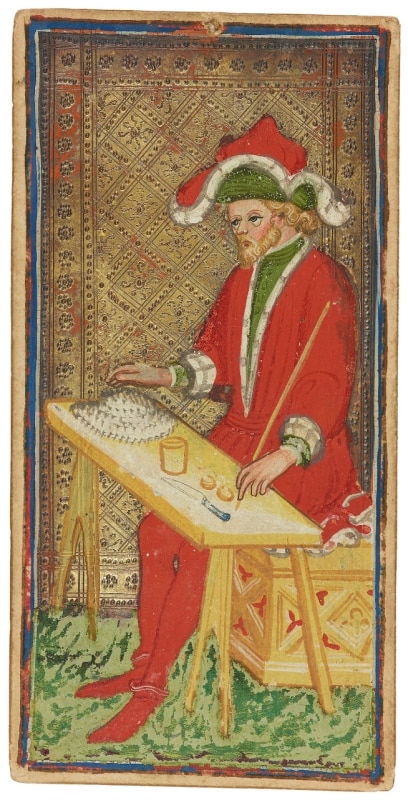
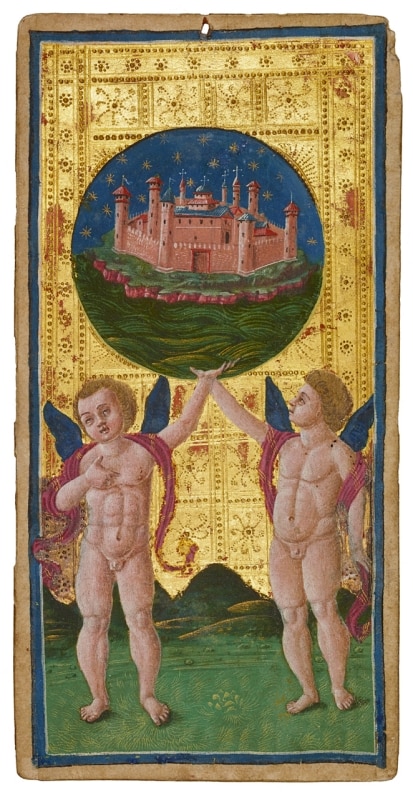
Seventy-eight cards divided into two main groups: fifty-six known as the Minor Arcana, split into four suits—Coins, Cups, Swords, and Batons—and twenty-two Major Arcana, archetypal figures that follow a symbolic journey from the Magician, the juggler who opens the deck, to the World, the final card of the cycle, passing through Death, Love, the Hanged Man, the Star, the Moon, the Sun, and the Fool, the only unnumbered card.
Tarot has maintained an extraordinary iconographic continuity: figures such as Death or the Wheel of Fortune still speak to the present six centuries later.
Paolo Plebani
Today tarot cards evoke DIY divination sessions among friends (more often among women), Jodorowsky-style esotericism, or a few laughs at dinner parties. But in their origins, back in the fifteenth century, they were simply a card game. “For three centuries, until the eighteenth century, tarot was basically like our game of briscola—a trick-taking game,” explains Plebani. “Each card had a value, and the Fool worked as a sort of early precursor of the joker.”
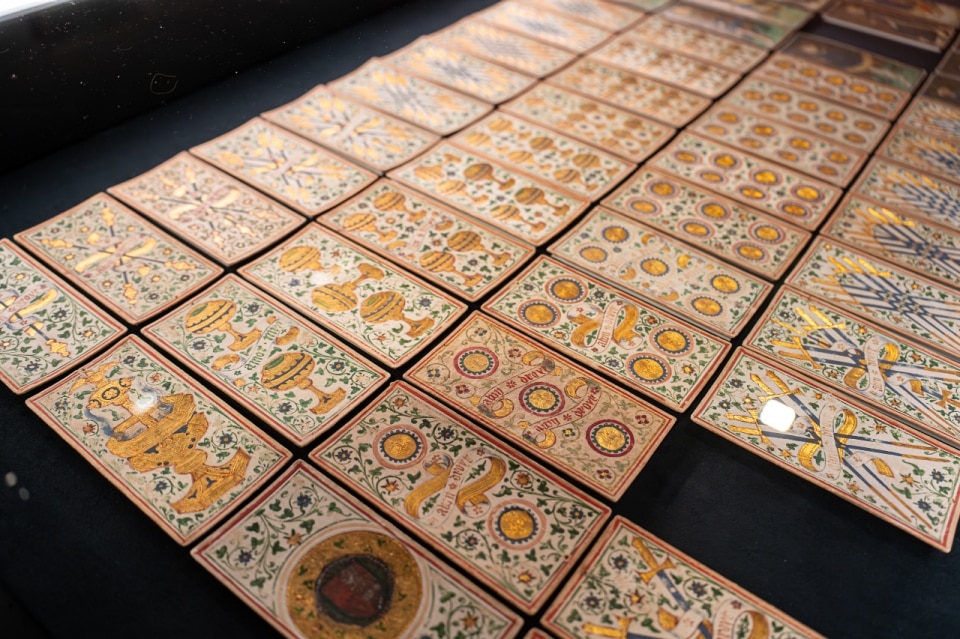
Commissioned by noble patrons and produced by artists, the earliest decks were small luxury objects: hand-painted cards, often with gold backgrounds and techniques similar to those used in medieval illumination. The structure of the deck was already very close to the one we know today, although the themes varied from region to region. North of the Alps, for example, hunting and falconry scenes appear—one of the decks on display, a rare example from Vienna, depicts greyhounds and riders in pursuit. In Italy, meanwhile, medieval symbolism intertwines with classical culture, religion, and the visual language of the Renaissance.
But it is with the intervention of literature that the allegorical imagery associated with the game begins to take a more unified form. Between 1351 and 1374, Francesco Petrarch wrote I Trionfi (The Triumphs), a poem imagining a symbolic sequence of forces governing human existence—Love, Death, Fame, and Time. During the Renaissance these allegories began to be represented as archetypal figures.
The Trionfi thus became an immensely popular iconographic repertoire. It is therefore no surprise that these images soon entered the workshops producing playing cards.
Looking at these painted artifacts today, displayed in the first rooms of the exhibition, they do not seem so different from the tarot decks that populate contemporary esoteric bookstores—or the Amazon searches of many curious readers. “Tarot has maintained an extraordinary iconographic continuity,” Plebani explains. “Figures such as Justice, Death, or the Wheel of Fortune may have changed names over time, but visually they have remained surprisingly similar across the centuries and continue to speak to the present.”
The cards: the lost deck
Very few of the earliest tarot decks from the fifteenth century survive today. It is through these rare fragments that art historians have tried, in recent decades, to reconstruct what visitors can now see at the Accademia Carrara. “We are writing the history of this game with very few surviving traces,” says Plebani. “Only about twenty decks remain, and many of them preserve just two, four, or six cards.”
Within this context, the Colleoni deck is an extraordinary case. Of the original seventy-eight cards, seventy-four survive today. Twenty-six are preserved at the Accademia Carrara—arriving in 1900 thanks to a bequest from the collector Francesco Baglioni—while the others are divided between The Morgan Library & Museum in New York and a private collection.
“It’s one of the few decks that allows us to perceive the set almost in its entirety. Seeing it reunited is an incredible experience,” Plebani says.
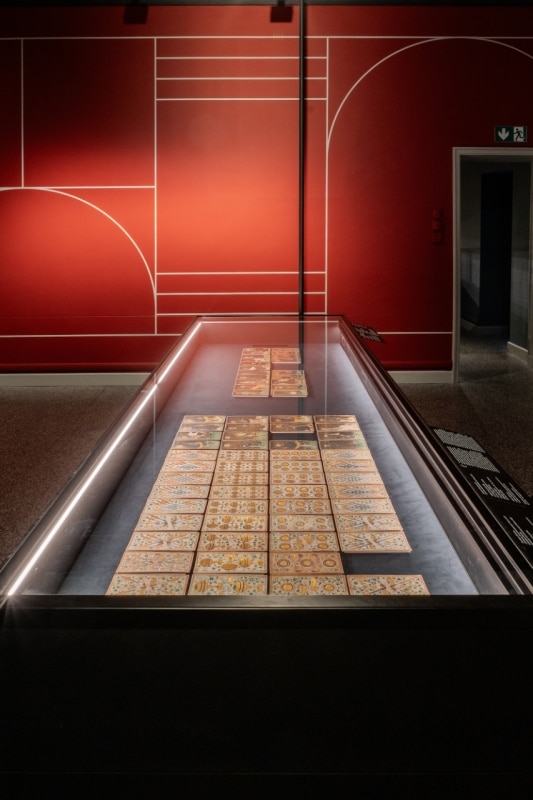
Displayed in a long glass case and illuminated with minimal light to protect the pigments while revealing the shimmering gold backgrounds, these cards mark the culmination of the exhibition’s first historical section—and form the bridge that leads visitors into the contemporary world.
Their Fortune: Italo Calvino and the Colleoni deck
With the invention of printing in the sixteenth century, tarot decks began to be produced in series, and the game spread rapidly across Europe. It moved from courts into taverns, inns, and streets, endlessly reinterpreted by ordinary people. For a long time, however, art history remained cautious about recognizing their cultural value—at least until tarot entered twentieth-century literature.
One room of the exhibition, designed like a library and filled with books from different periods, reconstructs the moment when Italo Calvino encountered the Colleoni deck.
In 1973 the writer published The Castle of Crossed Destinies, a book built from tarot imagery, where the cards become a true “narrative machine.” A group of travelers, suddenly unable to speak, recount their stories by laying the cards out on a table.
Not so different from what happens today at gatherings and dinners: with Calvino, tarot becomes a way of recognizing oneself and telling one’s story.
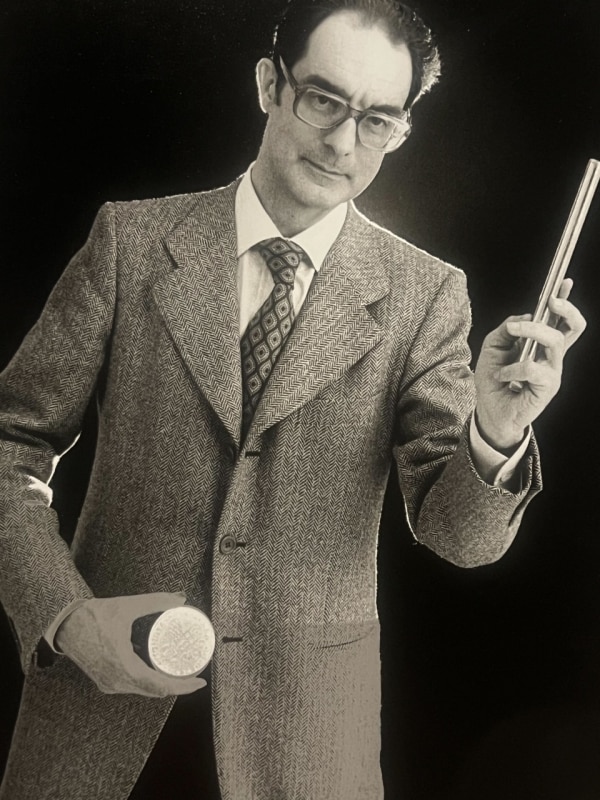
“Calvino is one of the first authors to whom we owe the modern fame of this deck,” Plebani explains. “In 1969, with the publisher Franco Maria Ricci, he published the first complete photographic reproduction of the Colleoni deck. Invited to write a text for the volume, he ended up constructing an entire book from the cards themselves.”
It was for the publication of I Tarocchi dei Visconti that Calvino even staged himself within the deck: in a photograph accompanying the book—now displayed at the Accademia—the writer poses as the Magician, the figure that opens the sequence of the Major Arcana.
But Calvino was not the only one to “bang his head against tarot,” as he wrote in a letter to Ricci, nor the only twentieth-century artist to portray himself as the first card of the deck.
The twentieth century and beyond
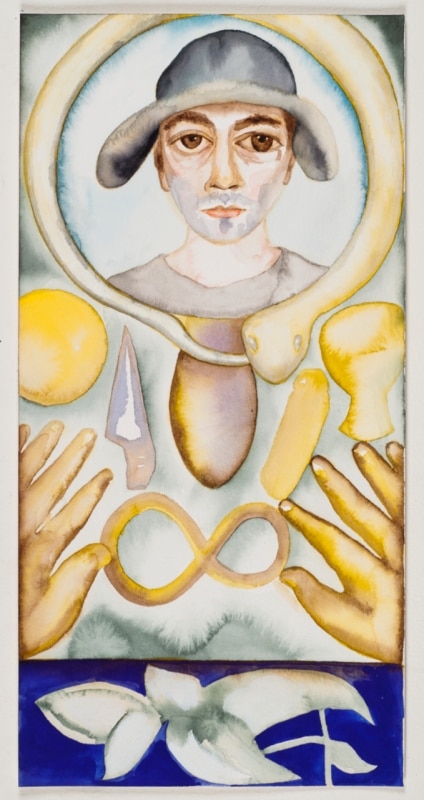
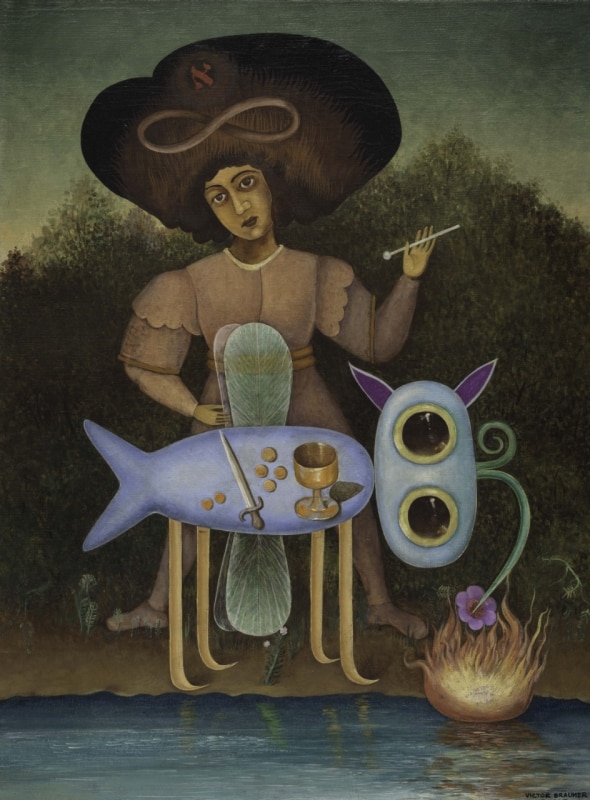
The Magician—the figure that opens the sequence of the Major Arcana—is a conjurer, a juggler, a trickster. He wears an enormous hat and stands before a table on which several “ingredients” are arranged—water, fire, earth, and air—with which he will attempt to rebuild the world from scratch. In the twentieth century, an era of social and artistic revolutions determined to overturn the status quo, many artists seem to recognize themselves in this ambiguous figure and in his foundational gesture: combining different elements to generate new visions of the world.
An exhibition is not a book: it is a staging in which objects tell a story.
Paolo Plebani
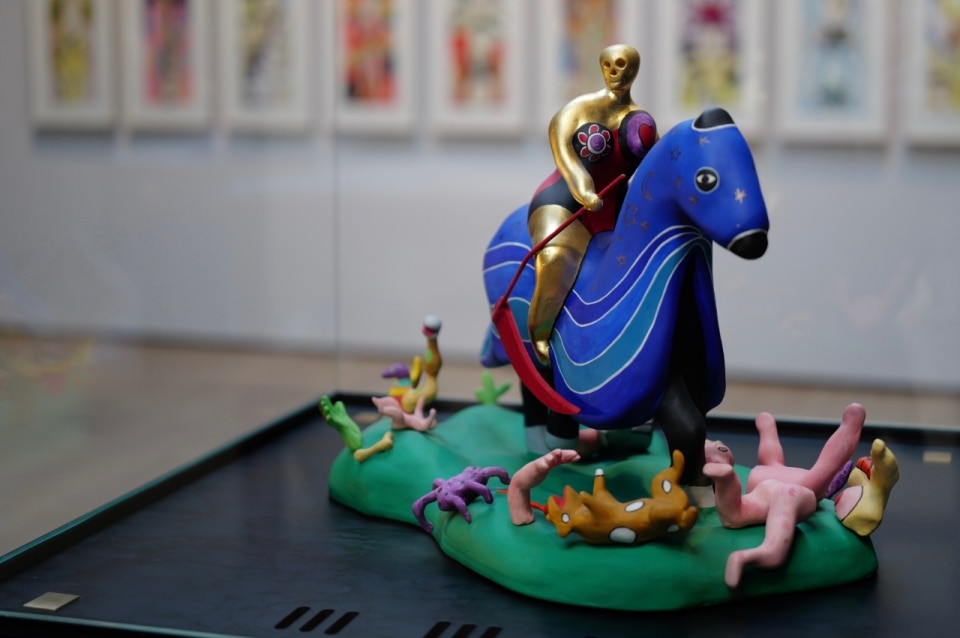
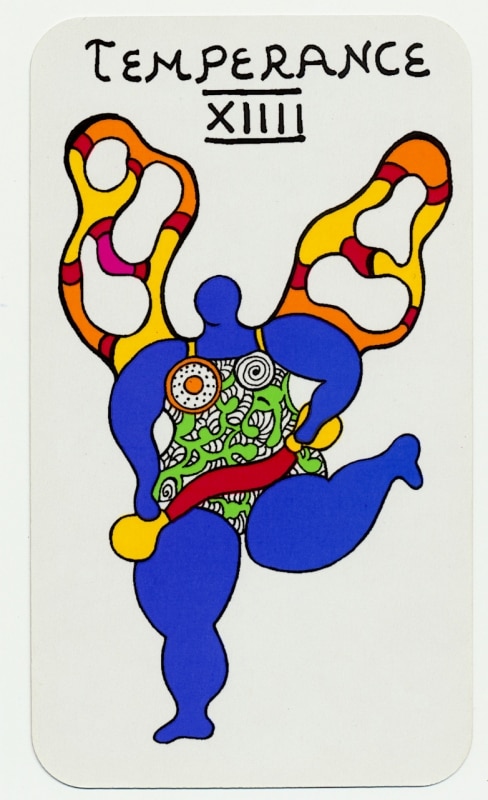
Some, like Victor Brauner in the painting The Surrealist, portray themselves precisely as the Magician, surrounded by the symbolic objects of the magician’s table. Others, like Leonora Carrington, went so far as to create their own tarot decks, reinterpreting the Major Arcana through her visionary universe populated by fantastic animals, alchemical motifs, and hybrid figures. Still others, such as Niki de Saint Phalle, transformed tarot into architecture: in the final rooms of the exhibition visitors encounter images and models of her Tarot Garden, the monumental sculpture park built in Tuscany between the 1970s and the 1990s.
Among the display cases in the twentieth-century section also appears the surrealist magazine Minotaure, founded in Paris in 1933. On the cover of one of the issues shown in the exhibition, drawn by André Derain, the figure of the Minotaur is overlaid with cards from a Marseille tarot deck.
In short, tarot begins to mean something different for everyone—and this is precisely the reason for its survival across six centuries. “Images are always an open text,” says Plebani, “but in tarot this quality is particularly evident.”
And if the last century belonged to the Magician, one might wonder which card in the deck will come to represent our own.
- Exhibition::
- “Tarot. The Origins. The Cards. Their Fortune”
- Curated by:
- Paolo Plebani
- Where:
- Accademia Carrara, Bergamo
- Dates:
- February 27-June 2, 2026