

March 6, 1475, Caprese—a tiny village clinging to the slopes of the Casentino hills, not far from Arezzo. Michelangelo di Lodovico Buonarroti Simoni was born there, almost by accident; his father was serving briefly as a local magistrate. Caprese no longer exists as an independent town: today it is called Caprese Michelangelo, as if geography itself had been forced to surrender. It is the fate of places that produce prodigies: they cease to belong to themselves.
However, before the works—before the marble, the fresco, the dome—there was the man. And the man was anything but easy. This is what textbooks smooth over, what commemorations erase, what time turns into romantic legend: to those who knew him, Michelangelo was an uncomfortable, almost intolerable presence. Not out of cruelty, or not only that, but because of an intensity that left no room to breathe—for himself or for anyone else.
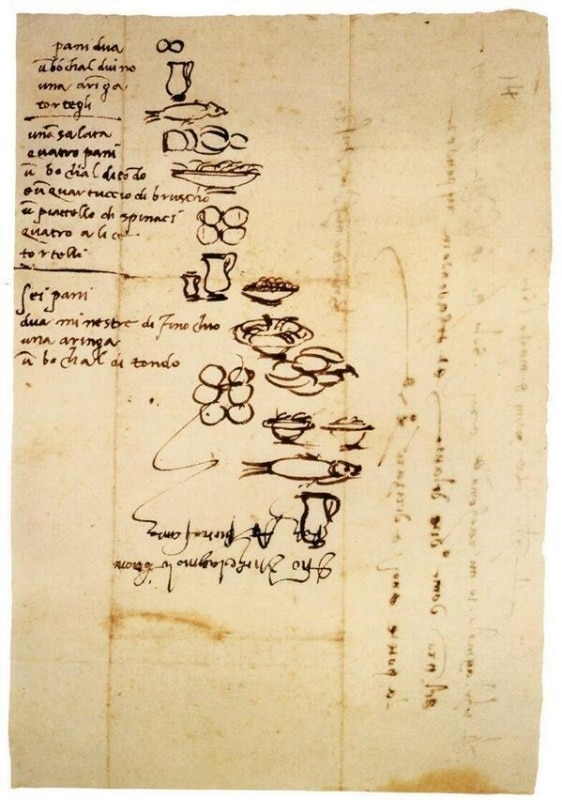
Giorgio Vasari, who knew and admired him, left us the portrait of a brooding, suspicious man, sparing with affection and lavish with resentment. Michelangelo did not forgive. He remembered offenses with an almost artistic fidelity, as if wrongs, too, were material to be worked and preserved in their hardest possible form. He did not hesitate to insult his patrons: Pope Julius II chased after him through Bologna after he abandoned Rome without permission; the Medici family treated him as a household genius, yet he never relinquished the privilege of insolence. When he refused to do something, he simply did not do it. He slept fully dressed, rarely washed, lived like an ascetic—not out of religious vocation but from a fierce indifference to the material world, except when it came to money, about which he was meticulously attentive, at times obsessively so. There is also a private Michelangelo, in his letters to his nephew Lionardo: almost tender, concerned for his family’s health, alert to small domestic matters. He lived alongside his larger-than-life public image, never quite reconciling with it.
Michelangelo is the first artist of the modern age to turn incompletion into a conscious aesthetic system.
Solitude was his natural condition, not his punishment. He did not complain of being alone; he sought it out, shaping it like raw material. His friends were few and chosen with a care resembling the selection of marble: Vittoria Colonna, the Marchioness of Pescara, with whom he maintained a correspondence of remarkable spiritual and poetic depth; Tommaso de' Cavalieri, the young Roman nobleman to whom he dedicated drawings and sonnets of an intensity long debated by critics and still resistant to definitive categorization. Michelangelo loved, but he loved as he sculpted: by subtraction, by concentration, with an energy that burned from within.
He was also a poet—and not a minor one. His sonnets have the same tactile density as his sculptures: they weigh on the tongue, they resist, they do not flow easily. He wrote of beauty and death in a voice that did not distinguish between the two, sensing them as variations of the same obsession. His verse has muscle.
It is from within this impossible, brilliant, solitary character—violent in judgment, capable of secret tenderness—that the works were born. Not despite the man, but through him.
The most honest perspective on Michelangelo is not that of “greatness,” an overused concept worn thin by centuries of rhetoric, but that of irresolvable conflict. He is the first artist of the modern age to turn incompletion into a conscious aesthetic system, to grasp that form does not simply emerge from stone: it remains trapped within it. This is not metaphor. It is technique. It is theology.
To look at the Prisoners, the giants never fully freed from stone—today in the Galleria dell’Accademia in Florence—is to witness something art history still struggles to name precisely. They are not unfinished for lack of time or patronage, but because that is their definitive form. Bodies surface from marble as from a heavy sleep, muscles swollen with energy that finds no release, the surface still rough at mid-thigh, mid-shoulder. Michelangelo called this principle non-finito: the figure already exists within the stone; the sculptor’s task is to remove the excess. But the Prisoners tell us that the excess is never entirely removable. Something always remains. Something always holds you back.
That gap of a few inches measures the entire distance between the divine and the human, between the finite and the immeasurable.
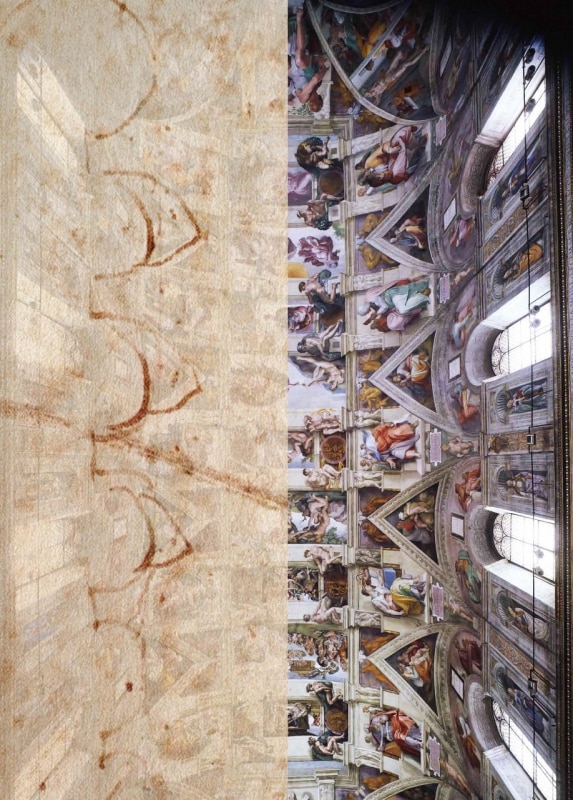
The Sistine Chapel is the reverse of that same logic. If in the Prisoners matter restrains, here everything is released—or at least appears to be. Michelangelo frescoed the ceiling between 1508 and 1512 with a speed already legendary, lying on scaffolding more than sixty feet above the floor, tormented by back pain, failing eyesight, and his fraught relationship with Julius II. The result is the most ambitious narrative ever painted: 907 figures, thirteen scenes from Genesis, prophets and sibyls, and at the center of it all, the Creation of Adam—the finger of God almost touching that of man. Almost. That gap of a few inches measures the entire distance between the divine and the human, between the finite and the immeasurable. No one before him had calibrated it with such precision.
Twenty-two years later, between 1536 and 1541, Michelangelo returned to the same chapel to paint the Last Judgment on the altar wall. The mood had shifted. The Renaissance was over; Rome had been sacked; the Reformation had torn Christendom apart. The judging Christ who dominates the composition bears nothing of evangelical gentleness: he is an irate Apollo, a god of force who condemns with an upraised arm like a wrestler. Around him, some 450 figures twist in a cosmic centrifuge. It is panic as composition. It is the end of the world as a formal problem.
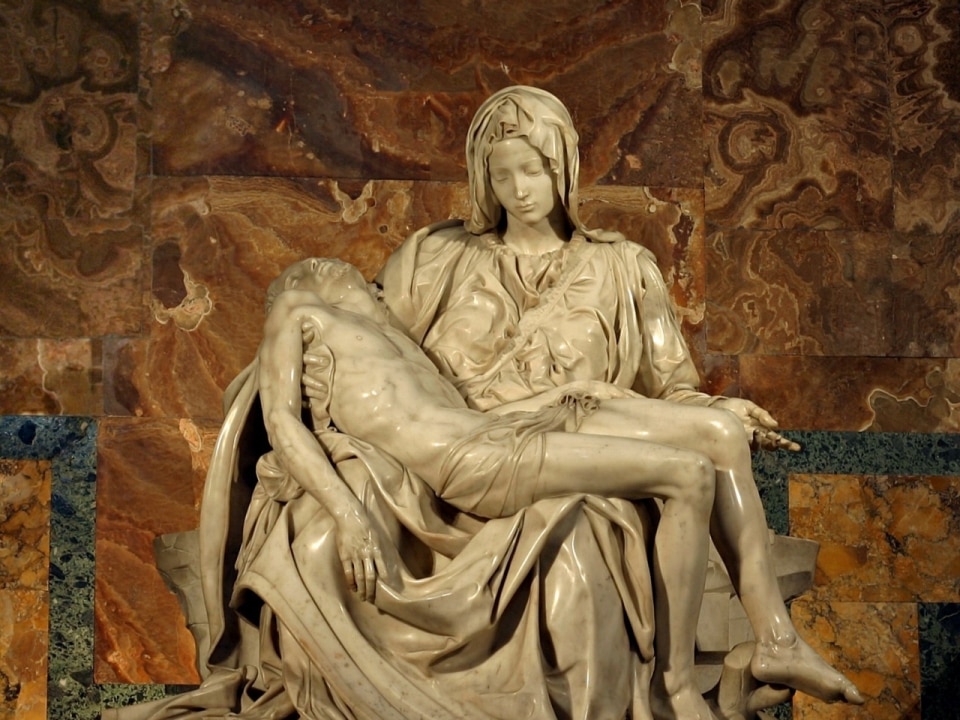
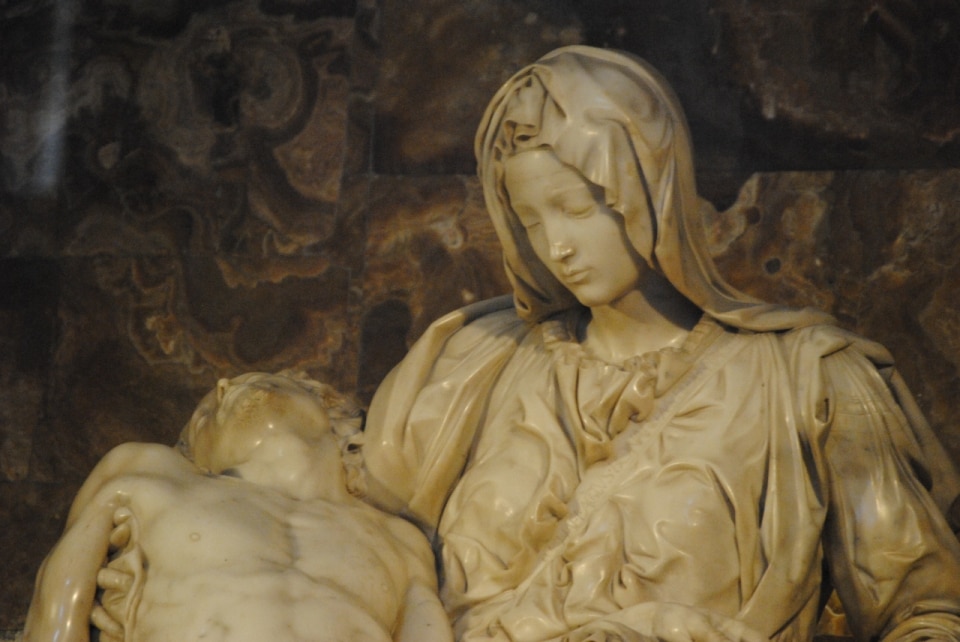
Before all this—and perhaps beyond all this—there is the Pietà in St. Peter’s, sculpted between 1498 and 1499, when Michelangelo was just twenty-four. The Virgin is young, too young for a mother cradling her dead adult son, and Michelangelo knew it. He said that purity preserves bodies from the corruption of time. Theology? Aesthetics? For him, they were the same thing.
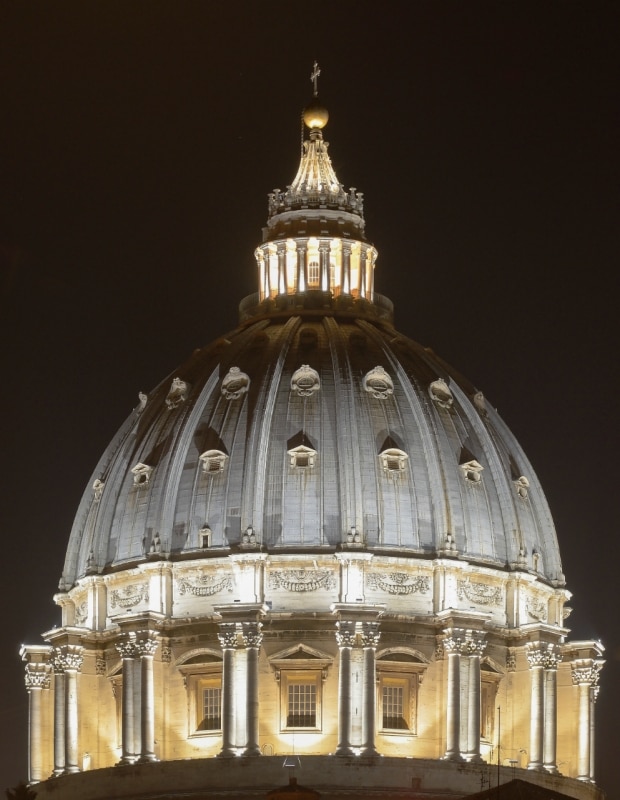
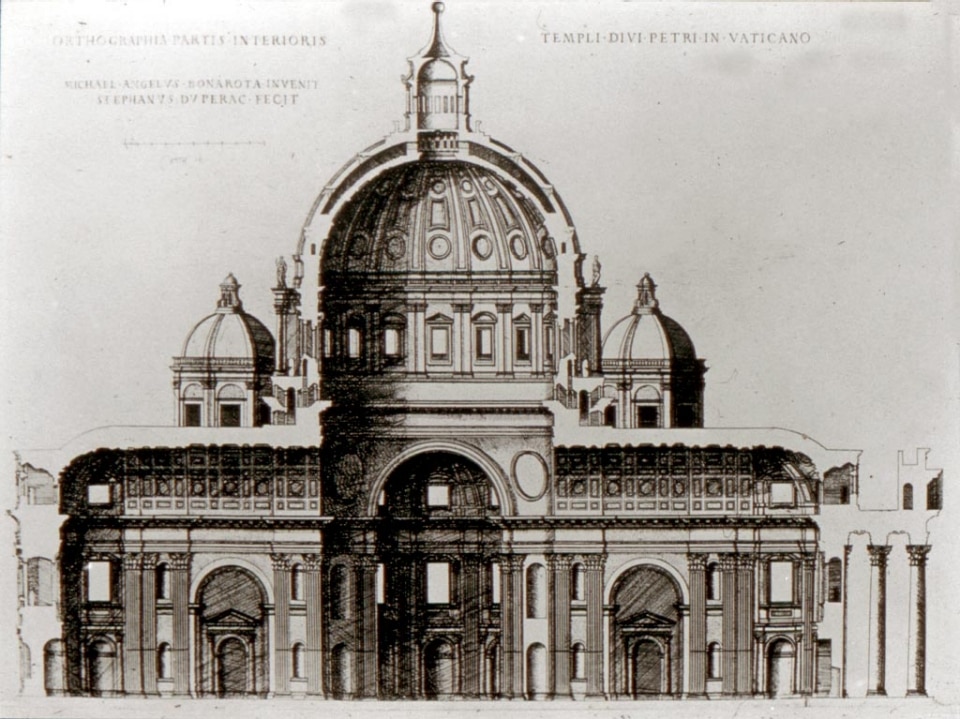
Then there is architecture. In 1547, at seventy-three, Michelangelo became chief architect of St. Peter’s in Rome, at a moment when the project was mired in rivalries and dwindling funds. He simplified, returned to Donato Bramante’s Greek-cross plan, and conceived the dome that still dominates Rome’s skyline. He would not see it completed. Michelangelo died in 1564 at eighty-eight, and the dome was finished in 1590 by Giacomo della Porta and Domenico Fontana. However, the concept was his: a sphere rising on sixteen ribs, compressed and powerful like a muscle, a marble vault that still bears the weight of the stone from which it was born.
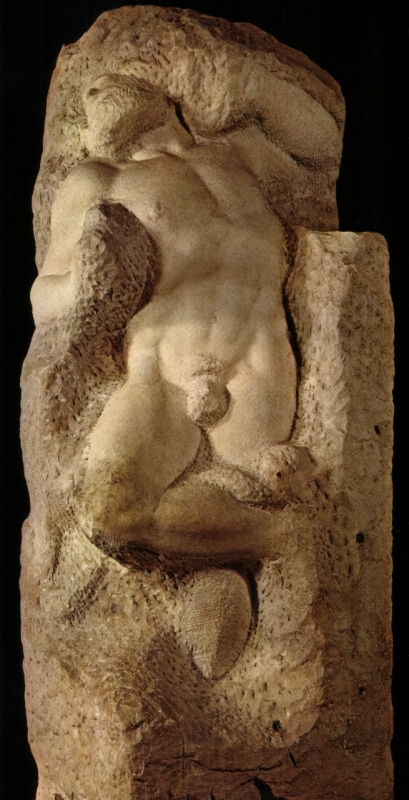
Today, when art celebrates the unfinished, the fragment, the process as product, Michelangelo appears strikingly contemporary. Not because he can be made relevant to the modern world, but because his work had already solved the problem modernity keeps pretending to uncover—perfection does not exist, and form is always at odds with the matter that shapes it, so that every work becomes a record of a struggle never entirely resolved. His Prisoners are not waiting to be finished.
Opening image: Michelangelo Buonarroti, Michelangelo's Pieta, 1497-1499, St. Peter's Basilica in the Vatican, Vatican City. Courtesy Wikimedia Commons