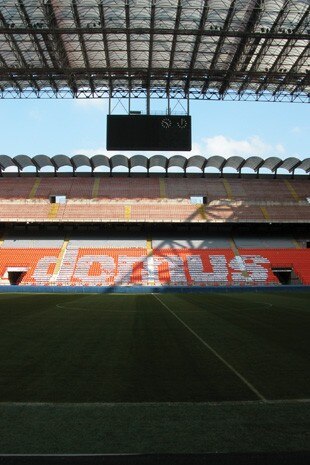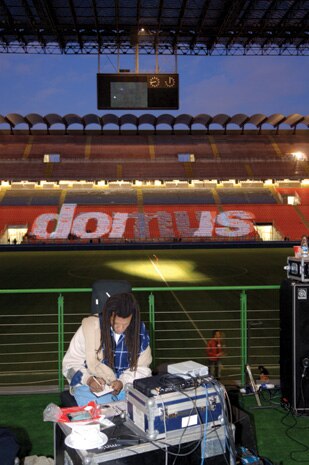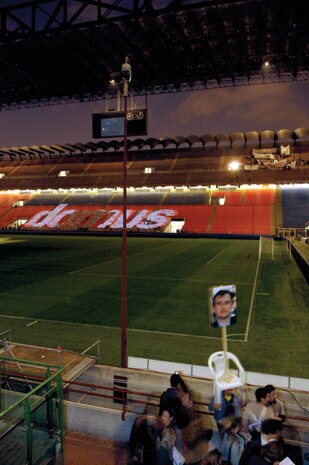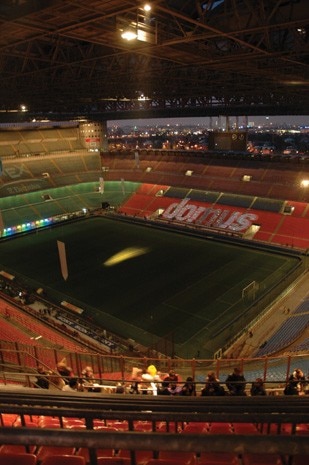
Visitors to the Furniture Fair, as well as families, art enthusiasts and electronics fans. On Thursday evening it was a mixed an original crowd – totalling around 40 thousand people – that crossed the threshold of the San Siro stadium not, as is usually the case, to watch a football match or a rock concert. They were there to take part in the event organised by Domus – in collaboration with Inter and Milan and Rolling Stone magazine – the first all-nighter inside a football stadium, one of the biggest in Europe. For most of them, many young and very young, it was oddly their first time inside the Milanese temple to football.
Domus Circular was a real experiment. The idea to be tested was that of attempting to transform a giant concrete container dedicated to the ritual of football into an urban piazza. A piazza where people ‘circulate’, meet up; if they want to can see a concert or if they prefer look for something else – an installation, a performance, a discussion – moving around to explore a nearby but as yet unknown space.
Just 48 hours after the chaotic events that lead to the suspension of the Inter Milan Euro-Derby for which Inter paid the heavy price of disqualification, San Siro changed face. From sports arena to pubic space, a place in which to wander around freely and unexpectedly even in the most inaccessible areas – from the terraces to the changing rooms, from the VIP gallery to the “third ring” that 100 metres high, offers a spectacular view onto the pitch whilst opening up an unexpected window onto the city skyline.
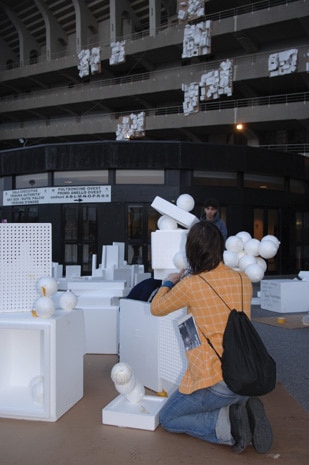
So whilst in the “Domus Picnic” area, set up by Gruppo A12, the question was raised of how far off the moment to eliminate barriers to the stadium might be, just a short distance away Yona Friedman (born in 1929) had prepared a unique installation that invited people to make a “ville spatiale”; in other words architecture that encompassed the continual transformations of social mobility. The destructive instinct prevailed however and his objects, also fixed to the outside of the structure, were thrown onto the ground and a sudden battle of polystyrene ensued. In the warmth of the executive lounge Alessandro Mendini, Piero Gilardi, Lea Vergine, Stefano Casciani and Hans Ulrich Obrist paid homage to Domus’s leading art critic, Pierre Restany. At the same time, from the bar parterre, Enzo Mari engaged in a lively question and answer session with the visitors.
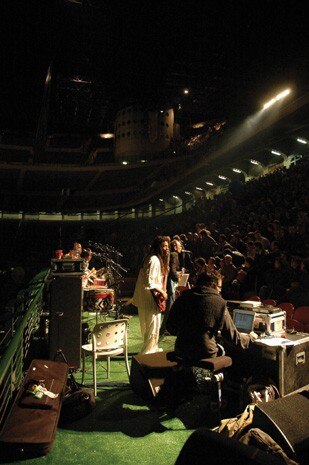
The evening’s events continued with New York musician Arto Lindsay’s percussionists who, from the central gallery, played for over an hour, meanwhile, sudden interventions took place involving a number of performers (the Kinkaleri) invading the pitch and shouting at the top of their voices to the bewildered amusement of the spectators.
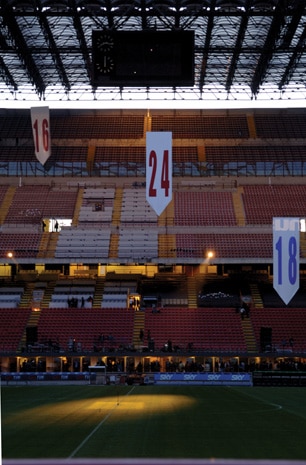
This brought about a predictable desire to imitate, immediately suppressed by security staff. Elisabetta Benassi took over a room normally used by the ball boys with the video “Tutti morimmo a stento”, whilst Marcello Maloberti directed a group of assistants with chairs/works of art fixed on their shoulders and Luca Vitone lead a Ligurian choir in the second tier. Impromptu protests were held by the students at the IUAV from Venice. Since no-one was bothering to climb all the way up “ramp 16” to see their “unrealised projects”, they decided to attract attention of the crowd by hanging banners down from the terraces. Around midnight, finally, the changing of the guard as art gave way to music when the TDK Dance Marathon kicked off in the stadium’s underground parking lot.
The ‘babel’ of cultural events had a beneficial desecrating effect on the city’s cathedral to football that for a night was abandoned by its faithful (the fans) and inhabited in a highly personal way by the most improbable crowd ever to have set foot in a sporting arena. To the point at which the public itself, the crowd that circulated incessantly around the various levels, complaining at times that they couldn’t find the events, became part of the installation, to watch and be part of.
The organisers on the other hand, didn’t want to just stage a series of concerts and shows, or a simple ‘event’. The challenge instead was to attempt to escape from the “logic of the event” at all costs. The important thing was not to compete with the ritual of football or the mega concert but rather to propose a different kind of use for a space with an extraordinary symbolic value and demonstrate the flexibility of use potentially to be interpreted.
So you could say that the experiment has been a fruitful one, showing that a stadium can have multiple uses and a life of its own, for a night like this as on other occasions. “Can a football stadium be inhabited as if it were part of the city?”, asked Andrea Lissoni at the outset, who together with Stefano Boeri conceived and curated the event. At the end of the day, Milan has offered an initial encouraging answer. Definitely a yes.