With the audacity of mathematical formulas like this one, young Italian economist Lorenzo Pellegrini has tried to describe the complexity of the environmental issue in his graduation thesis “Corruption, Development and the Environment”*, written for the Vrije Universiteit Amsterdam in 2008. The particularity of Pellegrini’s approach lies in the links that he attempts to identify and define, with the charisma of exact science, between “green” political decisions, development problems, and the world’s widespread corruption, particularly in areas that in the 1960s would have been called “underdeveloped”. In the above formula, the power exponent i represents the individual countries examined; ERRI stands for Environmental Regulatory Regime Index, meaning the varying degrees of attention for the environment found in different countries’ legislations; Y1997 is the per capita income in 1997; C is the index of perceived corruption in 2001; and lastly, Z is a vector of additional explicative variables that is useful for verifying the consistency of the results obtained in the research. In a nutshell, the results lead to observations that are only seemingly obvious and finally backed scientifically. Richer countries tend to have more restrictive environmental policies, while in countries with a high degree of perceived corruption (as chance would have it, these are also the poorest) the ERRI index is drastically lower. Pellegrini’s research is far-reaching in its attempt to evaluate environmental risks brought on by new countries joining the European Union – some of them with a high C and quite a low ERRI. In the light of a technical and cultural overview of the globe, and certainly of Europe, where the subject of sustainability plays an increasingly important role in design and architecture, there is a strong impact from serious disparity between countries that are associated under a common political banner, but this impact is more on an ideological plane than on a concrete one. Just as it is unthinkable to have a “two-speed” economy for European countries, it is equally difficult to imagine an environment that gets cleaner the higher a country’s income and development rate are. Global pollution certainly does not stop within the limits established by countries, much less in those established by local organisations, as ideologists and the inventors of Ecopass zones, Carbon Taxes, Carbon Credits and similar economic expedients would have us think.
AN UGLY SHADE OF GREEN CONSCIENCE
A strident phenomenon among the indicators that point to objective disparity between rich and poor economies, the sign that some are trying to cheat at the sustainability game, is precisely the new financial market of Carbon Credits. This concept of certificates obtained for CO2 (carbon dioxide) emissions is based on a mechanism that might work on a logical level, but that seems quite muddy from an ethical point of view. Polluting countries, industries and economic operators can calmly continue to dirty the world, all the while muffling their conscience (and that of many environmental organisations in the same manner) by literally buying certificates from those who don’t pollute and are even (supposedly) countering the effects of emissions: forest reserves, in the first place, but also entire Third World countries where forests are often one of the few available resources. Firstly there is controversy over how the compensation values should be established: should forests be planted in areas that lie close to where the damage is being done or in the other hemisphere? Over what time frame should the actual effect of CO2 reductions be measured? One year? Two? Three? One hundred?
Beyond this, the Carbon Credit market, like any financial market – in 2008 the programme was worth approximately 30 billion euros in Europe – is subject to the symptoms of general hebephrenia suffered by the world’s stock markets. Too many certificates flooding the market, or ambiguity and vacillations in government decisions concerning environmental issues, can cause their price to fall as much as one hundredfold. This means that enterprises wishing to take maximum advantage of the beneficial effects of greenwashing (that layer of ecological varnish that anyone can coat themselves with, even manufacturers of weapons of mass destruction) can harness the market’s “useful” instability to pursue kamikaze strategies at a very favourable price. Indeed, instead of trying to reduce or limit pollution and decrease the ecological footprint produced by the processes of design, production, transportation and distribution of goods, they only need to wait for the right moment in order to activate speculation that will allow them to obtain a bright, almost fluorescent, green image with all the ensuing benefits connected to governmental facilitations and the easing of global commercial operations.
Yet not all manufacturers are content to wash their hands of the environmental issue in this hypocritical way. Some actively commit themselves to the nature-friendly redesigning of their products’ entire lifecycles. In this special issue of Domus we present the cases of several manufacturers (fortunately some are Italian) that are rising to the challenge of the environment issue (on different scales and markets) by studying and proposing solutions for energy and resource savings. They are also inventing new manufacturing procedures in which poisons and polluting constituents are eliminated, and working towards effective traceability of their products’ green potential, including raw materials and the way they are obtained. Whether they are handles or flooring, sanitary appliances or light switches, coffee or laptops, they might be drops in the ocean compared to the tidal waves wreaked on the climate by global warming. But they have the power to dig into the rock of public indifference and the indulgence among politicians towards polluters and pollutants – more than a zillion phoney Carbon Credits.
A SUSTAINABLE PEACE
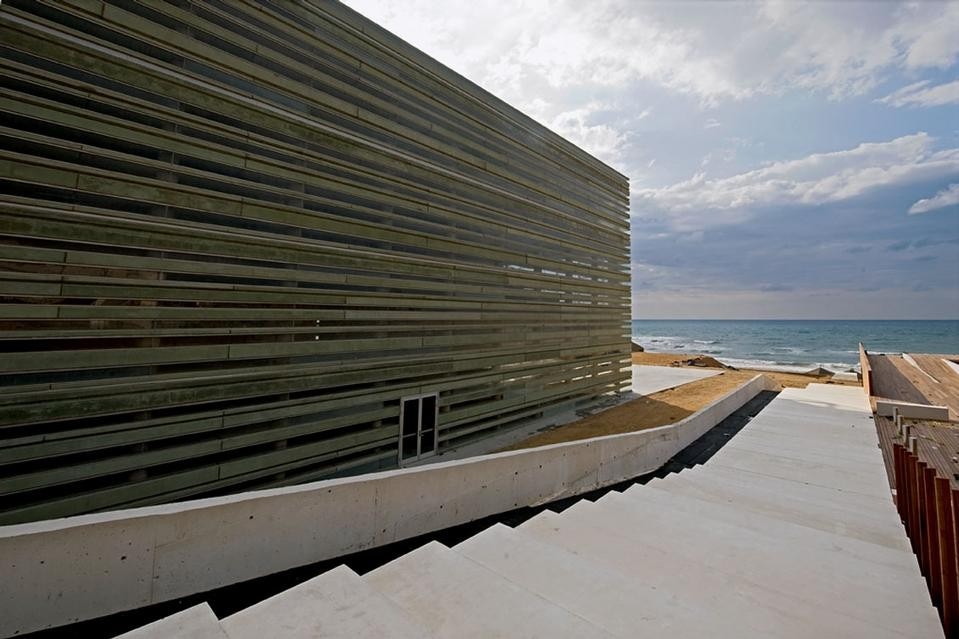
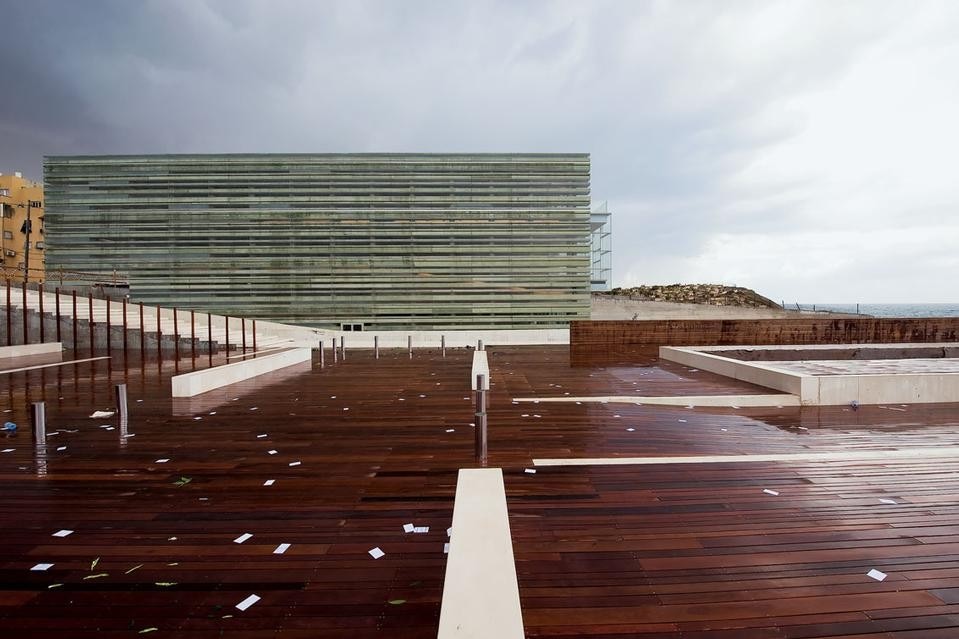
The recent events in the Gaza Strip, aside from the horror and compassion aroused in the civilised world’s humanitarian conscience, have also upset the environmental issue, at least symbolically, in terms of architectural design and its representativeness. On 26 October 2008, about two months before the outbreak of Israeli military attacks on Gaza, the new Peres Peace House was inaugurated in Jaffa. The building was designed by Massimiliano Fuksas for the Peres Peace Centre, founded by Simon Peres, the “enlightened” statesman now President of Israel. Its inauguration was attended by a very mixed bag of personalities: formerly glamorous film actresses like Sharon Stone or Anouk Aimée, classical/pop singers like Andrea Bocelli, Mercedes Sosa and Slash, were joined by politicians, intellectuals and scientists. They discussed the themes to which the Peres Centre is actively committed, with numerous projects for collaboration between it and Arab and Israeli institutions. The following speakers, for example, addressed the subject of the emergency food shortage in poor countries caused by the combined effects of the environmental and economic crises: Walid Abed-Rabboh, leader of the organisation Horizon for Sustainable Development and former Palestinian Minister of Agriculture; Fouad Abou-Hadb, General Supervisor of Egyptian Agriculture, Co-Chairman of the Joint Agricultural Committee Egypt-Israel Cooperation; Guido Barilla, President of Barilla Holdings; Ilan Chet, ex-President of the Weizmann Institute, a microbiologist and professor at the Hebrew University. The atmosphere was full of high hopes and Fuksas’s project poetically stressed the ideal of collaboration beyond peace and war. It is in fact situated on the very edge of the sandy coast, like a refuge for all those in flight from conflict and catastrophe. This architecture, albeit in its ambiguity between reality and representation, manages to convey the optimistic sensation that peace, at least culturally, is at last possible.
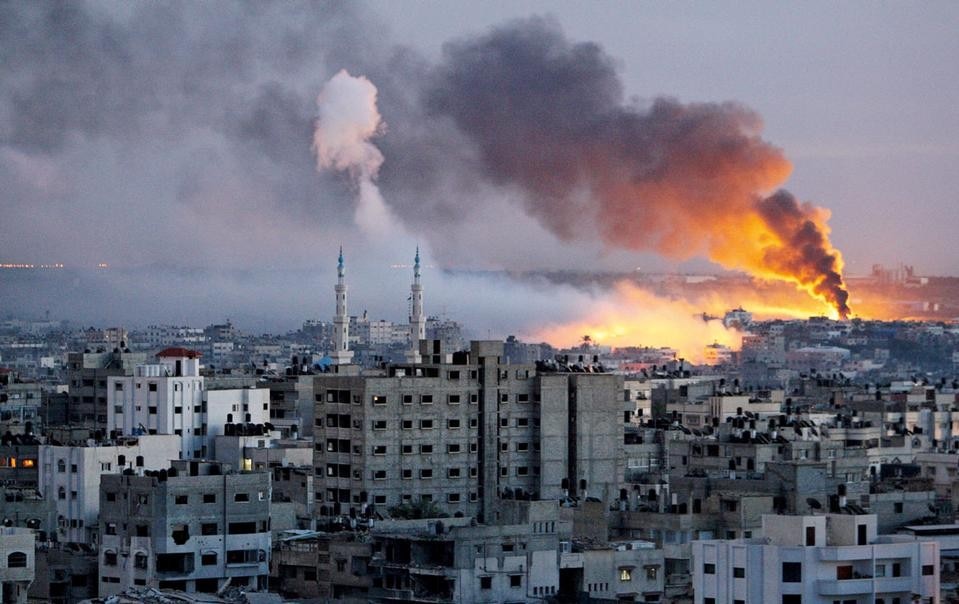
Instead, the fighting in Gaza that started the year 2009 under a cloud of civil irresponsibility, accompanied by the massive destruction and hundreds of lives lost, dragged the dialogue between Palestinians and Israelis right back to square one. It has seriously jeopardised any possibility of acting in the Middle East towards a peaceful coexistence, sustained by an economy and an environment that is not poisoned, either chemically or morally. The signal is truly a premonition: ideal sustainability, allowing the most peaceful possible, dignified and unpolluted survival of people, a coexistence of nations and populations, involves at all events an existence. In the natural desert, as in the one that might follow successive, small and large-scale environmental or war-related apocalypses, the ecological balance is probably perfect. But it is certainly a balance that has no room for any existence, starting from that of human beings, with its eternal, arduous issues, including those of architectural design.