In 2001, under new directorship, the New Museum aspired to an independent home. It invited five offices, all relatively unknown in the US (SANAA, Reiser + Umemoto, Gigon Guyer, Abalos Herreros, and David Adjaye), to propose plans for an empty parking lot on a degenerated boulevard in downtown Manhattan. The Bowery, a few blocks east of Broadway, was a disregarded street, infamous for its gangs, bums and punks. The decision to move here, rather than the more obvious “art neighbourhood” Chelsea, accelerated a process of gentrification that was already under way. The change happening on the Bowery illustrates a shift that has been taking place all over Manhattan since the last decade. 9/11 and the Bush regime have turned the US in a fearful, inward-looking society. Ideas have been twisted for economic gain and intellectual debate is suffering. In the meantime, due to successes on Wall Street, enormous amounts of money have been poured into the city. High-end residences and designer restaurants soothe ideological discontent. Too eagerly, art, architecture and design have given their carefully acquired credibility to this trend.
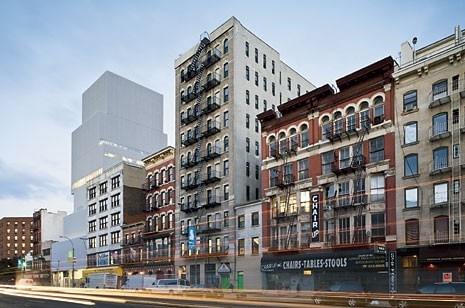
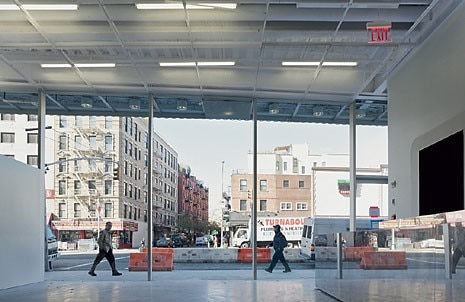
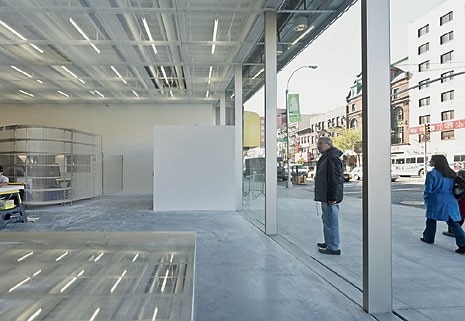
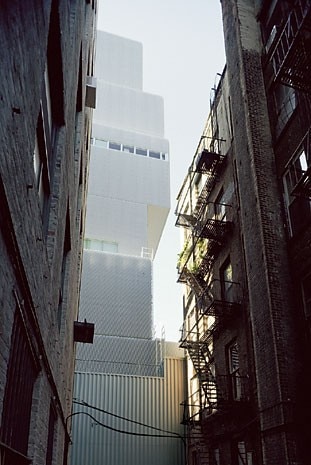
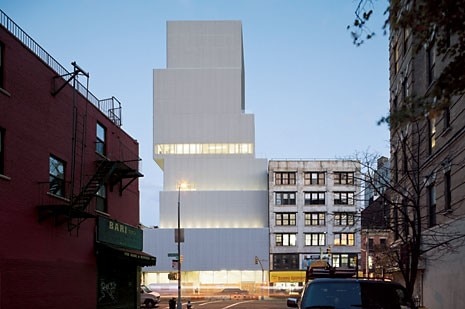
How does the SANAA-designed New Museum fit into this delirious landscape? SANAA found inspiration in various facets, most strongly in the mission of the institution and the character of the site. The museum’s desire to engage alternative voices and a willingness to explore uncertain conditions formed the conceptual design threads. It concerns an eminent synergy between the urban atmosphere and the institution. The building consists of a number of stacked boxes that shift in relation to one another, opening the building up to the city. Its slight instability resonates with today’s erratic society. As a tall building it sits on axis with a Chinatown housing project to the south and the Empire State Building towards the north. By not maximising the buildable envelope – something unheard of in a city where every square inch counts – it was possible to break the mass down into smaller volumes that relate to the neighbouring buildings and root the institution in its urban context. With its fully glazed storefront disappearing into the concrete floor, the lobby feels as if the sidewalk has extended itself all the way to the back of the building. This floor demonstrates the museum’s bold stance as a public forum and its openness towards the city. Freely accessible, there is a cafe, a bookstore and a glass-walled gallery towards the back, all visible from the street. Behind the core for vertical transportation, the loading area is also fully exposed. Fourteen-foottall glass doors offer views of art coming in, crating and uncrating; the museum as an organism.
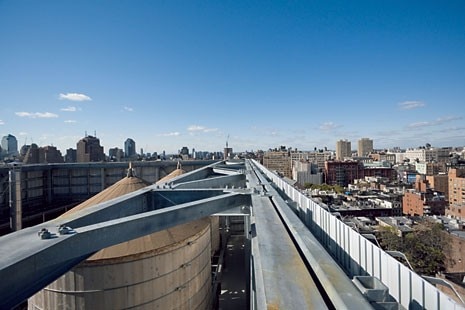
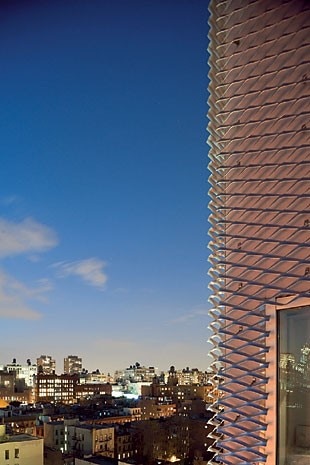
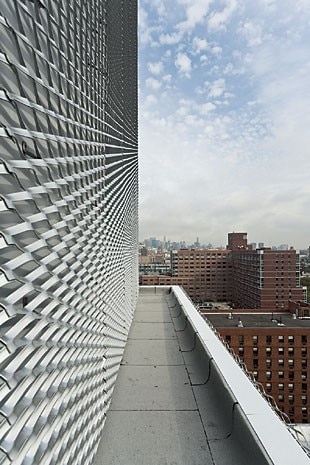
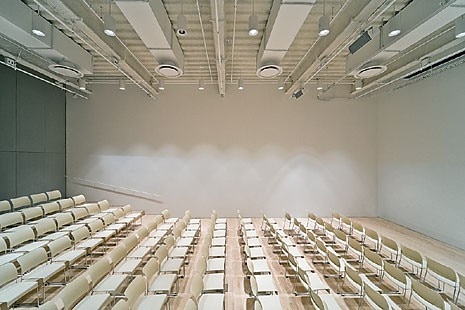
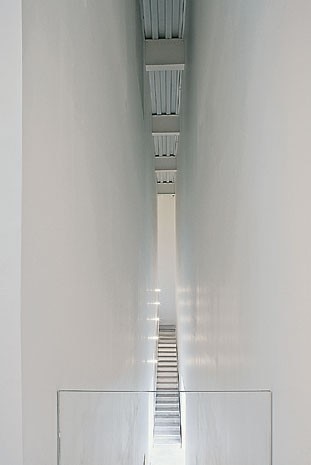
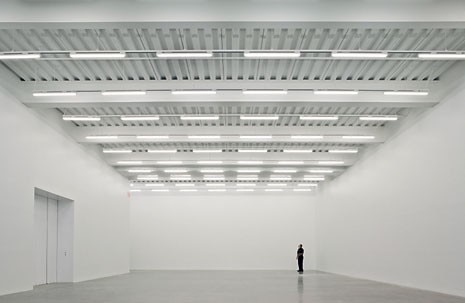
Designing space for art not yet conceived often results in large, flexible rooms awaiting future division. The SANAA building explores a different type of flexibility by providing the museum with a number of distinctive, well-proportioned galleries, many with skylights at different orientations. Every space has its own atmosphere. The natural light is augmented with a strict grid of fluorescent tubes. At night, the interior light spills out through the slits, softly illuminating the exterior. Higher up are the education floor and office spaces, whose long band windows further open the building up to the city. The highest public floor is an event space. Here the shift between the boxes creates terraces for the public, with views to massive housing projects on the east and a dense cluster of towers on Wall Street to the south. In its materialisation the building is basic. Concrete floors, vandal-proof sheetrock, exposed I-beams and metal deck make the building sit comfortably within its rugged context. The strategy was to embrace the notoriously challenging construction conditions in New York, beautiful rough. The exterior boxes are clad in brightly anodised, expanded aluminium mesh that continuously changes character depending on environmental conditions. The abstractness of the exterior functions like the neutral backdrop in a Walker Evans picture. It forces you to look more carefully at that which sits in front of it, be it the lost alcoholic or the banker on his walk home.
Just as New York has transformed, the art world has gone through dramatic changes during the past decade. Will the museum keep its radical roots in a more money-driven environment, especially with an expanded staff, a larger board and many more visitors? Ms Tucker passed away on October 17, 2006. In her memory, the fully glazed ground floor is named the Marcia Tucker Hall. Amidst a city in flux, it sits fearlessly awaiting a trash can.