Prefabricated cubism
by Fabrizio Gallanti
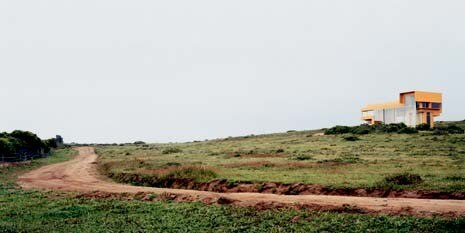
The M7 prototype is the result of a slow process of research and development, begun in 2001 by the Chilean architects’ cooperative URO1.ORG. Its aim was to find modular construction solutions that would allow users to freely configure and construct their own small-scale architecture. The weekend home, located at Tunquén on a green plateau facing the Pacific Ocean, was used as an experiment to study a variety of possible materials and to perfect assembly methods based on extreme simplicity and practical economy.
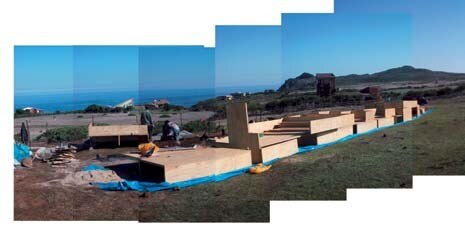
The brief received by URO1.ORG was strictly conditioned by the client’s very tight budget (initially around 7,000 euros) and by the near-wilderness of the site. These restraints prompted the architects to treat the building as the final assemblage of prefabricated parts, to be made in Santiago and only later transported to the site on a single journey by truck. The house was erected using only screws and drills to assemble 27 prefabricated units comprised of nothing but two plywood pine planks 21 millimetres thick and glued together.
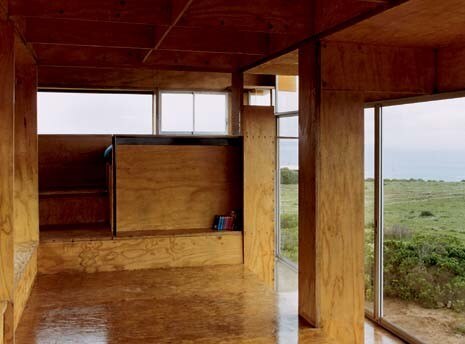
The aim was to work to millimetre tolerances, so as to guarantee the precise jointing of parts and minimise construction times. A cabinet-maker prepared the modules. The prototype was thus transferred into a conceptual and figurative dimension between design and architecture. The plywood (on sale at any DIY store) functions both as a frame and as an infill. The modular rigour of the assemblage, dictated by the possible variations of a single repeated element, creates a positional logic of scores, used as walls, ceilings or floor as desired. In this way, despite the tiny space available, an extreme and forceful perceptive consistency of interiors is achieved. Depending on their location, the planks in fact serve as beams, columns or wind-braces.
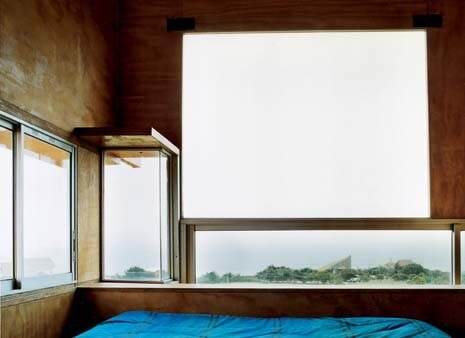
In this way, once the last module has been assembled and the last screw driven, the house is structurally erected as a monolithic element. There is therefore no break between furniture and constructional tectonics. The logic of the interlocking parts in itself provides shelves, tops, recesses and hollow spaces that can be conveniently reused to contain books, dishes or ornaments. The geometric modulation of the parts is dictated by the measurements of the plywood units: 2.40x0.40 m. The interior spatial arrangement thus offers deliberately open solutions: a difference of level can be a seat or an oversized step; a window ledge creates a plane that can be used as a bench or shelving; two blocks of concrete buried in the ground as a discontinuous foundation will accommodate the bathroom and a Jacuzzi, installed directly in the sitting-room.
Successive changes of floor levels and vertical surfaces, always legible as plain slabs, identify differentiated areas that are never, however, crystallised in any set form. The project therefore allows for a complex range of interiors, where movement within the domestic space is accompanied by a varied play of fenestration to frame changing glimpses of landscape. As a result the surroundings, reduced to the purest natural elements (light, grass, the sound of waves, brine on the wind, and the scent of flowers at certain times of the year) reach into the house and expand the tiny scale of the prototype: just 45 square metres.
The internal layout (vaguely reminiscent of Adolf Loos’s experiments, as far as the substantial identity of architecture and furniture is concerned) expressively reinterprets design methodologies characteristic of Dutch neoplasticism or Russian constructivism: architecture as a three-dimensional play of planes and surfaces. In the comment by the architect Rodrigo Pérez de Arce, the cooperative’s reference seems to be “Rietveld shopping at the Home Store”.
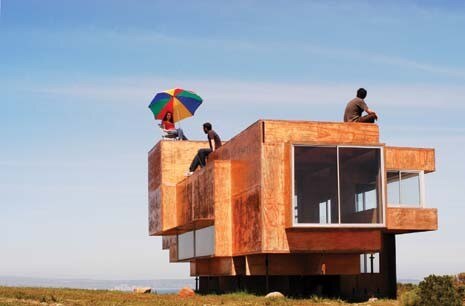
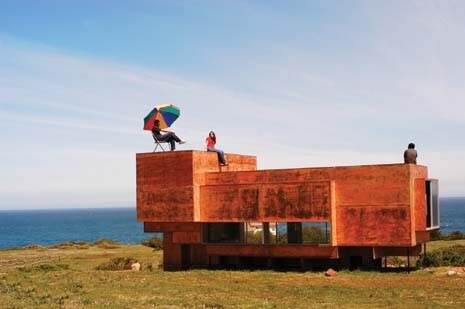
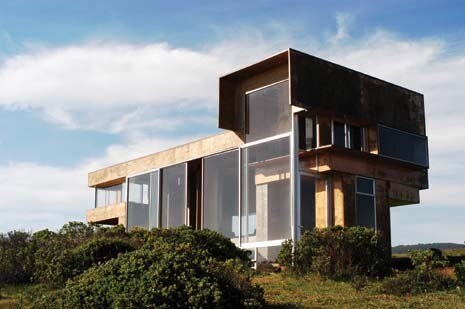
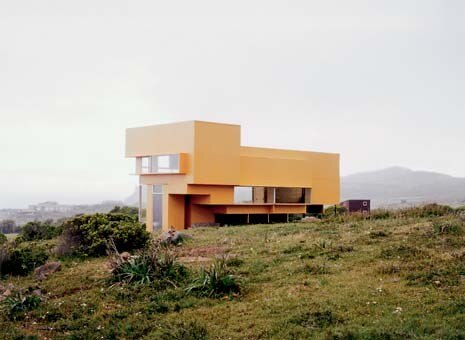
The tectonic logic of the project morphology is legible from outside the prototype, where the paroxysmal succession of overhangs, hollows and volumetric gaps denotes the radical detachment of the work from its background. Indeed there is no attempt to blend into the landscape. On the contrary, the project’s abstract matrix is boldly stated. It is no coincidence that the house shuns (within the limits of a highly seismic zone) any contact with the land.
A few sturdy piers, made of tubes normally used for scaffolding, lift the house off the ground and reveal the structure of wooden crates in its foundations and a disconcertingly unexpected “lower region” of the house resembling a boat in dry dock. A fibre glass and resin cladding, painted pale yellow, necessary to protect the house from the weather, erases the vibratory richness of the pine fibres inside, while emphasising the plastic play of volumes. The house was assembled in just nine days by the members of URO1.ORG, helped by friends and family camped in tents. The drills were powered by a petrol generator (there is no electricity on the site).
Except for the roof modules, which were hoisted by a mechanical shovel (the only machine that could be rented locally), the rest was lifted manually by squads of six. Rainwater from the roof is removed by tilting the whole house a few degrees: a stone placed under the spirit level was used to calculate the structural displacement. In all, of the 167 boards used in the project, the loss of material came to half a board.
The final cost of completion was 235 euros per square metre. Most of the expenses were met by the cooperative. For a whole southern winter, the skeleton frame stood bare against the Pacific heath, exposed to severe wind and weather until new funds could be spent on finishing the windows and buying the necessary fibre glass. The experience accumulated during the M7 module project has been ploughed back by the cooperative into the development of a system of prefabricated modules, called MN PRO, comprising a sandwich of materials and characterised by an extremely simple assembly system. This is intended for use as a construction kit, particularly suitable to the market conditions of a developing country.
It would also allow the implementation of products to integrate industrially processed raw material, in view of possible exports. A possible international patent and potential public financing, combined with technological innovation, would further boost what has to date been a unique story of enthusiasm and abnegation. At the start of the M7 prototype project the average age of URO1.ORG’s members was 25.