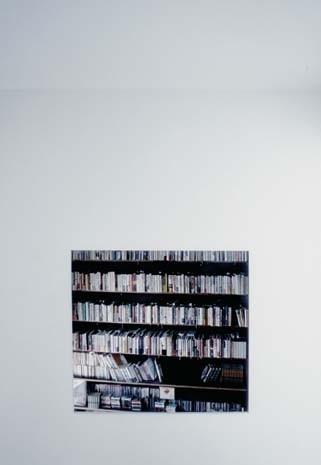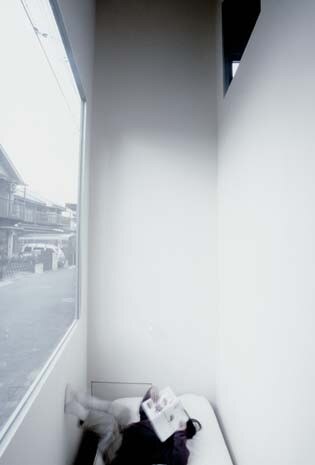
Miyako Maekita is standing in a tiny space filled with bookshelves that will be her husband’s study. From time to time, the profiles of her six-year-old son and thirteen-year-old daughter pop up in the openings surrounding the space. Miyako, an outspoken copywriter, begins to tell the story of her neighbourhood in this Tokyo residential quarter.
Miyako Maekita: This is a corner lot, so everyone always looks at it in passing. And though they just look, they seem to hold the place in high esteem. To give one example, when we had just put up the construction notice, someone came and dug up a lot of the very nice purple wildflowers growing there.
So we posted a note saying, ‘Please return the flowers, as we are going to replant everything here’; sure enough, one month later, there was a pot of very healthy flowers returned to the spot, along with an apology note signed ‘Your Flower Thief’.
Before we started building, there were a good many plum trees planted here, and everyone seemed quite attached to them. So we didn’t want just a building as a statement; we wanted to commission someone who could come up with a rational design for an individual house that would be in harmony with the environment.
Domus: And you thought of Sejima?
Maekita: Yes, my husband first discovered and originally proposed her.
Buildings are inevitably bigger than people. You need money to build them, so they carry connotations of power and often have this sense of, ‘Look at me!’ I really can’t stand that. But when I first came across a book of Sejima’s work, I thought, ‘Now here’s a person I’d like to ask’. I liked what I saw: light, clean and white, no bravado at all.
Domus: Did you have an original image in mind? Any special idea of the house you wanted to build?
Maekita: I’d read Tadao Ando’s book on the ‘urban guerrilla house’ and felt a certain resonance with his notion that ‘a house doesn’t have to be cosy’. A house is a place for attuning your mind, for tempering the body, so it needs light and dark, the right sense of tension, so it really doesn’t have to be cosy. The ‘home sweet home’ idea is a mistake – or maybe that’s my own peculiar interpretation. Kids will sooner or later leave the nest, so what’s the point of making things so nice and cosy, as if they’ll always be here? It’s better, I think, for the house to prepare children for going out into the world. So when Sejima first asked me, ‘What kind of house?’ I told her, ‘Something like a temporary perch’. It’s quite small, not really a place to relax.
When I married, I remember telling someone I wanted to live in a ‘white house’ – that’s to say, a neutral house like a blank canvas, no obstacle to living or raising children. I never told Sejima that I wanted a white house, so I was rather surprised that the result was white.
Domus: You mean you made no detailed design requests?
Maekita: None at all. But Sejima is very attentive to people’s feelings. She hears everyone out herself. And she comes up out with lots of different proposals, each, moreover, worked up into a model.
My husband (an advertising film producer) and I are typically in the position of convincing others of ideas, and almost every day we experience the struggle of getting others to understand. It’s a credo of our professions that if something is truly excellent, people will accept it when it comes out, and that every single ‘unconventional breakthrough’ bravely held up as an example makes things that much easier for everyone.
That’s what made it so inspiring, so much fun to work with Sejima in creating this house.
Domus: The rooms of the house are fairly small and purpose-designated. Are you happy with that?
Maekita: Early on, when we asked her to design it, my husband talked about ‘a house like a one-room studio’. So when Sejima came up with this proposal, we thought, ‘Ah, now that makes sense’. The air connects throughout with no space shut off completely.
So if you want to see it that way, it most certainly is ‘one room’. Yes, we thought, this is new and interesting. We were really sold.