Why does it seem to be much harder to find convincing contemporary architects in Germany, Europe’s largest economy and a culture with a rich architectural history, than it is in significantly smaller countries like Switzerland – which has a population of less than one tenth of its big neighbour?
Germans can make cars and fine music, but what about buildings? People wonder whether commissioning Norman Foster to restore the Reichstag was a measure of the self-confidence of a society content to handle a project of such national significance in a truly open-minded way, or rather evidence of the lack of a plausible German architect to do the job.
While there is a vibrant younger generation, the scarcely visible profile of established German architects in the international arena strikes one as odd. Most of them, it seems, only work in their own country, rather than join the international flying circus of the perpetually jet-lagged. This may have to do with the fact that German architects, on the whole, need look no further for commissions than their own borders, since there appears to be an adequate pool of readily available clients in Germany. In a way, Oswald Mathias Ungers is a good example of this phenomenon.
All of his realized buildings are in German territory. Even the one project he has completed that is nominally abroad is technically on German soil: the German ambassador’s residence in Washington, D.C. Yet Ungers is a clearly distinguished architectural scholar with an international reputation, having held professorships at Cornell and Harvard Universities.
His well-publicized obsession with the rationalistic connection of stereometric forms and his conception of architecture as a strictly philosophical affair show that one can indeed gain international recognition without joining the inescapable ranks of architectural wanderers. In an Ungers building, you will never find the inessential. His pursuit of the verity of form rules out the superfluous and frivolous. For Ungers, architecture is a serious matter, and this results in serious buildings. His latest project in Bremen, a complex of two buildings for a branch of the local polytechnic, is no exception.
The surroundings do not easily lend themselves to an academic building. The site is situated right next to Bremen’s modest airport in a cluster of office buildings and multi-storey parking lots. Part of the reason for putting Ungers’ complex there was the easy access it offered to the aerospace companies based in the area. This may not exactly be the middle of nowhere, but it certainly is the middle of somewhere – that is, somewhere that is not really urban. One can find it a stimulating challenge to establish a contextual relationship when building in such places, or one can abandon this pursuit right from the start: forget context and instead create a self-contained world – which is just as valid an answer to the disconnectedness of such surroundings.
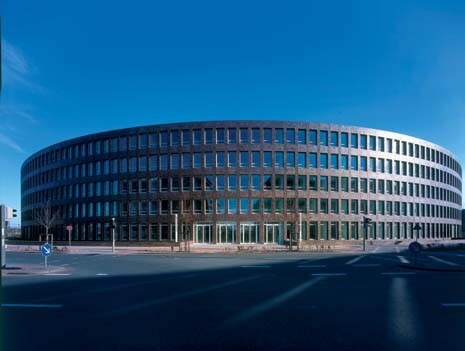
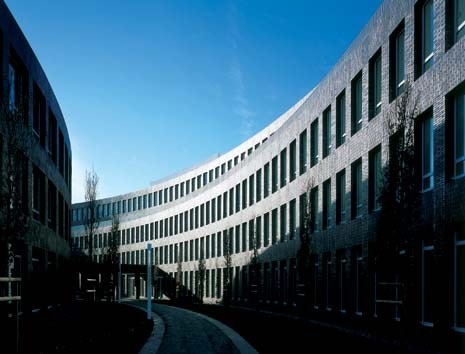
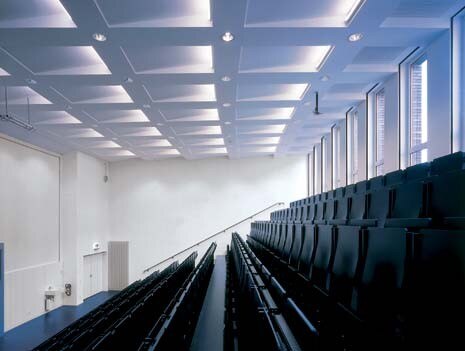
Ungers opted for the latter in Bremen. The complex is divided into two buildings that stand parallel to each other. Next to the street, the larger one is the Zentrum für Informatik und Medientechnologie (ZIMT), which provides room for teaching and research for up to 800 students. Behind its big sibling is a smaller block, the Gründerzentrum Airport, an incubator for start-up companies founded by alumni. Between the two blocks, joined at ground level by a small covered walkway, is a tree-lined path. It is the only semblance of urban life on the site, however modest it may be.
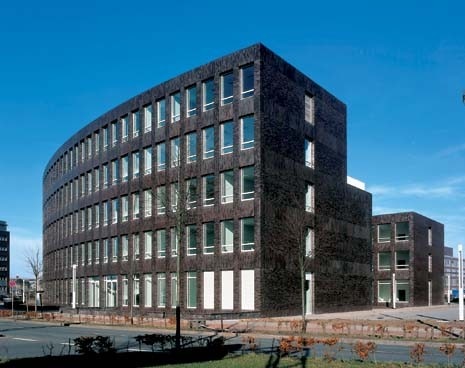
Ungers is known for his relentless pursuit of the cube – everything he designs is based on the square. Yet in Bremen he has had the courage to do something new: he has discovered the curve. The architecture’s outer shape reflects the curve of the road on which it is positioned. This gave Ungers the chance to go back to the idea of an amphitheatre, or to capture a segment of a circus maximus. The curve is the defining element of the project.
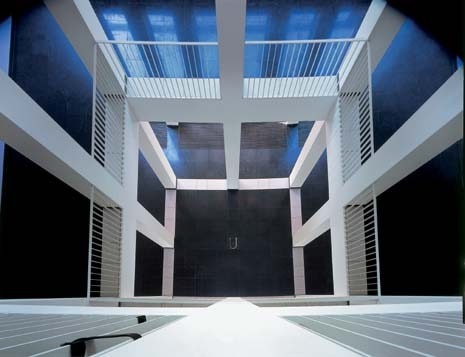
There is not a single room that is fully rectangular. When you enter the building, you are in a foyer that stretches three levels; at first sight it seems reminiscent of the strictly orthogonal Kunsthalle extension that Ungers did in Hamburg in 1996. But look again and you eventually realize that the foyer actually narrows slightly as you move inside.
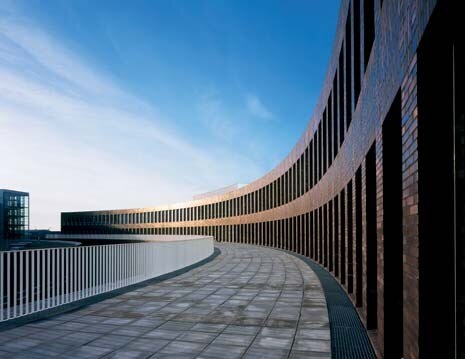
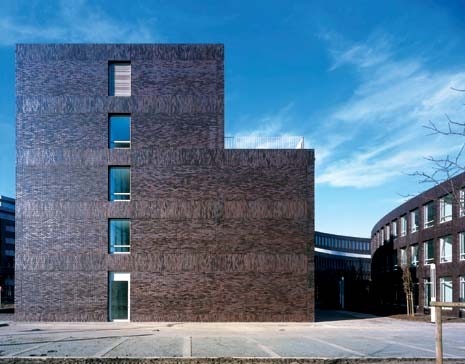
Unfortunately, Ungers missed the chance of letting in daylight through the roof to capitalize on this geometry and give the foyer an even more spacious feel. With 6,500 square metres on five levels, the research and teaching building is more than three times the size of the incubator building, which has only three stories. Consequently, the latter lacks the roof terrace that grandly extends the length of the inner side of the larger building’s fourth floor, providing a good view toward the airport (and a multi-storey parking lot that seems somewhat misplaced). Ungers cleverly hides the heating and ventilation plant under an even metal cover on the top level, which makes the building pleasant to look at from a distance or even flying overhead.
On top is a small platform for outdoor experiments. On the facade, Ungers used only one thing: brick. Known as Bockhorner Klinker, it’s a brick that forms an authentic, even ubiquitous part of the local building tradition. Ungers uses it in fully dyed form, which gives it more durability. The uniformity of the bricks complements the uniformity of the windows, which are identical in size on each facade and level. At both ends, the two buildings have rectilinear conclusions clad in the same ubiquitous brick. Ungers chose to accentuate each level by putting in a vertical brick course to provide a more expressive element. In producing an imposing, if serious, building, Ungers, in his own way, has produced an answer to the question of what constitutes genuinely German architecture.