
The Prince and the Architect
Milan and the Progetto Città event at the Fair have this year hosted the second edition of this unusual initiative, which awards prizes to mayors as public clients in tandem with architects. The prize-giving ceremony and its necessarily numerous introductions by politicians and sponsors have been primarily an opportunity to hear architects talk about the ideas underlying some of their projects for urban redevelopment.
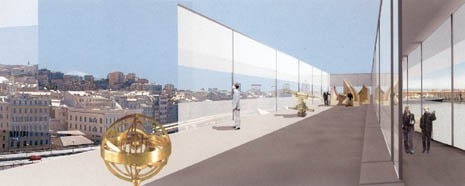
Ben van Berkel, a prizewinner in conjunction with the City of Genoa for the Piazza del Mediterraneo on the Ponte Parodi, describes their joint effort as “a new three-dimensional square, connected to the historic centre of Genoa which has many small squares within its fabric. The new Piazza is active 24 hours a day, with evening events. It comprises a three-dimensional space where people can stroll on the roofs, and a low building, with a complete opening onto which the sky seems to be almost squashed, as it is for the city as a whole.”
Again concerning the port of Genoa, Guillermo Vasquez Consuegra explained the project for the conversion of the Galata building into a Museum of Sea and Shipping. “The building has undergone continual processes of transformation in the course of history, but its marvellous section with large vaults on four levels and a neoclassical front needed a new space that would do them justice. A glass and aluminium veil wraps and protects the historic building and shows its recessed neoclassical façade and section on one side.”
Odile Decq, prizewinner in conjunction with the City of Rome for the Contemporary Art Museum on the ex-Peroni site at Porta Pia, pointed out that her design responded to “a challenge posed by a city like Rome so rich in history but poor on contemporary art. Hence their new approach to contemporary works, intended to bring the public closer to the artist’s world. The succession of walkways and staircases that characterise a project both simple and complex, in its continuous interconnection between exteriors and interiors, will enable visitors to follow the artist’s path”.
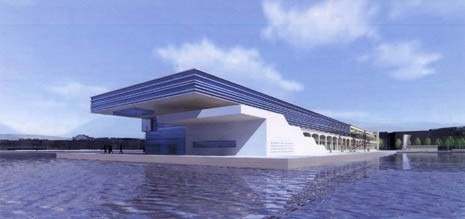
The project by Boris Podrecca to revitalise the ex-Magazzino Vini as a cultural centre springs from Trieste’s “desire to open up its horizons and reach out towards the sea”. “Like the city, always represented from above and straining like a diving-board towards the water, so the design opens up a seaside square around the neoclassical lighthouse”.
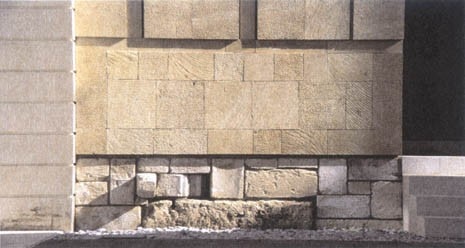
The isle of Ortigia next to the city of Siracusa, where the architect Vincenzo Latina has designed a square within its historic fabric, “has fed for centuries on its own stones, dismantled and reused according to the time-honoured custom of these places. In three successive phases the project has gradually freed an inner courtyard by a process of plundered stones, taken down and piled up for some future purpose”. Angelo Bugatti explained his award-winning project, undertaken with the city of Sondrio for Piazzale Bertacchi, as “no longer the redesigning of a square but the project for a system of urban voids, the formal restructuring of a system through the materials of architectural composition, stretching from the Castle to the river Adda. Its form is ultimately the city’s identity”.
The Milan Fair zone restored to the city
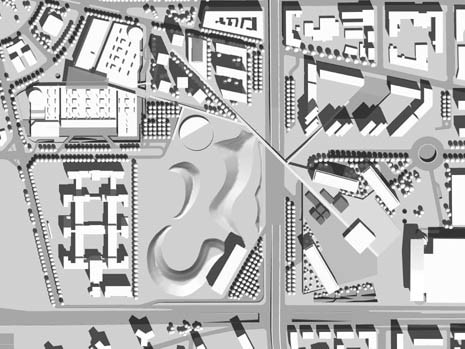
At the Società Nuova Portello stand, the architects responsible for the disused areas gravitating on the Viale Serra flyover illustrated the developments of their project to the City Council’s Building Commission. The aim is to give back to the city nearly 70,000 sqm of housing, 17,000 of which are public, as well as space to accommodate services, shops and crafts plus 80,500 sqm of park and gardens. The master plan and design of the service and shopping areas are by Gino Valle. Cino Zucchi and Guido Canali are responsible for the two north and south residential areas. The public park is designed by Charles Jencks and Andreas Kipar.
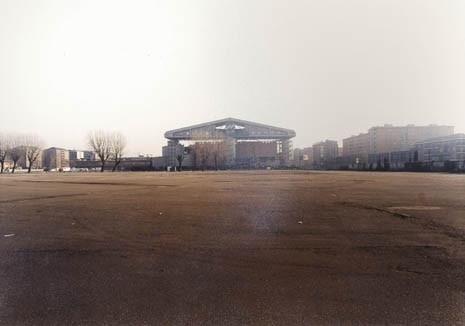
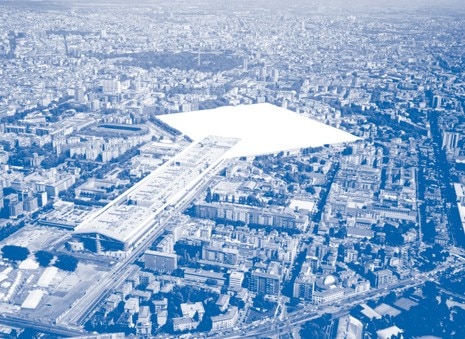
Meanwhile the new Fair, designed by Massimiliano Fuksas and currently under construction at Rho-Pero, is forging ahead. The President of the Fondazione Fiera, Luigi Roth, and the Managing Director of the Sviluppo Sistema Fiera, Claudio Artusi, held a press conference on the future of the present trade fair site. This will involve conversion on a scale unprecedented in any other consolidated urban fabric. Of today’s 444,000 sqm, the north part comprising Mario Bellini’s Portello pavilions will form an “urban pole” relating to the outer area now being built.
The remaining 260,000 to be disused will be converted by an international bid for tender due to start at the end of March, with an initial announcement leading to the selection of one firm around which a number of other concerns will be grouped. Together they will be appointed to implement the redevelopment project and acquisition of the area. The site transformation will reach beyond its present boundary to include restoration of the Vigorelli cycle-stadium, the comprehensive school in Via Gattamelata and the underground extension of this street. The winners will be announced by May 2004. During the following year the operation will be run-in, after which the fair will move permanently into the new Rho-Pero site. We shall be closely watching the developments of these processes and their implementation.