

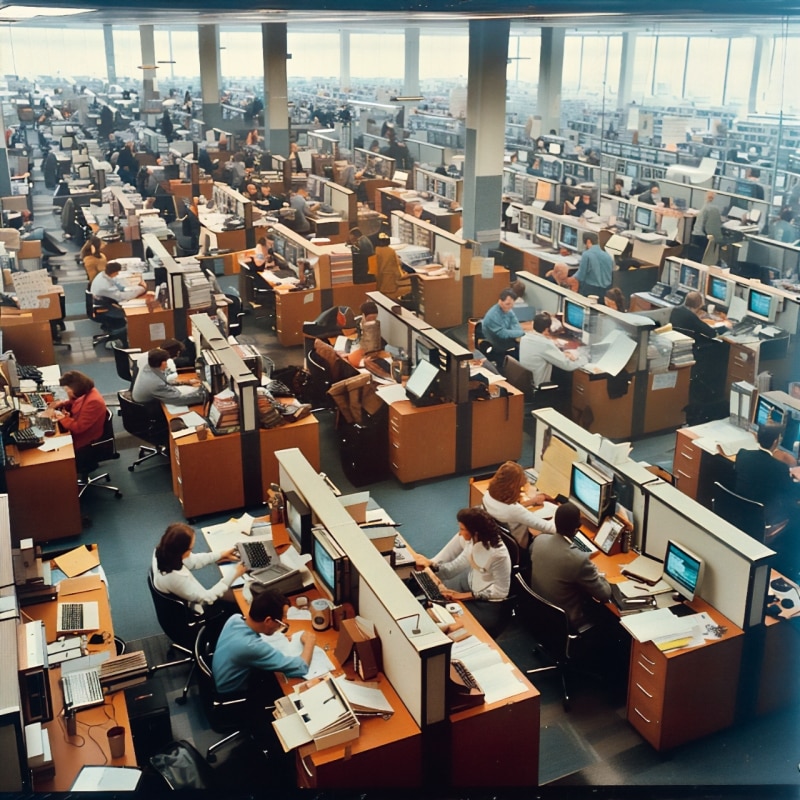
Throughout the twentieth century, workspaces were constructed as physical extensions of a production model that relied on a predominantly functional view of individuals. The Ford factory, with its steady and measured rhythm, was a perfect representation of the model of the period: order, predictability, repetition. The administrative office was the civil version of this philosophy, a place where hierarchy was expressed through architecture. These environments forged the domineering and persistent idea that work should adapt to available space, rather than the opposite. The desk was seen more as a symbol than as a support. The same went for the corridors, closed rooms and frosted glass that separated roles and marked distance.
The emergence of modernism brought a new aesthetic, but did nothing to change this paradigm. The glass-clad facades of the Sixties, with transparency as a metaphor for openness and modularity promising efficiency, all appeared to indicate a change. In reality, it was a new way to underscore the idea of efficiency as a primarily rational value. Natural light, ample surfaces and industrial materials were all tools for rendering work more linear, rapid and controllable. Individuals continued to represent an element within a system that was itself unquestionable. Modernist offices were perfect settings, although they rarely expressed a sense of belonging, created to be functional rather than welcoming.
The quality of relationships that develop within. A well-designed space fosters kindness, attentiveness and collaboration.
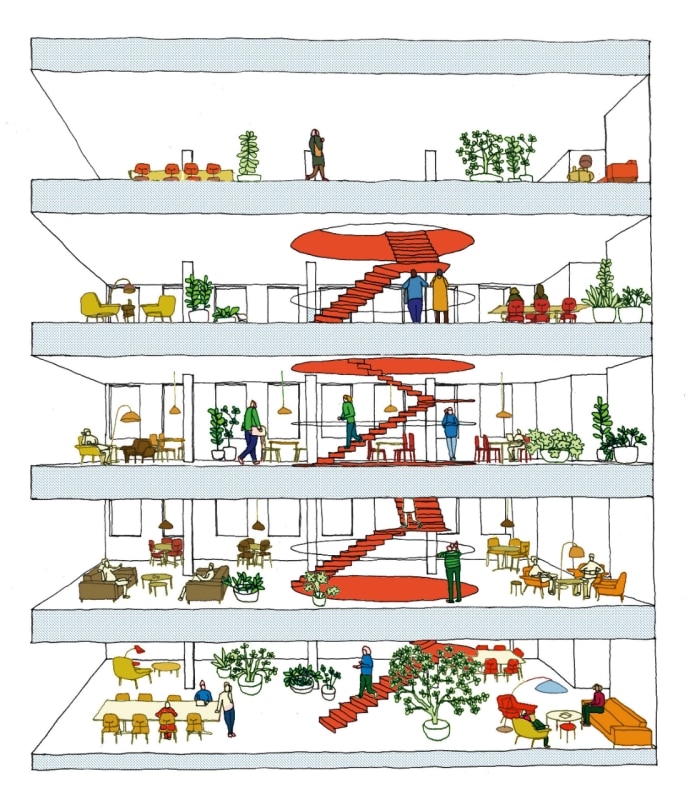
When the open space took hold in the Nineties, many saw this as marking the definitive arrival of a new concept of collaboration. The elimination of walls appeared to also express the breaking down of cultural barriers. The open space promised transparency, informality and the constant flow of ideas. However, reality demonstrated how that fluidity often led to a loss of intimacy. People no longer had space in which to concentrate, isolate themselves and breathe. Too often, the open-space office became an environment where everything was possible in theory, but where very little actually happened. It became, above all, a place that saw the loss of a fundamental concept: that of identity.
Then came the digital revolution, rapid and relentless, and – lastly – the pandemic, which accelerated all the evolutions that had remained suspended. Remote working separated presence from productivity. It demonstrated that physical space was not strictly essential for completing tasks or achieving goals. For the first time ever, entire organisations discovered that it was possible to work without sharing common space. This led to freedom, flexibility and autonomy, but it also saw the loss of spontaneous communication, of chance, and of that kind of informal exchange that, without anyone realising, represented the true cultural fabric of the working community.
What happens when we enter a place? How does it make us feel?
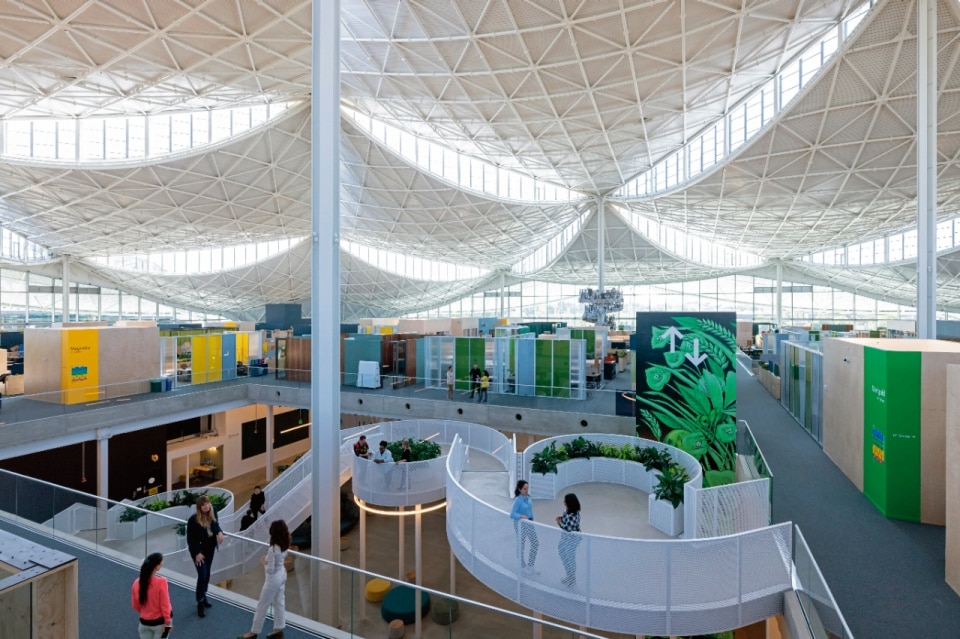
On returning, even partially, to the office, many people saw those spaces in a new light. Spaces that for decades had seemed ‘normal. suddenly appeared impersonal, devoid of warmth and designed more for containment than for expression. Without the need for daily presence, the limitations of the office became evident: it was not made to generate desire. This lack of desirability has become the core question of the present. Why return to a place that offers nothing that cannot be obtained elsewhere? What is the added value of physical vicinity? What characteristic of a space can demonstrate that being together is better than being alone?
It is within this fracture that contemporary transformations are taking place, with the rediscovery of space as experience, language and a living aspect of organisational culture. No longer a neutral container or a collection of square metres to be optimised, but rather an organism, an element that has something to express and that influences behaviour, relationships and shared values. Contemporary workspace planning entails taking on the new responsibility of interpreting people’s deep-set needs and lending them form. This brings into play three concepts that, until just a few years ago, were not considered to be central to company design: care, beauty and awareness.
After a century in which efficiency was the guiding principle, we are now discovering that the true measure of a space is not how much it makes work, but how much it makes life.
Care is what turns a collection of rooms into an inhabited space. It means attention to detail, to materials, to light and to sound. It represents the desire to create environments with which people can identify, in which one perceives intent. Care tells people that their well-being is part of the design, rather than a secondary aspect. This changes everything, because the quality of a space has a direct influence on the quality of relationships that develop within. A well-designed space fosters kindness, attentiveness and collaboration.
In this sense, beauty is not merely decorative. It is a form of energy. It is the ability of a space to generate in its inhabitants a sensation of well-being, openness and opportunity. A beautiful space is not necessarily rich or spectacular; it is harmonious, open to interpretation and capable of speaking to the senses as well as simply addressing function. Beauty is what encourages people to return. No place devoid of desire can generate community.
Awareness, ultimately, is the most profound aspect of the transformation. A space is never isolated: it exists within a city, a district, a story. Designing with awareness means understanding that the workplace is also an urban and political act, in the broadest sense of the term: a way to be part of collective life. This is why the choice to remain in urban centres rather than moving to more convenient or economical suburbs takes on particular importance. It means underscoring ties with the community, with the memory and the complexity of the city. It makes a statement: our work is not separate from the world, but rather part of it.
The consequence of all this is that the design of workspace can no longer simply respond to functional demands. It needs to serve more deeply set needs. What happens when we enter a place? What type of energy is expressed? How can relations be facilitated or hindered? How does it represent us? Above all, how does it make us feel?
A rethinking of space demands a rethinking of work itself. It means understanding that physical presence cannot be taken for granted, which is precisely why it needs to be celebrated. It means recognising that a space is not simply the location of activities, but rather of the factors that help generate culture, identity and a sense of belonging. After a century in which efficiency was the guiding principle, we are now discovering that the true measure of a space is not how much work it generates, but rather how much vitality it stimulates. A well-designed office does not maximise the number of workstations: it allows for significant relations, shared ideas and forms of collaboration that no digital platform can reproduce. It is a space that supports the community, inspiring it and lending it form.
After having discovered that we can work anywhere, we are now also learning that we do not want to. We desire spaces that reflect us, welcome us and speak to us. Places that are not neutral, but that express who we are and, above all, who we want to become. Now, more than ever, to design a workplace is to design identity.
Opening image: Photo StockCake