

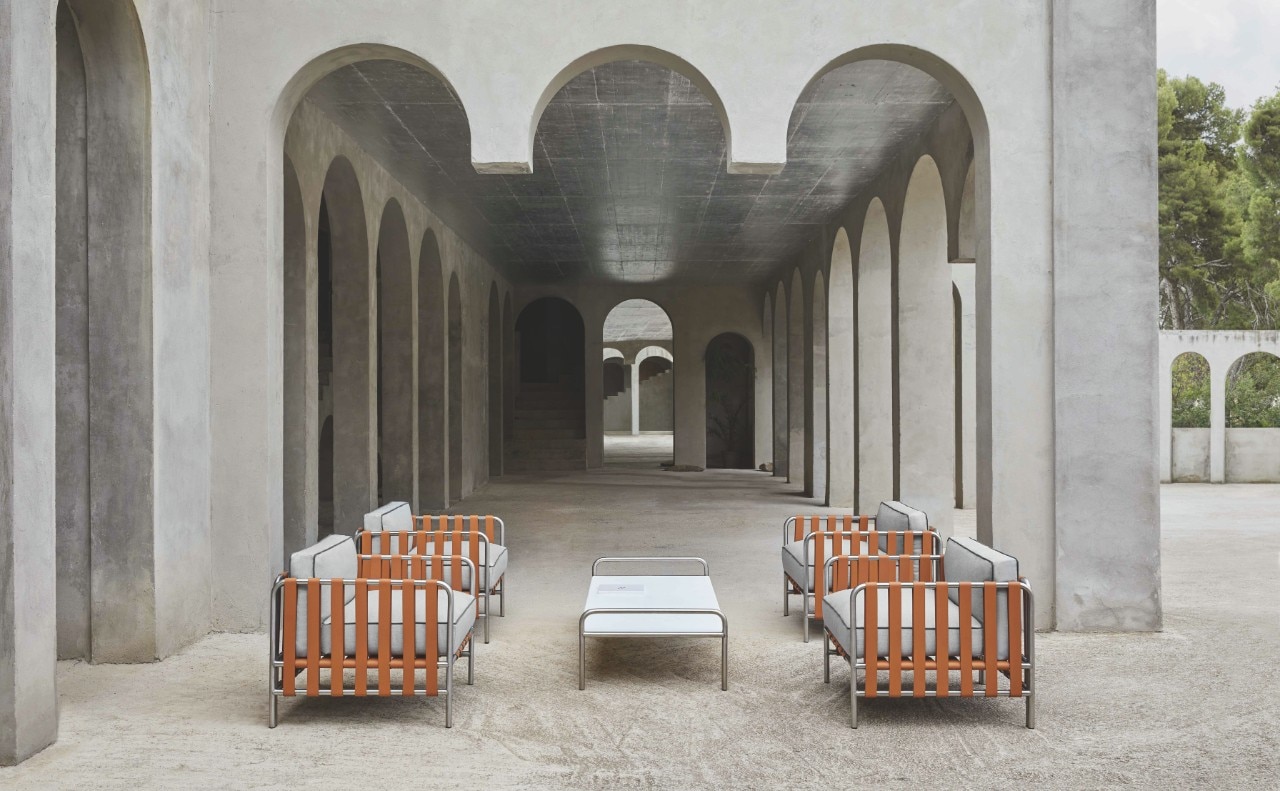

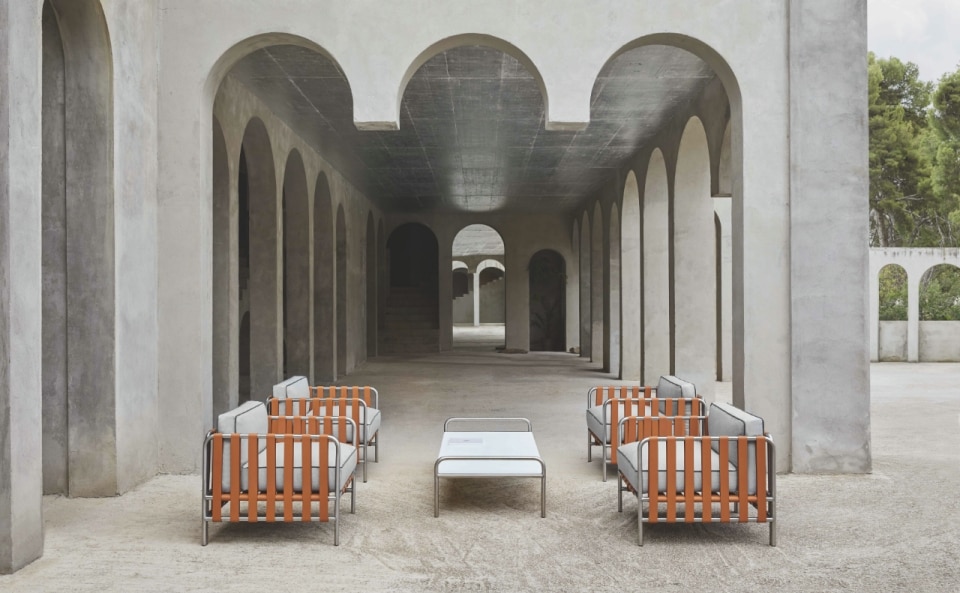
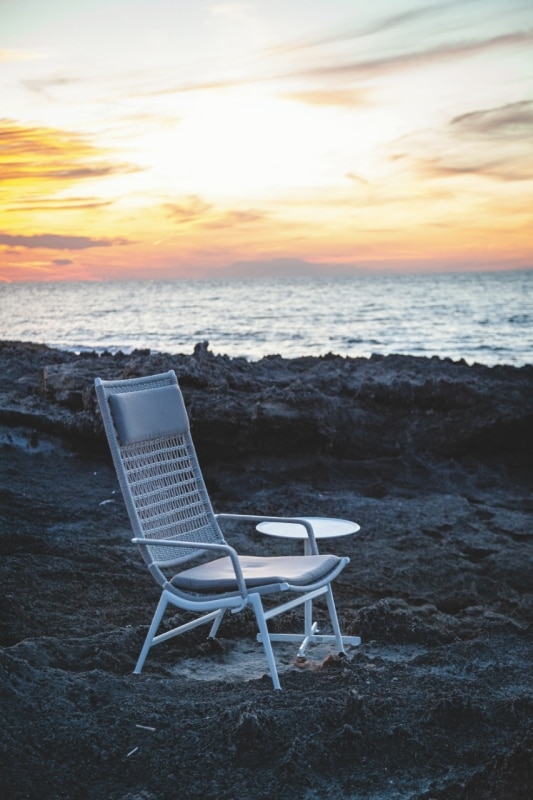
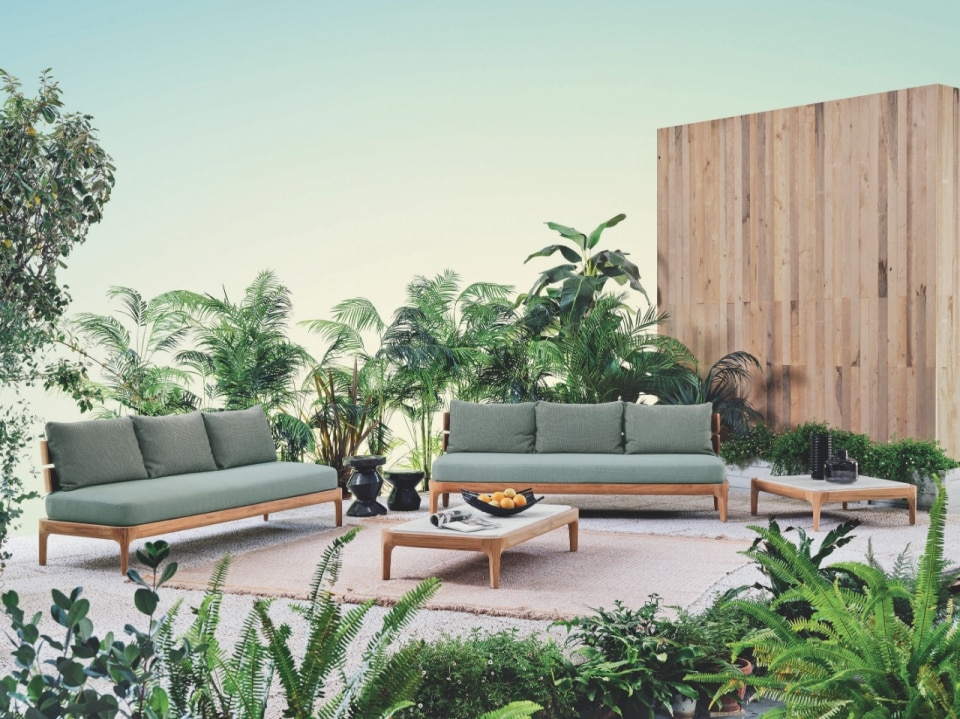
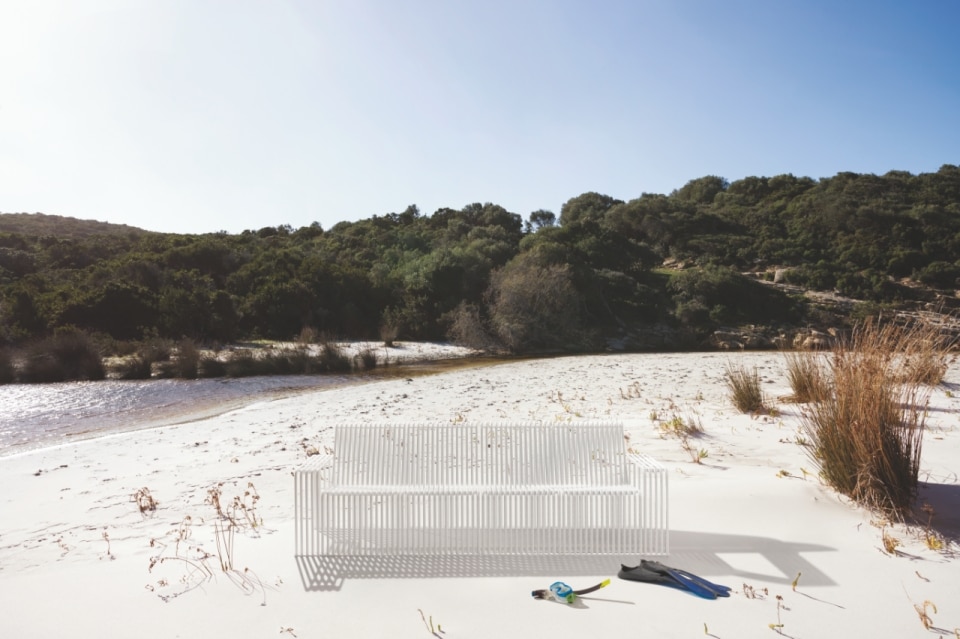
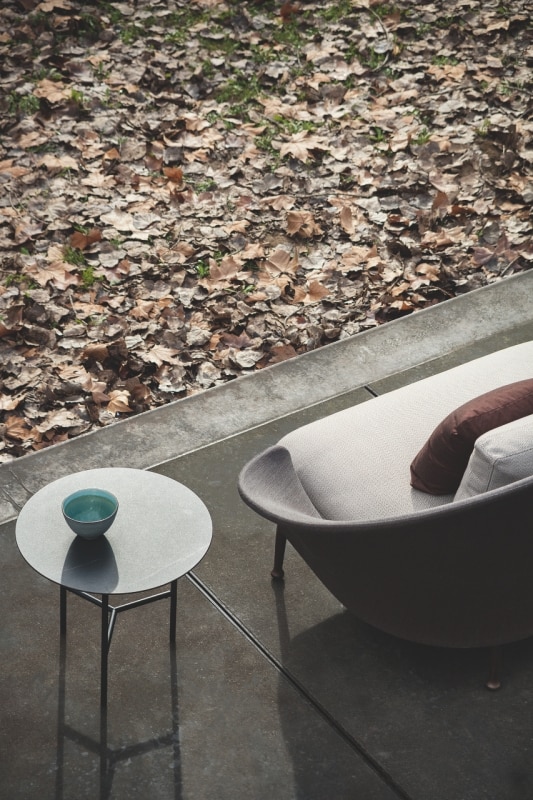
The first step in reflecting on the current scenario for outdoor furnishings is perhaps to rethink the language with which to address the subject. It would help tell the story of a transformation that is, at this point, complete: the outdoors is no longer an appendage to a house (or hotel).
It has become, to all intents and purposes, a part of “home”: a space for living and working, for socialisation and leisure as important as indoor areas, called on to respond to a range of functions and no longer relegated merely to relaxation.
Generous views, coherent colour palettes and shared materials nowadays allow for the construction of a narrative that flows between the two environments, in which the terrace or garden becomes a natural extension of living space, while modular systems allow external areas to be reconfigured according to the seasons or the occasion, without distorting the overall vision of design.
In the new outdoor lexicon, temporal confines have become as blurred as those that separate spaces: outdoor design is moving beyond the idea of seasonal furnishing, embracing a concept of habitation that spans the entire year and that is also driven by technological evolutions in terms of materials.
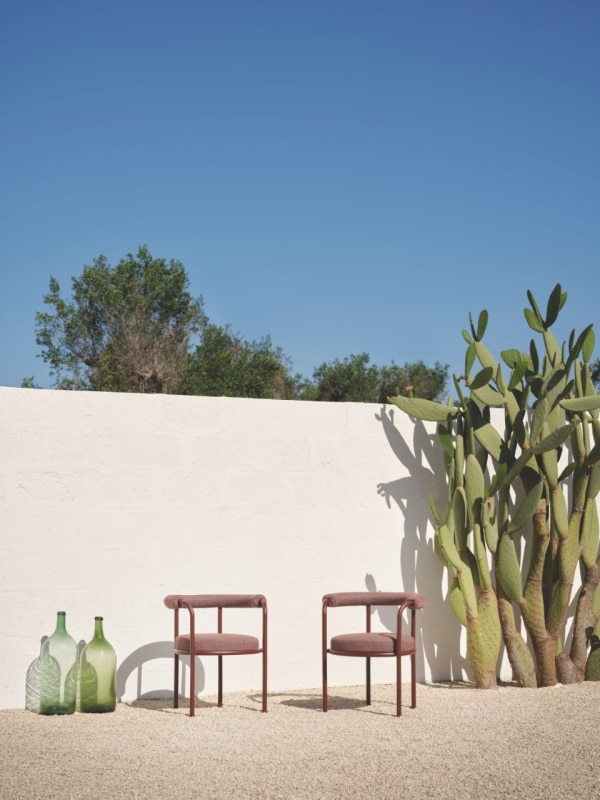
As summed up by Roberto Pompa, the appointed representative for the Outdoor Furnishing Group of the Assarredo – FederlegnoArredo association and both founder and president of Roda, a leading brand in the sector, “the challenge for businesses and designers is not to create an external version of the indoors, but rather to share the same cultural premises: quality of design, attention to comfort and visual coherence. Indoor furnishing and outdoor furnishing now run parallel, sharing the same levels of quality and stylistic research. Since the start of the two-thousands, the outdoor scene has seen the emergence and growth of an ‘Italian’ way of approaching external space that stands apart on a global level”.
This growth has been marked by an overcoming of theoretical confines, to the extent that there is no clear perimeter to the sector (which is wide ranging: furnishings, as well as illumination, surfaces, cladding…) nor any aggregated data concerning the segment, volume, turnover or target markets, leading to estimates being based on the furnishing sector as a whole.
Even more than a lobby or a room, it is the swimming pools, external areas and relaxation spaces that really make an impression on user experience
Roberto Pompa
“This is why we felt, on an association level, the need to create a dedicated group, because this is an area in which Italian industry has much to say, and that offers significant opportunities for growth”, says Pompa.
While the Covid period saw a significant boost for the domestic market, with the rediscovery of external space, more economically important scenarios are now being created through the contract sector.
“In the world of hospitality, external space is no longer a residual aspect of design. I remember that at the beginning, we from the outdoor sector would be called on once a hotel had been completed and the owners, at that point with the budget all but exhausted, had realised that they needed to put at least something outside. Now, the situation has been completely turned on its head: exterior design is often the first element on which the identity of the hotel is constructed”, observes Pompa.
“Even more than a lobby or a room, it is the swimming pools, external areas and relaxation spaces that really make an impression on user experience”.
What direction is this market scenario taking, in practical terms? How are products responding to these trends?
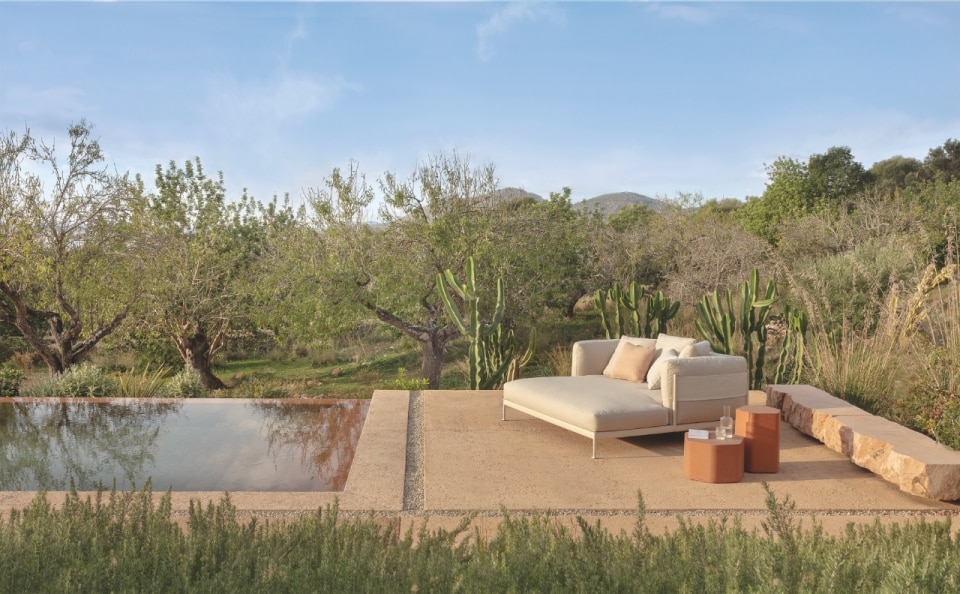
The transformation has been driven by innovations in materials: metals, technical fabrics, recycled compounds. Research is no longer focused on performance as an end in itself but rather on finding a balance between resistance, visual harmony and sustainability.
The designer Francesco Meda stresses how material aspects play a central role: “In our projects, we seek out materials that are tied to the environment, from teak to natural stone, that do not appear alien to the setting to which they are introduced, but that instead establish a relationship with nature”.
Ample attention is also focused on aluminium, which can be 100% recycled and that allows customisation in terms of colour even for smaller production runs.
“One central aspect is textiles, which have become a fundamental component of what can be seen as true outdoor lounges”, stress Ludovica Serafini and Roberto Palomba, of Palomba Serafini Associati.
“An increasingly evident overlap has developed in recent years between indoor and outdoor textiles: many materials designed for external use are being included in general collections, thanks to extensive research into structure and composition. Within this process, Italian manufacturers have demonstrated a particularly high level of attention and of design quality”.
The theme of sustainability affects the entire sector, but without rhetoric. Durability, dismantlability and controlled supply chains have become conditions for design.
“We see sustainability above all as the designing of objects that do not age”, explain Alberto Basaglia and Natalia Rota Nodari from the firm Basaglia Rota Nodari. “It involves focusing on clean forms that are not tied to fashion and that are capable of lasting ten years or more without losing their meaning or value. This is important, for example, for all aspects of outdoor design concerning the urban environment, an important space that fully tests the most critical aspects of a product: resistance to stress from prolonged and not always attentive use, aesthetic quality, and the capacity to harmoniously become part of a setting”.
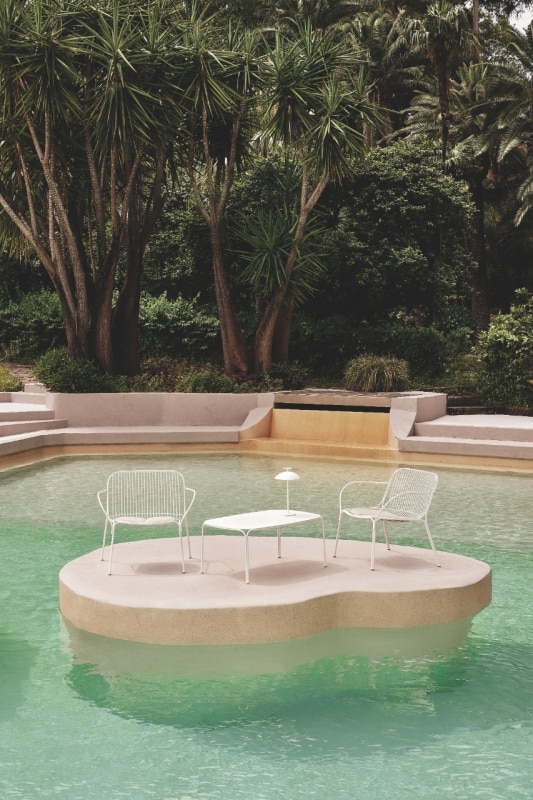
In these terms, formal research becomes part of a wider-ranging strategy: fewer substitutions, less waste, less need for maintenance, more value over time.
Research into comfort has also radically evolved. It is no longer a question of softness or generous padding, but rather of ergonomics, breathability and durability.
Seating designed for prolonged use, surfaces that do not heat up, fabrics capable of resisting intensive cycles of use without a diminishment in quality.
All these aspects are extended across increasingly wide-ranging product collections, in light of an organicity of design that plays a determining role for both private clients and the contract sector.
“Nowadays, we seek to duplicate functions traditionally related to the indoors in outdoor space”, confirms Meda. “If, indoors, you have a sofa with a side table, you expect to find the same dynamic and the same ease of use outdoors”.
For both designers and companies, this means not focusing exclusively on individual elements. Outdoor space is increasingly seen as a unified project, in which furnishings, claddings, floors and lighting all come together to create a coherent environment.
“Isolated items no longer make any sense, and we are increasingly working in terms of collections”, states Meda. “Those investing in external space want a complete, legible and established solution”.
This vision is shared by Ludovica Serafini and Roberto Palomba, who see the maturity achieved by the sector as representing an additional responsibility: “Nowadays, outdoor space inevitably relies on the construction of environments that are as empathic and comfortable as interior space”.
Continuity between indoors and outdoors is not a cancellation of differences, but rather their skilful integration. “External space continues to have its own specific characteristics, represented by materials, combinations and dimensions. The quality of design lies in allowing the two worlds to communicate, without losing their identity”.