

In his small and sophisticated Racconti di qui (Tales of Here), which I reviewed in Domus 936, Italian architect Davide Vargas theorised on how to live and work as an architect with a "zero carbon-footprint". Everything that happens to him happens always and only where he lives. "I work in Aversa, a fine old Norman town with an introvert radial plan. Increasingly under assault by a lawless city, it is even more provincial than Caserta".
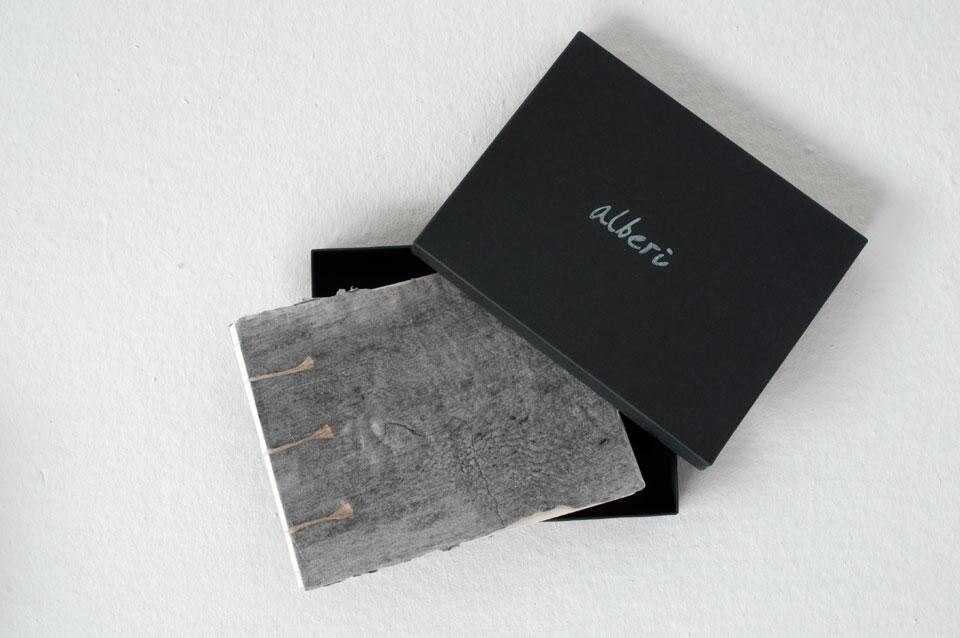
Entitled Alberi, his new "project in book form" is a complex work in the guise of an artist's book (250 copies) featuring printed and calligraphic texts alongside 23 plates of pilot-pen drawings, on sheets of paper double the size of the book and folded in half. It is not simple to read as the gaze is torn between the artist's book, his theoretical and poetic writings and a long series of nervous, scratchy, black drawings.
This time, the "here" is Aversa's tree park (Parco Pozzi), a locus conclusus that to Vargas is full of the past, history and memories. An initial drawing traces a map of, it with the trees marked out. This cold, Winter park is where Vargas executed his resilient performance. Twenty-three days produced 23 drawings, each one of a tree. One per day in February and March 2009 (from 13 February to 17 March).
![Top and above: Davide Vargas, <em>Alberi</em> [Trees], Il Filo di Partenope, Naples 2012 (23 illustrations; limited edition of 250 copies). Cover and page details](/content/dam/domusweb/en/reviews/2012/11/02/the-forest-of-life/big_398471_7615_RUS_85461.jpg.foto.rmedium.jpg "Top and above: Davide Vargas, <em>Alberi</em> [Trees], Il Filo di Partenope, Naples 2012 (23 illustrations; limited edition of 250 copies). Cover and page details")
Willow trees, oaks and the holm-oak planted in memory of his father's tragic death — blood, an old people's home and someone else's overcoat. Disfigured and amputated branches, leaves gathered from the ground and crumpled on the paper, these are no longer trees but vertical skeletons of formerly tormented trees, a distorted and disintegrating colonnade of solitary presences. "Davide Vargas's forest of life" is dissolved and mineralised into an archaeology of the soul that is trying to whisper a message to its readers — a desperate message, perhaps? Alessandro Mendini
![Davide Vargas, <em>Alberi</em> [Trees], Il Filo di Partenope, Naples 2012 (23 illustrations; limited edition of 250 copies). Page details](/content/dam/domusweb/en/reviews/2012/11/02/the-forest-of-life/big_398471_2123_RUS_85471.jpg.foto.rmedium.jpg "Davide Vargas, <em>Alberi</em> [Trees], Il Filo di Partenope, Naples 2012 (23 illustrations; limited edition of 250 copies). Page details")
![Davide Vargas, <em>Alberi</em> [Trees], Il Filo di Partenope, Naples 2012 (23 illustrations; limited edition of 250 copies). Page details](/content/dam/domusweb/en/reviews/2012/11/02/the-forest-of-life/big_398471_2503_RUS_85481.jpg.foto.rmedium.jpg "Davide Vargas, <em>Alberi</em> [Trees], Il Filo di Partenope, Naples 2012 (23 illustrations; limited edition of 250 copies). Page details")
![Davide Vargas, <em>Alberi</em> [Trees], Il Filo di Partenope, Naples 2012 (23 illustrations; limited edition of 250 copies). Page details](/content/dam/domusweb/en/reviews/2012/11/02/the-forest-of-life/big_398471_7570_RUS_85511.jpg.foto.rmedium.jpg "Davide Vargas, <em>Alberi</em> [Trees], Il Filo di Partenope, Naples 2012 (23 illustrations; limited edition of 250 copies). Page details")
![Davide Vargas, <em>Alberi</em> [Trees], Il Filo di Partenope, Naples 2012 (23 illustrations; limited edition of 250 copies). Page details](/content/dam/domusweb/en/reviews/2012/11/02/the-forest-of-life/big_398471_8301_RUS_85521.jpg.foto.rmedium.jpg "Davide Vargas, <em>Alberi</em> [Trees], Il Filo di Partenope, Naples 2012 (23 illustrations; limited edition of 250 copies). Page details")
![Davide Vargas, <em>Alberi</em> [Trees], Il Filo di Partenope, Naples 2012 (23 illustrations; limited edition of 250 copies). Page details](/content/dam/domusweb/en/reviews/2012/11/02/the-forest-of-life/big_398471_9044_RUS_85551.jpg.foto.rmedium.jpg "Davide Vargas, <em>Alberi</em> [Trees], Il Filo di Partenope, Naples 2012 (23 illustrations; limited edition of 250 copies). Page details")
![Davide Vargas, <em>Alberi</em> [Trees], Il Filo di Partenope, Naples 2012 (23 illustrations; limited edition of 250 copies). Page details](/content/dam/domusweb/en/reviews/2012/11/02/the-forest-of-life/big_398471_5510_RUS_85561.jpg.foto.rmedium.jpg "Davide Vargas, <em>Alberi</em> [Trees], Il Filo di Partenope, Naples 2012 (23 illustrations; limited edition of 250 copies). Page details")