


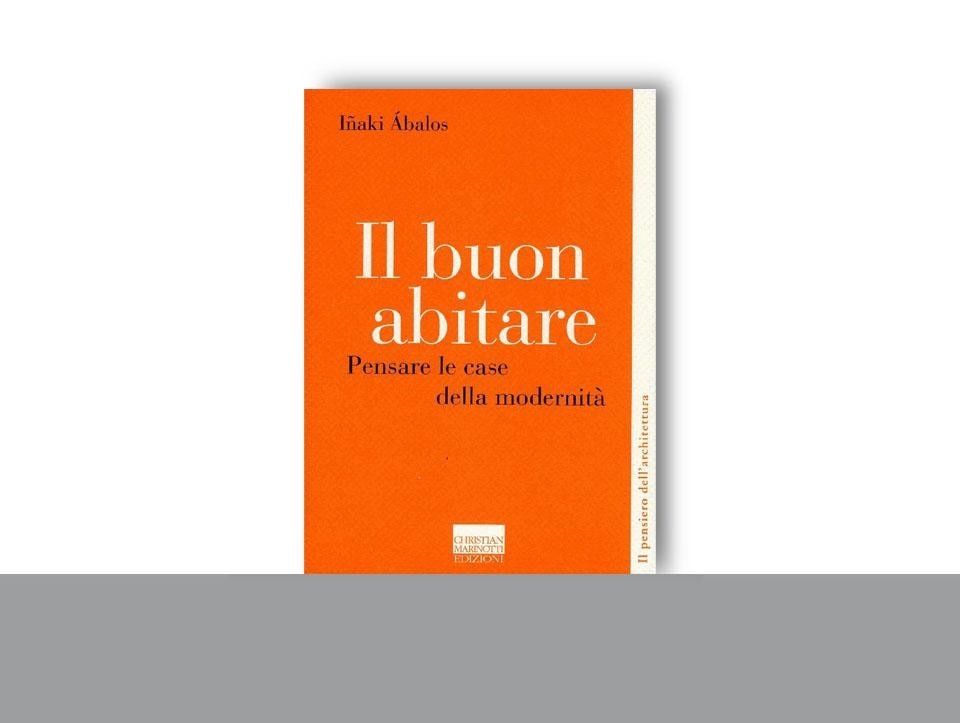
Iñaki Ábalos, Christian Marinotti, Milano 2009 (pp. 238, € 22,00)
The debate on living has been in difficulty for some time. It seems to embrace too much, rewriting everything and absorbing protocols and rituals made familiar by other debates. It jumbles everything together and overestimates the cultural aspects, which are expected to resolve what is difficult to address. Maurizio Vitta's book entitled Dell'abitare ("About living", published by Einaudi, 2008) is exemplary in this sense, transferring a form of discussion recurrent in landscape studies to a different field.)
In the light of these bulimic approaches that shift quirks and stances from one field to another, Iñaki Ábalos's work seems to retrace a different specificity: seven housing archetypes from the 20th-century, a period in which, according to the author, architects devoted more energy to the subject than previously. The archetype is always a construct and a reduction. This is why the great works are missing, writes Ábalos, as they are too complex to be reduced for educational purposes. So, no Ville Savoye, Fallingwater or Villa Tugendhat. Instead, we have Mies's patio houses, linked to the Nietzschean superman; Heidegger's hut, which refers to the fullness of the existential being; a contrast between the rationalist villa and the town house in the Jacques Tati film Mon Oncle, a clear reference to the opposition between faith in progress and criticism of positivism; and Picasso's villa in Cannes, reinterpreted using Merleau-Ponty's phenomenology. Warhol's Factory is an archetype of the 1950s' New York loft and is linked to Marx, Freud and Reich's criticism of the family. Then comes a motley bunch (the houses of Eisenman and Graham, and Buster Keaton's house in One Week) linked to the living of the post-humanist model. The house painted by David Hockey in A Bigger Splash in 1967 and the works by Alejandro de la Sota and Julius Shulman are expressions of the classical pragmatic approach. The writer offers a repertoire of imaginary houses, each of which is given a subject and a philosophical tradition. The houses are often the sum of various examples, with an imaginary visit to a private house being adopted as a rhetorical expedient, traditional practice in the construction of technical know-how. These visits look at forms, spaces and materials but also express specific interest in the imaginary inhabitants, conjuring up likely and unlikely figures and referring to moral issues and values, first and foremost those present in the essential distinction between private spaces and those of "performance", as Goffman would have said.
We can, of course, debate the way in which the philosophical references are drawn. Their didactic sequence is somewhat reminiscent of high-school philosophy digests, and they are nonetheless asked to back up the buon abitare (a loose translation of la buena vida in the original title). This book has far from modest ambitions. Ábalos says that we must respond to the numerous recent attempts to revive the debate on the house, which are based on social idealism and on planimetric methods of investigation. These are naive attempts, trapped in ideological cages. Behind the criticism, we clearly perceive the silhouette of 1990s' studies, from which the book tries to distance itself by adopting a different perspective and different angles. It does not forgo flights of fancy, but at the same time tries to offer some resistance to the loose nature of the discussion on living. Cristina Bianchetti